Deckline
Atmosphere does the heavy lifting here, and for a sub-three-dollar card game set during a 1990s Eastern European collapse, that is sometimes enough. Know the ceiling going in.
GamerScout Verdict
Worth one session for atmosphere alone, but anyone chasing mechanical depth or replayability should look elsewhere.
Compare Prices(5 stores)
Every store in this table quotes us in euros, so the EUR figure is the price the seller actually set, not our arithmetic — which is why EUR is also the currency we rank in. We only list an offer here when the store gives us its price in euros, so nothing in this table is a number we invented.
Pick USD, PLN, GBP, CAD or AUD in the header and we convert from EUR at the European Central Bank reference rate — converted amounts are prefixed with ~. Your bank or the store may apply a different rate at checkout. We never hide offers based on where you are: everyone sees this whole table.
We may earn a commission when you buy games through links on this page — at no extra cost to you. It never affects our rankings or verdicts.
Price History
Screenshots & Media
About Deckline
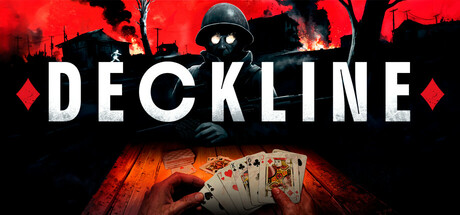
My first instinct with Deckline was to compare it to my strategy backlog: is there a decision tree here, build order considerations, meaningful variance run to run? Short answer is no, and you should know that before you spend a minute on it. What Room Games has built is a faithful, first-person recreation of Durak, the traditional Russian trick-taking card game, wrapped in one of the most oppressive atmospheric shells I have encountered in the indie space in a long time. That tension is real. The question is whether it is enough to hold a full session together. The rules of Durak are straightforward once you sit with them. Each player receives six cards from a 36-card deck, and a trump suit is established by the bottom card of the remaining pile. From there, the attacker places any card or multiple cards of the same rank, and the defender must beat each with a higher card of the same suit or any trump. Block everything and the roles flip. Fail and you absorb the table, handing the attacker another turn. The goal is to empty your hand before your opponent empties theirs. The AI is no pushover; reviewers have clocked it as a roughly 50/50 proposition, and there is genuine skill in timing when to burn trump cards and when to absorb a bad hand to set up a later salvo. Veterans of Eastern European card games will feel at home immediately. Complete newcomers will lose a few rounds before the logic clicks, then find themselves reasonably engaged. Where Deckline earns its praise is atmosphere, full stop. The bunker is dimly lit, low-poly, PSX-textured, and soaked in a grainy VHS filter that makes everything feel like recovered footage. Artillery rumbles constantly outside. Explosions shake the walls and kill the lights, forcing you to reach for the lamp on one side of the table or the anxiety medication on the other, each an actual interactive object that keeps screen blackouts from interrupting your hand management. Your squadmates grow quieter and more withdrawn as the session progresses, their nervous movements and deteriorating composure doing more narrative work than any written line of dialogue. The sound design, specifically the muffled conflict bleeding through concrete walls, is the game's single strongest asset and the main reason its Steam reception landed at roughly 86 percent positive across a few hundred reviews. But the ceiling is low and the community knows it. The so-called story mode resolves into a win or loss screen, credits, and a return to the main menu. The marketed "diverse endings" are not branching narrative outcomes; they are the two natural conclusions of any card game. There is no hand rearrangement in the UI, no optional Durak rule variants, no multiplayer, no progression layer of any kind. Players who go in expecting Inscryption-style environmental interactivity or Buckshot Roulette-style mechanical escalation will be disappointed, and several Steam reviewers flagged exactly that gap between marketing copy and reality. The interactables, the lamp and the pills, are atmospheric props rather than systems with meaningful knock-on effects. For my tastes, which lean toward decision depth and late-game complexity, Deckline runs out of interesting things to say after a session or two. The trump timing and hand management have a genuine skill ceiling, but the lack of rule variants or progression means you are essentially playing the same game repeatedly against the same AI opponent in the same room. That said, if what you want is a twenty-minute atmospheric horror experience built around a card game you may never have encountered before, this is a well-crafted, micro-priced delivery of exactly that. Set your expectations at the right altitude and it lands.

Strategy & simulation
Tags
System Requirements
Minimum
- OS
- Windows 10 64 Bit, Windows 11 64 Bit
- Memory
- 400 MB RAM
- Storage
- 300 MB available space
- Graphics
- NVIDIA GeForce GTX 550 Ti
- Processor
- Intel(R) Core(TM) i3-2100 CPU @ 3.10
Keep exploring
Community Discussion
Be the first to comment on Deckline.
Reviews & Ratings
No ratings available
Game Info
- Developer
- Room Games
- Publisher
- Room Games
- Release Date
- May 7, 2025