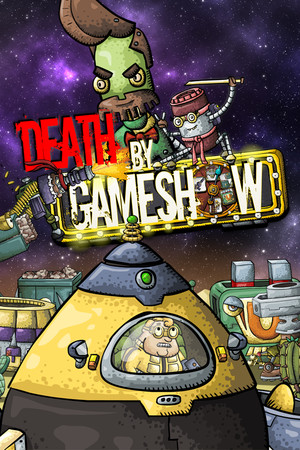
Death by Game Show
Fifty levels of droid-wrangling chaos that rewards split-second resource calls over careful long-game planning - tolerable if you mute the voiceover, honest about its own shallowness if you aren't.
GamerScout Verdict
Best for arcade-minded players who want short, punishing droid-wrangling sessions and can ignore the dated pop-culture noise.
Compare Prices(0 stores)
Loading prices...
We may earn a commission when you buy games through links on this page — at no extra cost to you. It never affects our rankings or verdicts.
Price History
Screenshots & Media
About Death by Game Show
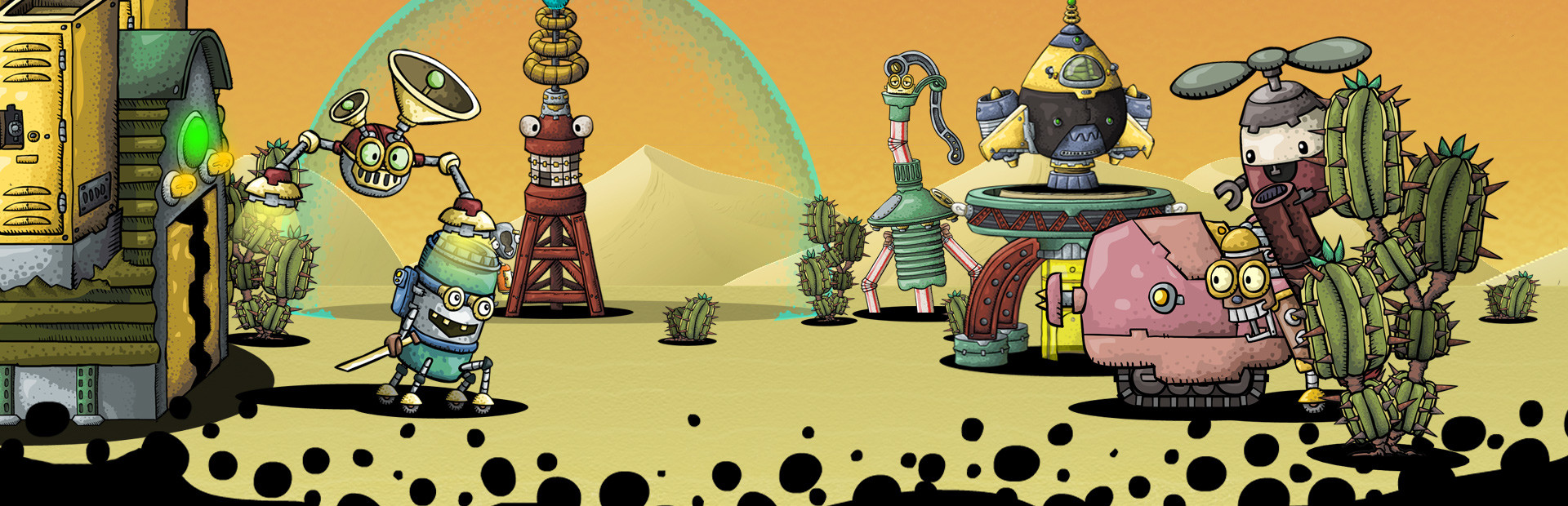
My instinct when I see a strategy-tower-defense hybrid is to ask one question: does the decision layer hold up past the opening hours, or does it collapse into muscle memory? With Death by Game Show the answer arrives faster than you'd like. The core loop puts you in the shoes of U.H. Wutt, a portly future-human condemned to survive 50 "rehabilitation" challenges on a live droid game show. You run left and right across a 2D circular arena, spawning up to eight friendly droids at a time from an energy bar that regenerates slowly, collecting coins with a grapple hook, and placing defensive buildings while enemy waves flood in from both sides. Level objectives vary - cash collection, timed survival, strict droid-count limits - and the early handful do a decent job of trickling in the ten droid types and the ten buildable defenses, including crowd favorites like the magnet-launching toaster and the swinging Scrote Hammer. That variety looks promising on paper. The problem is that the decision space never deepens to match the chaos on screen. When there is too much happening to formulate a real plan, and the planning phase between waves is too brief to build a long-term tactic, you end up reacting rather than strategizing. The energy cap of eight active droids keeps spawning from becoming mindless, but it also puts a ceiling on the combinatorial depth that makes tower-defense titles satisfying at higher difficulty. Certain levels do restrict which droid types you can field, which forces genuinely interesting composition choices, but those moments feel like exceptions rather than the design's default mode. Reviewers across the board flagged this friction: the game sits in a middle ground between fast action and thoughtful strategy without fully committing to either lane. On the positive side, the art holds up well. Hand-drawn, newspaper-cartoon visuals give the arena a distinct look that stands apart from generic pixel-indie output, and the animation work is clean enough to read unit positions in a cluttered fight. The humor is a heavier lift. The game draws openly from Mike Judge's Idiocracy as inspiration, peppering signs, soundbites, and building names with pop-culture gags. Whether those land is personal taste, but multiple critics noted the jokes grow wearing before the campaign is halfway done, and the repeated death-screen audio clips in particular push players toward the mute button fast. If you enjoy that brand of absurdist toilet comedy, the theming is consistent and committed. If you don't, it is inescapable. From a strategy-gamer's standpoint, what actually holds mild replay value is the Steam Workshop integration and the built-in level editor. You can build and share your own challenge maps, repaint droid skins, and even edit in-game text - a surprisingly generous toolset for a small indie release. If the community around it were larger, that sandbox could extend the game's life meaningfully. As it stands, the Workshop is quiet, so the editor functions more as a curiosity than a content pipeline. The campaign itself clocks in at a length that won't overstay its welcome if you play in short sessions, and the progressive coin rewards (even on failed runs) mean forward progress rarely feels completely blocked. That fail-forward economy is the smartest system in the game. Who is this actually for? Players who enjoy the kinetic pressure of something like Swords and Soldiers, tolerate steep arcade-style difficulty curves, and are not expecting the droid-management to rival a proper RTS will get reasonable value from the 50-level run. Genre purists chasing the depth of a real tower-defense or a proper real-time strategy will hit the ceiling quickly and feel the repetition before the credits. For the asking price in the sub-five-dollar tier, expectations should be calibrated accordingly, and the mute button should be considered a mandatory first step.

Strategy & simulation
Tags
System Requirements
Minimum
- OS
- Windows XP, Vista, 7, 8 and 10
- Memory
- 1 GB RAM
- Network
- Broadband Internet connection
- Storage
- 500 MB available space
- Graphics
- Graphics Card with 512MB RAM
- Processor
- Dual Core Processor
Keep exploring
Community Discussion
Be the first to comment on Death by Game Show.
Reviews & Ratings
No ratings available
Game Info
- Developer
- Oointah
- Publisher
- Unknown
- Release Date
- Jan 22, 2016