Darwinia
Forget the RTS tag warning you off - Darwinia strips the genre to its bones and rebuilds something quieter, stranger, and genuinely worth your evening.
GamerScout Verdict
Buy it for the atmosphere and puzzle-RTS identity; skip it if you need deep replayability or tight unit AI.
Compare Prices(0 stores)
Loading prices...
We may earn a commission when you buy games through links on this page — at no extra cost to you. It never affects our rankings or verdicts.
Price History
Screenshots & Media
About Darwinia
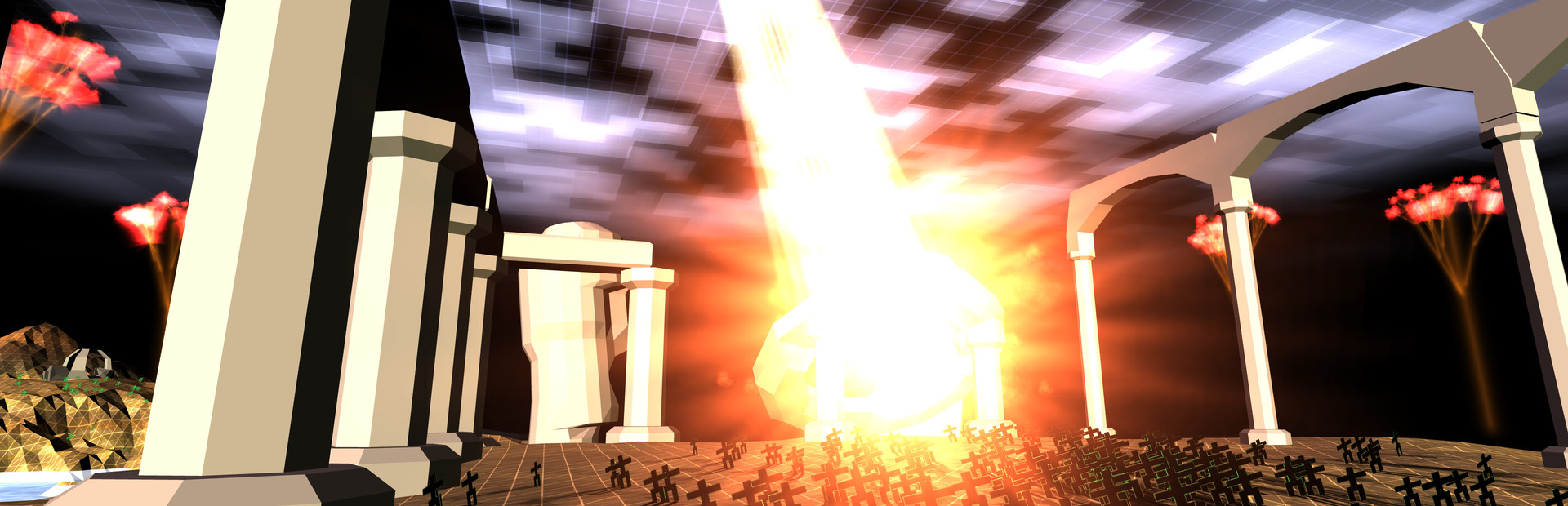
My instinct when something gets labeled a god game, an RTS, a puzzle game, and an action game in the same breath is to assume the developer couldn't commit to any of them. Darwinia is the exception that earns its genre soup. Introversion built a singleplayer campaign around a beautifully weird premise: you are a hacker who stumbles into Dr. Sepulveda's private digital ecosystem, a world of single-polygon AI creatures called Darwinians living out their little simulated lives inside a network of surplus 1980s hardware. A virus has corrupted everything, and you are conscripted to fix it. The atmosphere - sparse vector landscapes, an ambient score from Trash80 that leans melancholy rather than bombastic, and a visual style openly lifted from Tron and Defender - lands harder than the raw polygon count has any right to suggest. The mechanical loop is tighter than it first appears. You operate a Task Manager (a deliberate Windows reference) to spawn units: Squads for direct virus combat, Engineers for collecting the souls of fallen Darwinians and reprogramming satellite dishes and incubators, Officers to shepherd your growing Darwinian population across the map, and Armour that doubles as troop transport or static turret. Each level is essentially a large interlocking puzzle of floating island segments, and the order in which you clear virus pockets, reactivate facilities like the Soul Repository and Pattern Buffer, and ferry Darwinians to safety genuinely matters. Research runs in the background, with Dr. Sepulveda handling one upgrade at a time, so you are constantly making small prioritization calls - better squad firepower now, or more simultaneous tasks later. That decision layer is slim by grand-strategy standards, but it is real, and it creates meaningful tension across the campaign's dozen or so levels. The control scheme has a story of its own. The original release used mouse gestures to summon units - draw a shape, get a squad. It is still toggleable, and it is still finicky. Introversion patched in a clean icon-based system that most players will use instead, and it works fine. What the tutorial does not do well is explain objective logic. Multiple reviewers across two decades flag the same sticking point: the first mission is confusing, the objective text leans on techno-babble, and the help system offers little rescue. Push through it, because the game opens up once the initial friction passes. The difficulty slider, added post-launch, runs from 1 to 10 and scales enemy numbers, speed, and health, so there is room to tune the experience once you understand the systems. Where Darwinia struggles is replayability and AI robustness. The campaign runs roughly six to eight hours on a first playthrough, and there is not much structural reason to return beyond the map editor, which unlocks on completion. Unit pathfinding has been a known pain point since launch - squads can get snagged on invisible geometry, and Darwinians will occasionally ignore Officers entirely. A 2022 update labeled the 10000th Anniversary Edition improved compatibility, but the core AI behavior remains a product of its era. If you arrive expecting StarCraft-level unit control fidelity, you will leave frustrated. If you arrive expecting a meditative, atmospheric tactics puzzle with a genuinely original identity, you will find something that still holds up. From a strategy-depth perspective, Darwinia sits closer to a puzzle-RTS hybrid than a proper wargame. The absence of resource scarcity (you can always summon another squad if one dies) removes economic pressure entirely, which flattens the late-game decision space. What replaces it is positional and sequential thinking - clearing the right sectors in the right order, keeping Darwinian population alive long enough to power facilities, and managing the research queue with some intention. It is not a game that rewards build-order mastery or AI-reading. It rewards patience, curiosity, and a willingness to operate inside a system that does not explain itself upfront.

Strategy & simulation
Tags
System Requirements
Minimum
- OS
- Windows 10 or later
- Memory
- 4GB of RAM
- Graphics
- 4GB of VRAM
- Processor
- Intel Core i5 (Westmere) or better
- Graphics API (ANGLE)
- Direct3D 11+ or Vulkan 1.2.160+
- Graphics API (OpenGL)
- OpenGL 3.3+
DLC & Add-ons for Darwinia1
Expansions, DLC packs and add-on content for this game. Click any item to see store offers.
Keep exploring
Community Discussion
Be the first to comment on Darwinia.
Reviews & Ratings
Game Info
- Developer
- Introversion Software
- Publisher
- Introversion Software
- Release Date
- Dec 1, 2005