
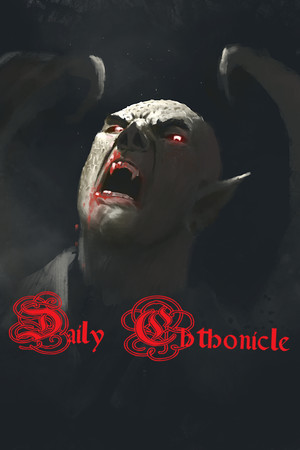
Daily Chthonicle: Editor's Edition
A Lovecraftian management sim where your six reporters are both your newsroom and your monster-hunting squad - genuinely original concept, rough edges included.
GamerScout Verdict
Worth picking up for players who enjoy management loops with tactical item and spell decisions, but expect a rough, unpolished exterior throughout.
Compare Prices(0 stores)
Loading prices...
We may earn a commission when you buy games through links on this page — at no extra cost to you. It never affects our rankings or verdicts.
Price History
Screenshots & Media
About Daily Chthonicle: Editor's Edition
My spreadsheet instincts kicked in the moment I saw the city map with nine assignable districts and a roster of six reporters to fill them. Daily Chthonicle: Editor's Edition sits in a genre gap that almost nobody else occupies: it is part resource-management loop, part occult investigation RPG, and it wears its H.P. Lovecraft influences loudly. You run the editorial desk of a supernatural newspaper in a 1940s noir city crawling with cultists, ghosts, shapeshifters, and worse, and your job is to close every open case before your team gets incapacitated. It is a stranger brief than it sounds, and for a certain kind of player, that strangeness is exactly the point. The core loop is assignment-and-wait, which will immediately filter out a large slice of potential buyers. You place reporters across city locations, they surface clues, contacts, obstacles, and leads, and you make reactive calls on what to pursue. Closing a case means gathering enough evidence to publish a special edition, and three closed cases end a chapter. It reads like a mid-complexity management sim on paper, and largely plays like one. What elevates it above pure idle clicking is the equipment and spell layer: reporters can carry items like body armor and first aid kits, cast spells using laboratory reagents, and earn magic initiation through leveling up via published stories. Matching a Flame spell against a freezing enemy, or going Stealth on an adversary to earn a tactical bonus, introduces a light but real tactical dimension that rewards paying attention to encounter specifics rather than just mashing confirm. Where the game stumbles is in presentation and interface clarity. The UI is genuinely cluttered - text boxes are oddly angled, the distinction between "continue to next prompt" and "send reporter off" is not always legible, and the graphics land firmly in functional-but-bare territory. Static scanned images standing in for action sequences is a budgetary reality the game never fully hides. Sound design is minimal. The procedurally generated cases are the heart of replayability, and they produce memorable absurdities (clown ambushes at the docks, skeletal guardians behind fortified doors), but the articles they produce auto-assemble from fragments rather than reading as coherent stories. Players who need narrative payoff for their investigation loops will find that hollow. Players who are chasing the management optimization angle - how do I rotate six reporters across nine districts while keeping sanity and budget healthy - will find the loop quietly compelling. For the strategy-curious crowd, here is the honest case for it: the Long Game mode, the four named Skirmish campaigns (Cthulhu Fhtagn, Azathoth Stirs, Shub-Niggurath, Yog-Sothoth), and a moddable skirmish scripting system give the game more structural variety than its price tag implies. The difficulty curve on Hard is genuinely punishing early, with reporter incapacitation arriving faster than newcomers expect. Starting with Easy Long Game is the correct call, not a concession - it teaches the assignment rhythm and the gear economy without punishing you for not already knowing how threat-level scaling works. The mod hooks in the skirmish scripts are a quiet strength that never got the community attention they deserved, likely because the player base stayed small. This is a one-developer passion project with Lovecraftian soul and a UI that needed another six months of polish. If the concept of routing a squad of occult journalists across a procedurally haunted city sounds like something you would min-max on a quiet evening, the low barrier to entry makes it worth the experiment. If slick visuals and narrative cohesion are non-negotiable for you, the rough edges will terminate your interest before the management depth has time to land.

Strategy & simulation
Tags
System Requirements
Minimum
- OS
- Windows 7
- Memory
- 1 GB RAM
- Storage
- 500 MB available space
- Graphics
- Even integrated laptop video is ok.
- Processor
- 1.8 GHz Single Core CPU
Keep exploring
Community Discussion
Be the first to comment on Daily Chthonicle: Editor's Edition.
Reviews & Ratings
No ratings available
Game Info
- Developer
- Sinister Systems
- Publisher
- Sometimes You
- Release Date
- Sep 30, 2016