Crayon Physics Deluxe
Draw ramps, levers, ropes, and Rube Goldberg contraptions with a crayon cursor, this IGF Grand Prize winner is a quiet miracle of one-tool design that rewards imagination over brute logic.
GamerScout Verdict
Worth it for patient, imaginative players who want to build their own solutions, not for those who need tight puzzle logic or long playtimes.
Compare Prices(5 stores)
Every store in this table quotes us in euros, so the EUR figure is the price the seller actually set, not our arithmetic — which is why EUR is also the currency we rank in. We only list an offer here when the store gives us its price in euros, so nothing in this table is a number we invented.
Pick USD, PLN, GBP, CAD or AUD in the header and we convert from EUR at the European Central Bank reference rate — converted amounts are prefixed with ~. Your bank or the store may apply a different rate at checkout. We never hide offers based on where you are: everyone sees this whole table.
We may earn a commission when you buy games through links on this page — at no extra cost to you. It never affects our rankings or verdicts.
Price History
Screenshots & Media
About Crayon Physics Deluxe
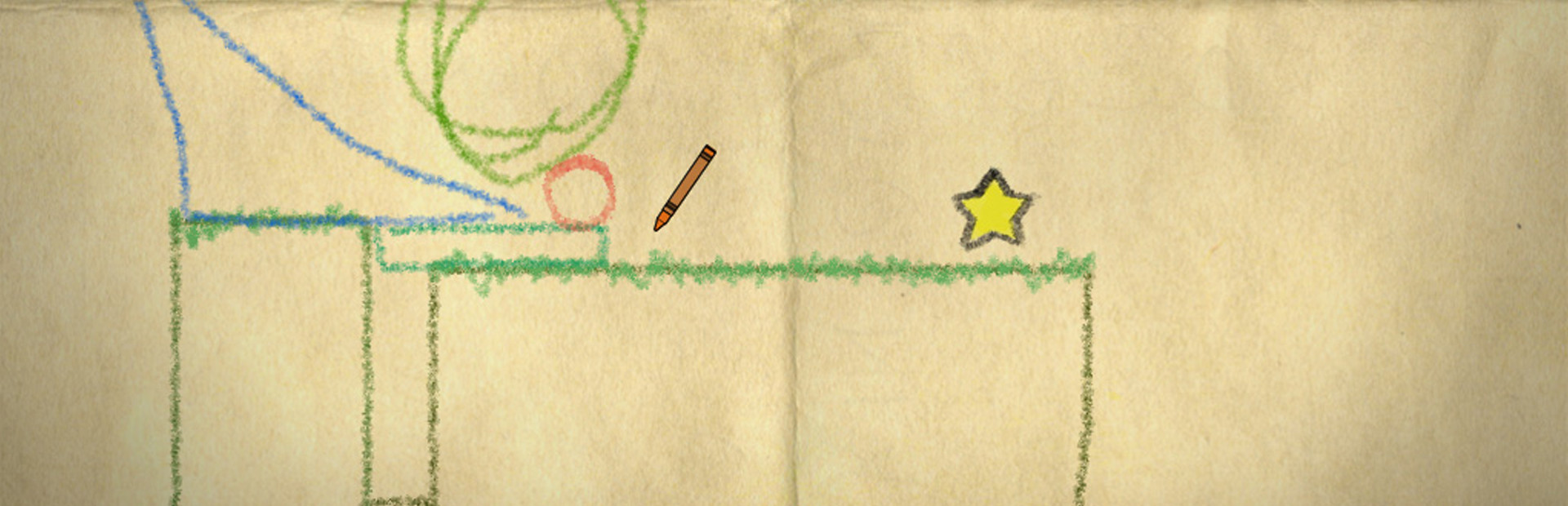
My first few minutes with Crayon Physics Deluxe felt less like booting a game and more like finding a forgotten sketchbook under a school desk. The whole visual language, crumpled paper backgrounds, slightly uneven lines, that waxy pencil texture on every drawn object, is so committed to its own handmade world that you almost forget there is a sophisticated physics engine underneath all of it. Developer Petri Purho built the original prototype in five days, and what became the Deluxe edition is still, years later, one of the clearest arguments I know for the power of a single, honest idea executed with care. The mechanic is this: you have a red ball, you have one or more yellow stars, and your only tool is a crayon cursor. Anything you draw becomes a physical object with mass and inertia the moment you lift the mouse button. A straight line becomes a ramp or a lever. A rough circle becomes a boulder that can swing from a pin. Draw a small circle attached to an object and you create a hinge; connect two pins with a line and you get a flexible rope. The game introduces pulleys, rockets ignited by collision, and animated obstacles as you progress through its seventy-plus levels. What keeps this interesting is that there is genuinely no single correct solution. The game actively encourages you to rate your own approach and awards extra stars for Elegant Solutions (a single drawn object) or Old School Solutions (no pins, no rolling the ball by hand). Chasing those bonus stars is where Crayon Physics quietly becomes a puzzle game with real depth, rather than a physics sandbox you beat by accident. The aesthetic and the soundscape are inseparable from the experience. The soundtrack is gentle, ambient, and slightly dreamy, the kind of music that slows your breathing without you noticing. Critics have called it "very soothing" while noting that the handful of tracks repeat throughout the full run, which is fair, and slightly noticeable by the time you reach the later islands. The visual presentation earns consistent praise for suiting the game perfectly, a nursery-school-fantasy-made-real quality that calms you into an experimental mindset rather than a competitive one. You end up spending time on funny, over-engineered solutions not because the puzzle demands it, but because the atmosphere quietly dares you to. Where the game genuinely struggles is in how it gates progress behind stars earned in earlier levels. If the physics engine works against you, or a rare glitch causes a drawn object to vanish mid-solution, that locked door becomes frustrating rather than motivating. The level design also draws criticism for inconsistency: some puzzles feel precisely authored, others feel solved more by chance than by craft. And the game is short. A direct run through the main levels clocks in under four hours, with a completionist approach reaching around seven to eight hours. For players who find a comfortable rhythm early, repetition can set in faster than the content runs out. The community-created level Playground extends that lifespan meaningfully, but it requires a willingness to go looking. Crayon Physics Deluxe is a game that knows exactly what it is and does not pretend otherwise. It is not long, it is not loud, and it does not reward players who want to be told the right answer. It rewards the person who draws a giant falling structure just to see what happens. If that sounds like you, this game will stay with you longer than its playtime suggests. If you need tight puzzle logic and guaranteed escalation, look elsewhere. There is a compatibility note worth knowing: the Mac version does not support macOS 10.15 Catalina or above, so macOS players should verify before purchasing.

Indie & narrative
Tags
System Requirements
Minimum
- Memory
- 512 MB RAM
- Processor
- 1 Ghz
- Sound Card
- 16-bit Sound Card
- Video Card
- Any 3D graphics accelerator with 128 MB of texture memory
- Hard Disk Space
- 50 MB Available HDD Space
- Operating System
- Microsoft® Windows® XP/Vista
- DirectX® Version
- DirectX® 9.0c
Keep exploring
Community Discussion
Be the first to comment on Crayon Physics Deluxe.
Reviews & Ratings
Game Info
- Developer
- Kloonigames
- Publisher
- Kloonigames
- Release Date
- May 6, 2009