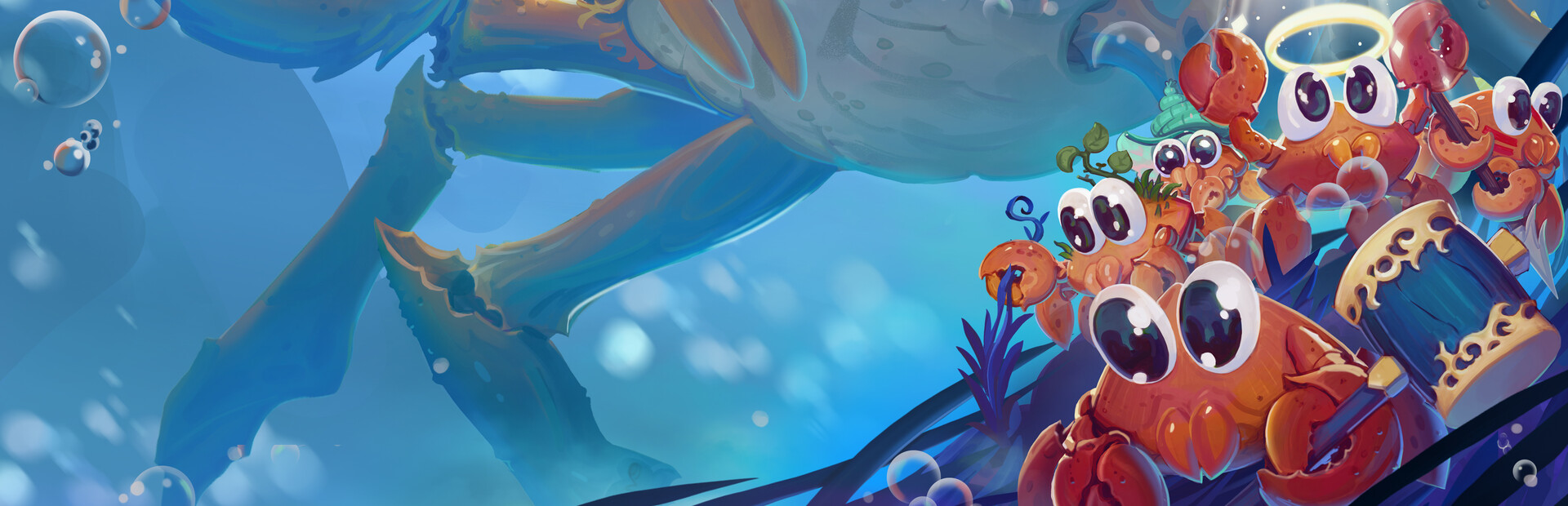
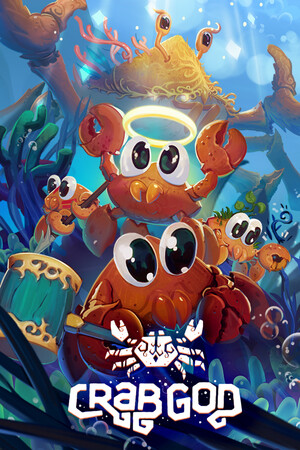
Crab God
Colony management meets coral gardening in a side-scrolling roguelite where your crabling roster decisions matter more than you'd expect from the cute visuals.
GamerScout Verdict
Best for cozy-strategy players who want a tidy roguelite session and don't need deep meta-progression to stay engaged.
Compare Prices(8 stores)
Every store in this table quotes us in euros, so the EUR figure is the price the seller actually set, not our arithmetic — which is why EUR is also the currency we rank in. We only list an offer here when the store gives us its price in euros, so nothing in this table is a number we invented.
Pick USD, PLN, GBP, CAD or AUD in the header and we convert from EUR at the European Central Bank reference rate — converted amounts are prefixed with ~. Your bank or the store may apply a different rate at checkout. We never hide offers based on where you are: everyone sees this whole table.
We may earn a commission when you buy games through links on this page — at no extra cost to you. It never affects our rankings or verdicts.
Price History
Screenshots & Media
About Crab God
I opened Crab God expecting a wholesome screen-saver with light strategy dressing, and I was wrong within the first twenty minutes. The five crabling roles - Gardener, Scavenger, Worshipper, Builder, and Hunter - interact in ways that actually demand resource sequencing: you cannot hatch new eggs without Favour, you cannot migrate without food, and you cannot gather food safely without Hunters absorbing night-time threats like the Darkmitt water spiders and predatory starfish that get nastier the deeper you dive. That is a real decision loop, and it tightens pleasantly as the ocean biomes shift from sun-dappled shallows into toxic brine pools. The closest genre siblings are Kingdom: Two Crowns and a lighter, more accessible Pikmin. Like Kingdom, progress is gated by resource thresholds rather than action economy, so there is no frantic micro; you assign roles, watch cause-and-effect unfold, and correct when the balance tips wrong. Unlike Kingdom, the roles are freely reassignable mid-level, which keeps runs from feeling punishing if your opening crabling split is suboptimal. The roguelite loop is short - a full run sits closer to four to six hours - and the absence of meta-progression between runs is the game's most cited shortcoming in community feedback. Players looking for persistent unlocks or cross-run power accumulation will hit a ceiling. What the achievements do instead is push you toward different role compositions on repeat runs, which is a reasonable consolation but not quite the same as a proper meta layer. For strategy veterans, the depth ceiling will feel modest. This is not a game where build variety spirals into theorycrafting wikis. The Favour currency system, which funds role-switching, plant upgrades, and egg hatching, is the closest thing to a resource multiplier worth optimizing, and it rewards Worshipper-heavy openers in the mid-game before pivoting to Hunters for the abyss sections. That arc is satisfying once, maybe twice. What keeps the loop alive past that is the ecosystem side of things: Gardener crabs grow coral structures that attract specific fish species, and the combinations of flora and fauna you unlock produce a genuinely dynamic biome that feels different at each depth tier. The visual payoff of a thriving reef is not nothing. The real-world conservation hook - Ritual Stones of Preservation that let you direct a portion of game revenue to causes like coral propagation, ocean plastic removal, or sea turtle protection - is implemented cleanly and non-intrusively. It does not pad the runtime or require extra payments. Whether that feature moves the needle for you as a buyer depends on your values, but it is at least mechanically honest: the stones are found during normal play, the choice is yours, and the developers do publish impact certificates. The audio design across biomes earns a specific mention - the shift from ambient shallow-water ambience to genuinely unsettling abyssal tones is well-executed and does a lot of heavy lifting for atmosphere that the relatively simple side-scroller geometry cannot provide on its own. Controller support existed at launch but drew some complaints about reliability, so keyboard-and-mouse remains the safer input choice on PC. The runtime is short enough that a full completion run sits well under ten hours, with achievement hunting pushing the figure toward thirty via multiple-run challenges.

Strategy & simulation
Tags
System Requirements
Minimum
- OS
- Windows 10 or newer, 64-bit
- Memory
- 4 GB RAM
- DirectX
- Version 11
- Storage
- 4 GB available space
- Graphics
- GeForce GTX 950 / Radeon R X 460
- Processor
- AMD FX 8300 / Intel Core i3 8300
- VR Support
- None
Recommended
- OS
- Windows 10 or newer, 64-bit
- Memory
- 16 GB RAM
- DirectX
- Version 11
- Storage
- 6 GB available space
- Graphics
- Radeon R9 280 / GeForce GTX 1650
- Processor
- Ryzen 5 1600X / Intel Core i5 8600K
- VR Support
- None
Keep exploring
Community Discussion
Be the first to comment on Crab God.
Reviews & Ratings
No ratings available
Game Info
- Developer
- Chaos Theory Games
- Publisher
- Firesquid
- Release Date
- Jun 20, 2024