
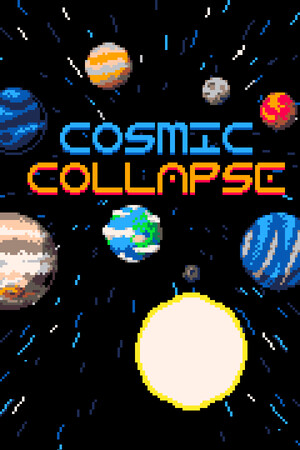
Cosmic Collapse
The Suika formula, stripped of its fluff and shot into orbit: drop planets, chain collapses, survive until you've squeezed two suns together. Small game, enormous pull.
GamerScout Verdict
Ideal for puzzle fans who want Suika-style drop mechanics done with more craft, more forgiveness, and a far better soundtrack.
Compare Prices(3 stores)
Every store in this table quotes us in euros, so the EUR figure is the price the seller actually set, not our arithmetic — which is why EUR is also the currency we rank in. We only list an offer here when the store gives us its price in euros, so nothing in this table is a number we invented.
Pick USD, PLN, GBP, CAD or AUD in the header and we convert from EUR at the European Central Bank reference rate — converted amounts are prefixed with ~. Your bank or the store may apply a different rate at checkout. We never hide offers based on where you are: everyone sees this whole table.
We may earn a commission when you buy games through links on this page — at no extra cost to you. It never affects our rankings or verdicts.
Price History
Screenshots & Media
About Cosmic Collapse
I sat down with Cosmic Collapse for what I thought would be twenty minutes and looked up ninety minutes later with a genuinely impressive high score and a mild compulsion to chase it higher. That is the whole pitch, honestly, and it lands cleanly. Swedish developer Johan Peitz built this on PICO-8, a fantasy console famous for imposing tight creative limits, and the constraints have shaped something that feels deliberately lean rather than merely small. Every element on screen earns its pixel. The mechanics sit squarely in the Suika-like tradition: you drop celestial bodies one at a time into a confined play area, and whenever two matching bodies collide they fuse into the next size up. You start with asteroids, work up through the moon, Mars, Venus, Earth, and onward through the solar hierarchy, chasing the goal of merging two suns. The physics engine, which Peitz wrote himself using a custom Verlet model, is noticeably softer and more forgiving than the original Suika Game's. Pieces roll and settle with a satisfying weight, and you can actually use smaller planets to nudge bigger ones into position, which opens up deliberate combo play rather than pure luck. The game-over condition is kinder too: a planet has to hold its center above the boundary line for a sustained half-second before it kills your run, so a bad bounce does not automatically end everything the way it does in Suika. Two mechanics separate this from the crowd. First, chaining collapses rewards you with score multipliers, which means patient, ordered placement genuinely pays off rather than just feeling clever. Second, once you accumulate enough points you earn a missile, a single-use tool that lets you detonate one planet of your choice. That pressure valve is invaluable when a medium-sized body is sitting directly between two larger ones that want to merge. It introduces just enough agency to push the game from frustrating into strategic, without ever removing the core tension. What the game does not give you is a progression chart showing the full evolution chain from asteroid to sun. That information gap is a real, if minor, friction point early on. A few runs sort it out, but it is the kind of small oversight that a future update could fix painlessly. The aesthetic is the other reason I keep recommending this to people who normally do not care about the Suika-like micro-genre. The retro pixel art, handled entirely by Peitz, has a warmth that evokes a certain era of handheld gaming without feeling cynically nostalgic. The soundtrack, composed by Vav, is a single looping chiptune that I would describe as genuinely meditative: it creates a low-gravity headspace that makes the game feel like a late-night ritual rather than an arcade sprint. The score attack loop, the gentle music, the soft physics collisions, they all pull together into something coherent and intentional. This is a game that knows exactly what it is and does not overstay its welcome. If you bounced off Suika Game because the physics felt arbitrary and punishing, Cosmic Collapse is the version you were actually looking for. If you have never touched the genre, this is as good a starting point as any, small enough to cost you nothing, deep enough to cost you an evening.

Indie & narrative
Tags
System Requirements
Minimum
- OS
- 7
- Memory
- 1 GB RAM
- Storage
- 50 MB available space
- Graphics
- any card
- Processor
- 700 MHz
- Sound Card
- any card
Recommended
Requires a 64-bit processor and operating system
Keep exploring
Community Discussion
Be the first to comment on Cosmic Collapse.
Reviews & Ratings
No ratings available
Game Info
- Developer
- Johan Peitz
- Publisher
- Apskeppet
- Release Date
- Jan 11, 2024