
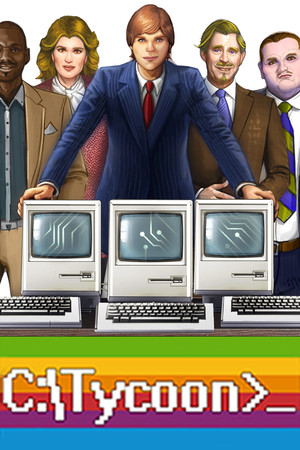
Computer Tycoon
Running a tech empire from a 1974 garage to the Singularity sounds like fantasy, but Computer Tycoon makes you earn every market-share point through hardware specs, OS choices, and global expansion math.
GamerScout Verdict
Best for grand-strategy fans who want market-simulation depth and can tolerate an ambitious Early Access roadmap still in progress.
Compare Prices(4 stores)
Every store in this table quotes us in euros, so the EUR figure is the price the seller actually set, not our arithmetic — which is why EUR is also the currency we rank in. We only list an offer here when the store gives us its price in euros, so nothing in this table is a number we invented.
Pick USD, PLN, GBP, CAD or AUD in the header and we convert from EUR at the European Central Bank reference rate — converted amounts are prefixed with ~. Your bank or the store may apply a different rate at checkout. We never hide offers based on where you are: everyone sees this whole table.
We may earn a commission when you buy games through links on this page — at no extra cost to you. It never affects our rankings or verdicts.
Price History
Screenshots & Media
About Computer Tycoon
I went in expecting something close to Game Dev Tycoon with a silicon coat of paint. What I got was closer to a stripped-down Paradox title where the spreadsheet IS the game. Computer Tycoon puts you in charge of a technology startup beginning in 1974, right at the start of the microprocessor revolution, and asks you to out-think eight AI competitors across six decades of simulated market warfare. The timeline runs all the way to a near-future singularity endpoint, and the two win conditions - achieve monopoly or reach technological singularity - give every session a very different strategic shape depending on which you chase. The core decision loop is tighter than it looks from the outside. Every product you ship forces a real tradeoff: do you spec for raw computing capacity, load up on features, cut price to grab market share, or position for prestige to pull in the high-margin segment? That question repeats across home computers, personal computers, portable machines, and handheld devices, meaning the product matrix compounds fast. Layered on top is the infrastructure side - factories, laboratories, marketing facilities, and leisure buildings that keep employee morale up. Expanding into new countries adds a labour-cost-versus-talent calculation: cheaper wages in developing markets versus access to more educated engineers in wealthier ones. None of this is hand-held. The learning curve is real, and the UI can feel dense when a dozen resource bars are all competing for your attention at once. The good news is a Beginner difficulty with optional opponent removal essentially turns the game into a sandbox where you can learn the systems at your own pace, which is exactly the right call for newcomers to the genre. The grand-strategy world-map layer is what separates Computer Tycoon from the usual tycoon crowd. You are watching a simulated market where competitor products have visible specs and pricing, and you have to respond with actual product design decisions, not just a slider adjustment. The diplomacy system has reportedly been partially inspired by classic 4X titles, and the developer continues to iterate on it. Three map modes - Historical, Simplified, and Randomized post-2000s borders - give the setup enough variety to support multiple campaigns without feeling identical. One legitimate complaint from early players was that competitors could occasionally collapse too quickly, leaving the mid-game without enough friction; that issue has been addressed across several patch cycles, though the game is still in Early Access and save compatibility between versions is not guaranteed. And that Early Access status is the honest caveat this game carries. It has been in development since 2017, built primarily by a single developer named Andris. Progress has been consistent but slow, and the scope has grown so substantially that the developer himself has noted the current roadmap is practically a sequel-level undertaking. The audio is minimal - expect to run your own playlist - and the visual side is functional Unity work rather than anything that will land in your screenshots folder. What it does have is a community that actively shapes development, a subreddit, a Discord, and a solo developer who reads every forum post. For strategy players who appreciate that kind of transparency, the Early Access warts are easier to accept. Steam users have landed on a Very Positive rating across nearly a thousand reviews, which for a one-person indie in a demanding genre is a signal worth taking seriously.

Strategy & simulation
Tags
System Requirements
Minimum
- OS
- Windows 7 or newer
- Memory
- 4 GB RAM
- Storage
- 3 GB available space
- Graphics
- Radeon HD 6850 or similar
- Processor
- Dual Core
Recommended
- OS
- Windows 7 or newer
- Memory
- 4 GB RAM
- Storage
- 3 GB available space
- Graphics
- Better than Radeon HD 6850
- Processor
- Quad Core
Keep exploring
Community Discussion
Be the first to comment on Computer Tycoon.
Reviews & Ratings
No ratings available
Game Info
- Developer
- Progorion
- Publisher
- Progorion
- Release Date
- Oct 12, 2017