
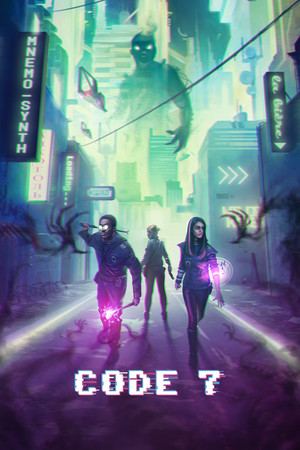
Code 7: A Story-Driven Hacking Adventure
Typed commands, a rogue AI, and a partner whose life depends on your next keystroke. Code 7 is the text adventure that refuses to feel like one.
GamerScout Verdict
Ideal for narrative-adventure fans who can tolerate an unfinished episodic arc and want a hacking game that actually makes typing feel tense.
Compare Prices(2 stores)
Every store in this table quotes us in euros, so the EUR figure is the price the seller actually set, not our arithmetic — which is why EUR is also the currency we rank in. We only list an offer here when the store gives us its price in euros, so nothing in this table is a number we invented.
Pick USD, PLN, GBP, CAD or AUD in the header and we convert from EUR at the European Central Bank reference rate — converted amounts are prefixed with ~. Your bank or the store may apply a different rate at checkout. We never hide offers based on where you are: everyone sees this whole table.
We may earn a commission when you buy games through links on this page — at no extra cost to you. It never affects our rankings or verdicts.
Price History
Screenshots & Media
About Code 7: A Story-Driven Hacking Adventure
I came into Code 7 braced for novelty-over-substance, the kind of indie experiment where the concept does all the heavy lifting and the actual playing is a chore. I was wrong, and I am glad to have been wrong. What Goodwolf Studio built here is something genuinely rare: a game where the constraint of a pure keyboard interface does not feel like a limitation, it feels like the whole point. You play as Alex, a hacker who wakes up with no memory aboard Schrodinger Station, an eerie research facility gone silent. Your only lifeline is Sam, a partner you guide through the physical spaces of the station while you operate remotely from a terminal running a fictional OS called LupOS. That spatial split is the emotional engine of the whole thing. You never move a body; you move a person you are starting to care about, and the weight of that asymmetry creeps up on you quietly. The hacking itself is not wallpaper. The game asks you to perform techniques like Brute Force attacks, Network Jamming, and Man-in-the-Middle maneuvers, each with its own feel. The Man-in-the-Middle sequences in particular stand out: they put you on a real-time grid, still controlled entirely through typed coordinates, navigating a virus past security programs while a clock ticks. The first time one of these fires up, the shift in pulse is immediate. The writing holds. The story leans on some familiar sci-fi scaffolding, an amnesiac protagonist, a sinister AI called S.O.L.I., existential questions about identity and what makes a mind worth saving. None of that is original territory, but Code 7 earns its tropes by threading them so completely into how you actually play that they rarely feel borrowed. Critic reception was warm across the board, and the Steam community sits at Very Positive. The voice cast deserves a specific mention: fully acted dialogue in a text-interface game is an unlikely combination that absolutely works, giving the silent terminal a strange warmth. The synth soundtrack does the same, sitting just under the tension rather than shouting at you. The caveats are real, though. This is an episodic game, and as of now the final episode is still in development, described by the community as being in extended hibernation while the remaining work gets finished. Buying in means accepting an unfinished arc. The timed sequences can also punish players who struggle with speed typing, though a built-in accessibility mode for visually impaired players can bypass the most demanding of these, which is a genuinely thoughtful inclusion that few games at this scale bother with. Episode 0 is free, which is the right way to decide whether the interface clicks for you before spending anything. If you have ever loved a slow-burn radio drama, or if you remember the satisfaction of a parser adventure that trusted you to pay attention, Code 7 is the kind of handcrafted work that stays with you longer than its modest review count suggests it should.

Indie & narrative
Tags
System Requirements
Minimum
- OS
- Windows 7
- Memory
- 6 GB RAM
- DirectX
- Version 11
- Storage
- 1 GB available space
- Graphics
- NVIDIA GeForce GT 252M
- Processor
- Intel Core i5 2,5 GHz
Recommended
- OS
- Windows 10
- Memory
- 8 GB RAM
- DirectX
- Version 11
- Storage
- 1 GB available space
- Graphics
- NVIDIA GeForce GTX 560 Ti
- Processor
- Intel Core i5 3.30 GHz
Keep exploring
Community Discussion
Be the first to comment on Code 7: A Story-Driven Hacking Adventure.
Reviews & Ratings
No ratings available
Game Info
- Developer
- Goodwolf Studio
- Publisher
- Rel.Pink
- Release Date
- Aug 11, 2017