
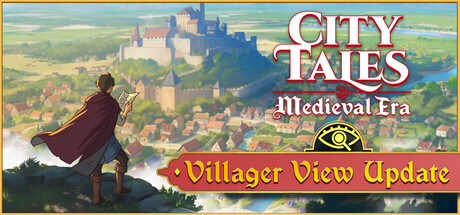
City Tales - Medieval Era
Skip the grid, draw your own kingdom: City Tales rewards patient planners who want a medieval builder with genuine layout freedom and a companion system that actually changes how you allocate resources.
GamerScout Verdict
Best for city-builder fans who prioritize spatial creativity and companion optimization over crisis management or punishing economies.
Compare Prices(8 stores)
Every store in this table quotes us in euros, so the EUR figure is the price the seller actually set, not our arithmetic — which is why EUR is also the currency we rank in. We only list an offer here when the store gives us its price in euros, so nothing in this table is a number we invented.
Pick USD, PLN, GBP, CAD or AUD in the header and we convert from EUR at the European Central Bank reference rate — converted amounts are prefixed with ~. Your bank or the store may apply a different rate at checkout. We never hide offers based on where you are: everyone sees this whole table.
We may earn a commission when you buy games through links on this page — at no extra cost to you. It never affects our rankings or verdicts.
Price History
Screenshots & Media
About City Tales - Medieval Era
My color-coded spreadsheet instinct fired up the moment I realized City Tales - Medieval Era does not let you drop pre-fab buildings onto a tile grid. Instead, you free-draw district boundaries with your cursor, shaping irregular plots that fill organically with homes and production buildings. That single design choice separates it from almost every competitor in the genre, and it is the main reason strategy-minded players should pay attention. The free-form zoning means your Woodcutter's Cabin needs to actually sit near trees, your Chapel placement determines which homes can upgrade toward tier V, and a poorly planned early district cannot simply be repositioned later once boundaries are set. That permanent commitment is the closest thing to meaningful long-term consequence the game offers, and experienced builders will feel it most sharply on the Advisor difficulty. The companion system is where City Tales gets genuinely interesting from a resource-allocation standpoint. You start with six named companions, including characters like Mischa, Judith, and Alberic, each with their own production specialization. Assign a companion to a logging camp and they gain experience in that production type; level them high enough and they unlock efficiency bonuses for every future building of the same category. The tension is not combat or crisis management but opportunity cost: do you park your best farming companion on a granary to level her up, or pull her to bootstrap a new district faster? That decision loop carries most of the mid-game. Later, Hamlets unlock as a separate late-game expansion mechanic, and 11 Masterworks provide long-horizon objectives for players who want a concrete endgame target beyond aesthetic satisfaction. Here is where I need to be straight with the strategy crowd, though. The economy across 48 resource types sounds dense on paper, but the actual pressure is low by design. There are no disasters, no raiders, no penalties for slow expansion. Even on Advisor difficulty the game leans far more toward cozy than punishing. If your spreadsheet instinct demands Anno-level supply chain stress or the existential dread of a Paradox bankruptcy screen, City Tales will feel underpowered. Critics at Metacritic (77/100) and across outlet reviews flagged this consistently: the absence of failure states means the mid-game can cruise on autopilot. The studio's answer is Painter Mode, a fully resource-free creative sandbox, but that skips the economic loop entirely rather than tightening it. Where the game earns real credit is in its production values and its development discipline. The 1.0 release in January 2026 arrived after roughly eight months of community-driven Early Access, and the differences between versions are substantial. Pacing was reworked, companion bottlenecks were fixed, three handcrafted maps were included, difficulty tiers were added, and voice lines were introduced for companions. The adaptive soundtrack, composed by Benoit Vanhoffelen with vocals from Iris Roche, shifts tone with your city's growth in a way that feels genuinely atmospheric rather than looping background noise. Performance is clean even on older hardware, and the tutorial respects your time without being dismissive. For newcomers to the genre, this is actually a strong entry point: the systems reveal themselves gradually, the UI keeps all 48 resources readable at a glance, and you will never hit a wall that punishes you for experimenting with an odd district shape. If you have 20 to 40 hours and want a builder where the primary challenge is spatial planning and companion optimization rather than crisis response, City Tales - Medieval Era delivers that in a polished, well-supported package. If you need your cities to occasionally burn, you will want to look elsewhere.

Strategy & simulation
Tags
System Requirements
Minimum
- OS
- Windows 10/11
- Memory
- 8 GB RAM
- DirectX
- Version 11
- Storage
- 12 GB available space
- Graphics
- AMD Radeon RX 470 / Nvidia GeForce GTX 960
- Processor
- Ryzen 3 1300X/Intel Core i3 9100
Recommended
- OS
- Windows 10/11
- Memory
- 16 GB RAM
- DirectX
- Version 12
- Storage
- 16 GB available space
- Graphics
- AMD Radeon RX 580 / Nvidia GeForce GTX 1060
- Processor
- Ryzen 5 1600X / Intel Core i5 8400
DLC & Add-ons for City Tales - Medieval Era1
Expansions, DLC packs and add-on content for this game. Click any item to see store offers.

Keep exploring
Community Discussion
Be the first to comment on City Tales - Medieval Era.
Reviews & Ratings
Game Info
- Developer
- Irregular Shapes
- Publisher
- Firesquid
- Release Date
- Jan 29, 2026