
City of Brass
Scimitar in one hand, whip in the other, twelve floors of cursed city ahead of you. A focused first-person roguelite that lands harder than its Metacritic score suggests for the right kind of player.
GamerScout Verdict
Worth picking up for roguelite fans who want creative first-person combat, as long as you go in expecting a 10-hour game, not a 50-hour one.
Compare Prices(4 stores)
Every store in this table quotes us in euros, so the EUR figure is the price the seller actually set, not our arithmetic — which is why EUR is also the currency we rank in. We only list an offer here when the store gives us its price in euros, so nothing in this table is a number we invented.
Pick USD, PLN, GBP, CAD or AUD in the header and we convert from EUR at the European Central Bank reference rate — converted amounts are prefixed with ~. Your bank or the store may apply a different rate at checkout. We never hide offers based on where you are: everyone sees this whole table.
We may earn a commission when you buy games through links on this page — at no extra cost to you. It never affects our rankings or verdicts.
Price History
Screenshots & Media
About City of Brass
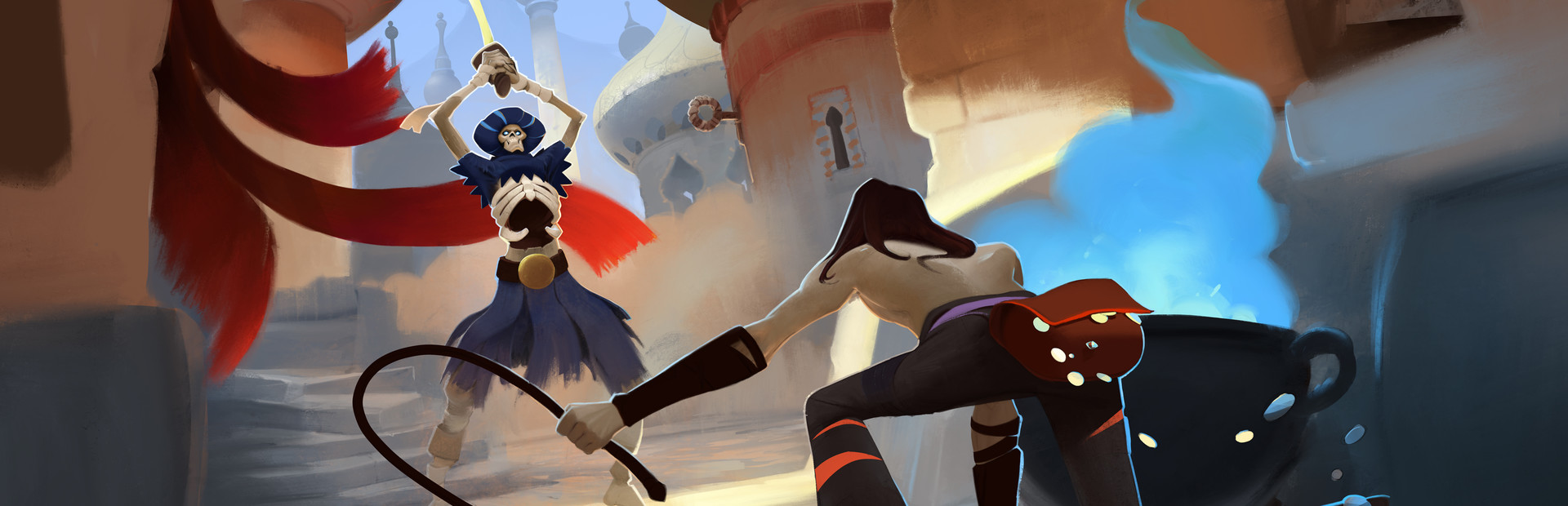
My first thought after clearing the tutorial was that nobody else is doing quite this in first-person roguelites: the whip is the whole soul of City of Brass, and it earns that distinction. Developed by a small Australian studio whose members cut their teeth on BioShock and BioShock 2, the game plants you inside a cursed Arabian Nights city as a thief with a scimitar in the right hand and a versatile whip in the left. That whip is not a gimmick. You can trip skeleton soldiers by aiming low, disarm archers by targeting their weapon hand, crack enemies in the face to stun them open for a sword follow-up, drag distant treasure toward you, pull foes into spike pits, or latch onto grapple hooks to vault over obstacles. The rhythm of reading a room, identifying the traps, then weaponizing the whole environment against the enemies crowding it is genuinely satisfying in a way that very few games in this genre reach. The structure is a procedurally generated run across twelve levels divided into four visual districts: a desert city, overgrown ruins, an opulent palace quarter, and underground catacombs. Each run takes roughly forty minutes to an hour if things go well. Boss encounters punctuate the mid-game and closing act, and scattered genie merchants let you spend collected treasure on upgrades like fire-enchanted whips, alternate melee weapons, health bonuses, and a ghostly companion that fights alongside you. A Blessings system (the game's modifier suite) lets you dial difficulty up or down before each run, disabling the countdown timer, reducing enemy count, or expanding your health pool if the punishing default difficulty is too steep. Using Blessings gates you off some leaderboard categories but not others, which is a reasonable compromise. There is also a cross-run progression layer: each failed run earns XP that unlocks new items and playable characters, including the Revenant, a crossbow-wielding alternative to the default thief. Where City of Brass stumbles is in content variety, and that friction is real enough to matter. The enemy roster is dominated by skeleton soldiers in varying states of armor, with only a handful of distinctly different types appearing in the back half. The four visual districts look genuinely handsome on first encounter, but the modular procedural generation means that textures and set-piece props begin blurring together well before you reach the end of a run. The Arabian Nights audio design, all oud strings and flute motifs, fits the aesthetic with care, but the tracks loop and repeat in ways that undermine the atmosphere they are trying to build. The item shop interface is clunky, and weapon comparisons offer no numerical values, which makes upgrade decisions feel murkier than they should. These are real complaints, and they explain why critical reception landed in that mid-60s-to-70s range across outlets. For the audience this is actually aimed at, the issues soften considerably. If you are the sort of player who pulls five or ten runs out of a roguelite before deciding whether it has legs, City of Brass will give you a tightly crafted window of genuine pleasure. The whip combat alone is inventive enough to carry the early hours, and the Blessings accessibility options mean the difficulty wall is negotiable rather than a hard stop. It is not a long-haul obsession like Hades or Dead Cells, and it would be dishonest to frame it as one. But for a few evenings of creative first-person trap-manipulation in a setting that almost no other game has thought to explore, it pays off more than its average review scores imply.

Indie & narrative
Tags
System Requirements
Minimum
- OS
- Windows 7 64Bit
- Memory
- 4 GB RAM
- DirectX
- Version 11
- Storage
- 4 GB available space
- Graphics
- GeForce GTX 550 or Equivalent card
- Processor
- Dual Core 2.4+ GHz
Recommended
- OS
- Windows 10 64bit
- Memory
- 8 GB RAM
- DirectX
- Version 12
- Storage
- 4 GB available space
- Graphics
- GeForce GTX 770 or Equivalent card
- Processor
- Intel i7 2.5 GHz
Keep exploring
Community Discussion
Be the first to comment on City of Brass.
Reviews & Ratings
Game Info
- Developer
- Uppercut Games Pty Ltd
- Publisher
- Uppercut Games Pty Ltd
- Release Date
- May 4, 2018