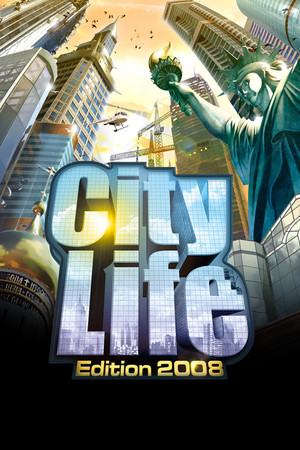
City Life 2008
Forget zoning budgets for a minute: this city builder makes you manage six warring social classes, and one bad neighborhood placement can torch your whole district.
GamerScout Verdict
Best entry point for newcomers to the series; veterans of earlier City Life editions will find too little new to justify the revisit.
Compare Prices(6 stores)
Every store in this table quotes us in euros, so the EUR figure is the price the seller actually set, not our arithmetic — which is why EUR is also the currency we rank in. We only list an offer here when the store gives us its price in euros, so nothing in this table is a number we invented.
Pick USD, PLN, GBP, CAD or AUD in the header and we convert from EUR at the European Central Bank reference rate — converted amounts are prefixed with ~. Your bank or the store may apply a different rate at checkout. We never hide offers based on where you are: everyone sees this whole table.
We may earn a commission when you buy games through links on this page — at no extra cost to you. It never affects our rankings or verdicts.
Price History
Screenshots & Media
About City Life 2008
I've spent time with a lot of city builders, and most of them want you to think about roads and tax rates. City Life 2008 wants you to think about whether your Elites can tolerate living within three blocks of Have-Nots, and what happens when Radical Chics move into a Blue Collar district. Spoiler: it ends in riots and burning cars. That single design decision, baking active class conflict into the core simulation loop, is what separates this game from the SimCity-adjacent crowd and makes it worth understanding on its own terms. The mechanics work like this: six distinct subcultures, Elites, Suits, Blue Collars, Have-Nots, Fringes, and Radical Chics, each tolerate two other groups and actively despise three. Every subculture has its own housing stock, commercial buildings, and a set of eight needs covering work, shopping, health, safety, education, leisure, quality of life, and neighborhood composition. Buildings unlock progressively as population and financial benchmarks are hit, so early cities start with a working-class spine of Blue Collars and Have-Nots before the wealthier strata become viable. The economy itself is deliberately streamlined: revenue-generating buildings tax their workers and feed the city coffers, while services like hospitals and police stations are pure costs. Surplus power can be sold for profit, making a well-placed power station one of the strongest early-game moves. It is a lighter financial model than Paradox-era grand strategy, but that accessibility is a deliberate choice, not laziness. The tension lives in the social layer, not the spreadsheet. The 2008 Edition is the definitive compilation of everything Monte Cristo released for this franchise, folding in the World Edition content and adding 23 new terrain maps, over 60 new buildings totaling 360 in the catalogue, landmarks like London's Royal Opera House and St. Paul's Cathedral, and a satellite map import tool that lets modders build cities around real-world geography. The full-3D engine supports 360-degree camera rotation and a street-level walk mode, which is genuinely impressive for a 2008 city builder. Up close, however, the pedestrian models are blocky and textures go low-resolution fast, so resist the urge to stay zoomed in. Your optimal play perspective is the mid-level isometric view, where the city reads cleanly and the social tension visualizations do their job. The weaknesses are real and worth flagging. The scenario mode, while expanded, leans on bronze-silver-gold population and income targets rather than anything historically grounded or narratively interesting. Maps within the campaign recycle geographical templates, so the sense of fresh challenge per scenario is thin. The finance model, praised by casual players, frustrates anyone who wants to fine-tune tax rates or model genuine economic downturns. There are also reported stability issues on modern Windows, including frame drops and screen artifacts, so check community workaround threads before committing. No mod ecosystem to speak of either, which hurts long-term replay depth compared to what Cities: Skylines built a decade later. For a newcomer to the series, though, this is the correct entry point: all prior content is included, free-mode and scenario mode both ship in the same package, and the class-conflict mechanic is one of the more genuinely original ideas in the city-builder genre. Experienced city sim players who have already logged time with the original 2006 release or the World Edition will find the delta small. But if the subculture tension loop is new to you, and you want a city builder with a different kind of strategic puzzle at its center, City Life 2008 delivers a premise that Cities: Skylines never really attempted.

Strategy & simulation
Tags
System Requirements
Minimum
- Sound
- Sound Card compatible with Direct X® 9
- Memory
- 256 MB RAM
- Graphics
- DirectX® 9.0c compatible 64 MB 3D graphic card (GeForce 4Ti or Radeon 8000)
- Processor
- 1.5 GHz Processor or the equivalent
- Hard Drive
- 4.5 GB free space
- Supported OS
- Windows 2000 with Service Pack 2/XP/Vista
- DirectX® Version
- DirectX® 9.0c or better
Keep exploring
Community Discussion
Be the first to comment on City Life 2008.
Reviews & Ratings
Game Info
- Developer
- Monte Cristo
- Publisher
- Focus Entertainment
- Release Date
- Sep 29, 2008