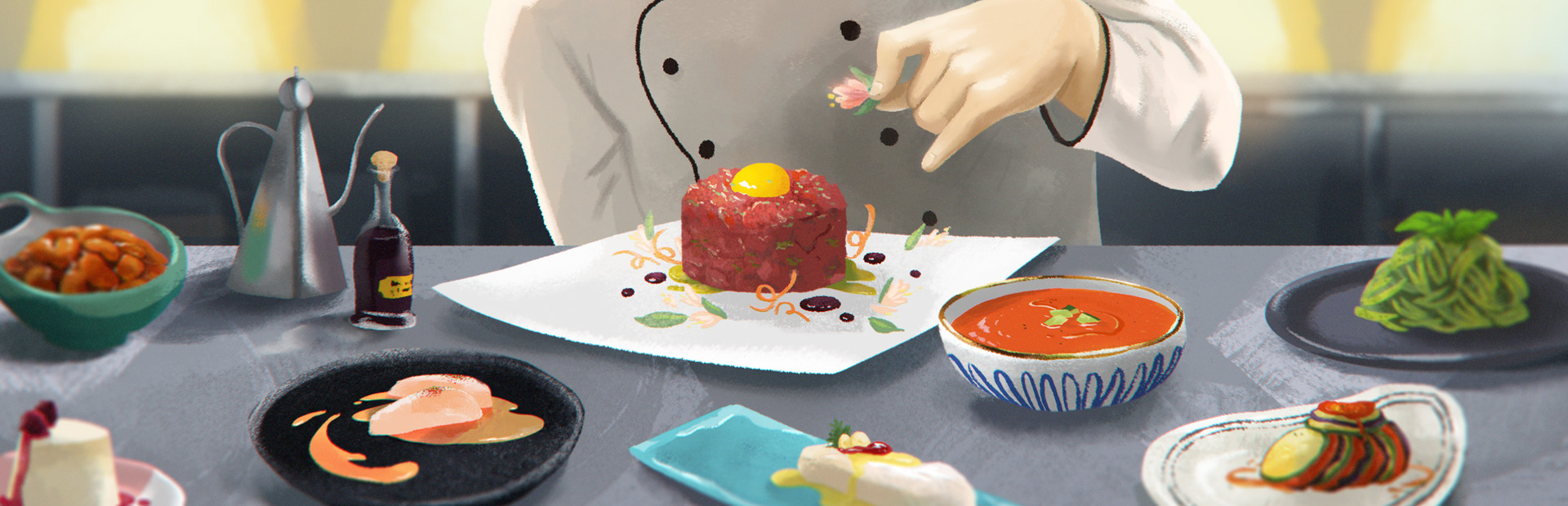

Chef: A Restaurant Tycoon Game
More restaurant sim than tycoon, this one rewards players who treat staff specialization and menu composition like an optimization puzzle rather than a casual toy.
GamerScout Verdict
Worth it for sim players who treat ingredient balancing as an optimization puzzle, not for those expecting a polished tycoon sandbox.
Compare Prices(5 stores)
Every store in this table quotes us in euros, so the EUR figure is the price the seller actually set, not our arithmetic — which is why EUR is also the currency we rank in. We only list an offer here when the store gives us its price in euros, so nothing in this table is a number we invented.
Pick USD, PLN, GBP, CAD or AUD in the header and we convert from EUR at the European Central Bank reference rate — converted amounts are prefixed with ~. Your bank or the store may apply a different rate at checkout. We never hide offers based on where you are: everyone sees this whole table.
We may earn a commission when you buy games through links on this page — at no extra cost to you. It never affects our rankings or verdicts.
Price History
Screenshots & Media
About Chef: A Restaurant Tycoon Game
My first instinct when loading this up was to treat it like a classic tycoon game and go wide fast, multiple venues, maxed headcount, aggressive expansion. That instinct will get you bankrupt inside five hours. Chef operates more like a focused management sim where every early-game decision compounds, and players who read the systems before they spend will find a surprisingly layered experience hiding behind a modest indie presentation. The mechanical core that actually holds up is the recipe editor. Rather than pulling pre-built dishes off a list, you construct your menu from over 30 dish templates, balancing five basic taste and aroma axes per recipe so that the final product rates well when customer palates are simulated. Get the balance wrong and your food quality score tanks, and since customers grade your venue on Service, Food Quality, Price, and Atmosphere independently before averaging the result, one weak pillar quietly kills your reputation star-by-star. It is a tighter feedback loop than it first appears, and the players who lean into ingredient theory rather than just unlocking the prettiest wallpaper tend to stick around longest. The staff system is the other place where genuine depth lives. Every employee accumulates experience on the job, and you can assign them to narrow specializations, so a chef leveled into main dishes works faster and produces higher quality output than a generalist covering everything. The problem is that once you scale to multiple concurrent staff across a second venue, tracking individual skill loadouts becomes genuinely fiddly, as the relevant stats only surface in a character screen that is not accessible during the simulation. Players who want a clean, automation-friendly mid-game may find this maddening. That friction is real, and it is the largest single complaint in community feedback. There is also a pathing and collision issue that has existed since early access: staff will occasionally clip into furniture and freeze, requiring either a save-reload cycle or firing and rehiring the affected worker. These are rough edges that should have been polished before 1.0, and the fact they persist is worth knowing going in. On the expansion side, the game shipped with three paid DLC cuisine packs covering Eastern Asian dishes, pizza and baked goods, and cocktails, so the base ingredient pool is narrower than the recipe editor makes it look until you factor in add-on content. No Steam Workshop support means modders cannot extend that pool themselves, which is a missed opportunity for a game whose whole identity is ingredient creativity. The tutorial, to its credit, is staged and readable, walking new players through the district-targeting system where your decor, pricing, and menu composition need to align with the specific social class that frequents your restaurant's neighborhood. Cheapskate districts want cheap proteins and carb-heavy dishes; premium districts punish you for the same menu. That audience-alignment mechanic is the strategic hook that keeps repeat runs interesting. For sim players willing to treat the recipe editor as the main event and accept the staff micro-management tax, there is a genuinely satisfying loop here. Go in expecting a polished tycoon sandbox and you will bounce off it. Go in expecting a number-crunching management sim with a cooking-science twist, and the hours will disappear.

Strategy & simulation
Tags
System Requirements
Minimum
- OS
- Windows Vista SP1+ (64 bit)
- Memory
- 3000 MB RAM
- DirectX
- Version 9.0c
- Storage
- 6500 MB available space
- Graphics
- NVIDIA GT 630, AMD Radeon HD6570, or equivalent
- Processor
- Intel Core 2 Duo @ 3.0GHz or AMD Athlon 64 X2 6400+ @ 3.2GHz
Recommended
- OS
- Windows 7/8/10 (64 bit)
- Memory
- 6000 MB RAM
- DirectX
- Version 12
- Storage
- 6500 MB available space
- Graphics
- NVIDIA GTX 960, AMD Radeon R9 295, or equivalent
- Processor
- Intel i7 920 @ 2.7 GHz, AMD Phenom II 945 @ 3.0 GHz
Keep exploring
Community Discussion
Be the first to comment on Chef: A Restaurant Tycoon Game.
Reviews & Ratings
No ratings available
Game Info
- Developer
- Innervoid Interactive
- Publisher
- Digital Tribe
- Release Date
- Aug 20, 2020
