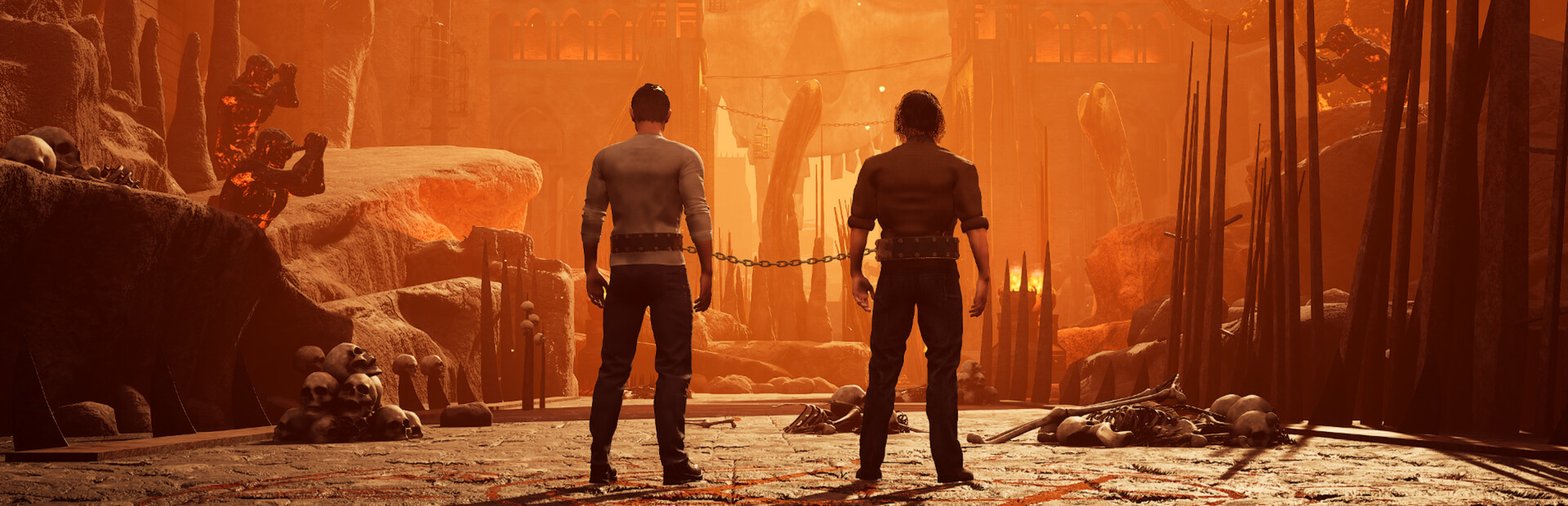

Chained Together
Proof that a single physics mechanic can carry an entire game: this Foddian co-op rage-climber weaponises your friends against you in ways Getting Over It never dared.
GamerScout Verdict
Best for groups of two to four who want a short, chaotic co-op session and can tolerate some rough-edged lobby setup.
Compare Prices(9 stores)
Every store in this table quotes us in euros, so the EUR figure is the price the seller actually set, not our arithmetic — which is why EUR is also the currency we rank in. We only list an offer here when the store gives us its price in euros, so nothing in this table is a number we invented.
Pick USD, PLN, GBP, CAD or AUD in the header and we convert from EUR at the European Central Bank reference rate — converted amounts are prefixed with ~. Your bank or the store may apply a different rate at checkout. We never hide offers based on where you are: everyone sees this whole table.
We may earn a commission when you buy games through links on this page — at no extra cost to you. It never affects our rankings or verdicts.
Price History
Screenshots & Media
About Chained Together
I don't review many games where the core design goal is to make you suffer alongside people you like, but here we are. Chained Together takes the vertical platformer formula made famous by Getting Over It and Only Up, and grafts one savage idea on top of it: a fully simulated physical chain that tethers all players together from hell to heaven. That chain is not a cosmetic. It wraps around platforms, creates tension across geometry, lets a quick teammate yank a falling player back to safety, and, far more often, drags the entire group screaming off a ledge because one person mistimed a jump. The emergent chaos that produces is the whole product. Mechanically, the game is lean. You climb a single continuous vertical map through distinct themed worlds, working in groups of one to four. Three difficulty modes change the stakes considerably: Beginner gives you checkpoints spaced across the climb, Normal mode sends you back to the very bottom on a full fall, and Lava mode adds a constantly rising floor of lava that punishes any hesitation. The chain configuration matters too. Open Chains arrange players in a line where the lead player sets the pace, while Closed Chains link everyone in a loop, giving each person full movement control at the cost of requiring tighter coordination. Across the map you can hunt down ten collectible Wings that, once all gathered, grant a glide ability on descent, meaningfully softening the punishment of late-game falls. These are the buildable advantages this game offers, and learning to use the chain geometry as a tool rather than treat it purely as a liability is the closest thing to a skill ceiling the game has. Where the game earns its very positive Steam reception is in the social engineering it forces. Every jump is a negotiation. Someone needs to count down, someone needs to not panic, and someone inevitably does both wrong things at once. The laughter-to-frustration ratio sits right at the edge of tolerable, which is exactly where this genre needs to land. Solo play exists and runs fine, though it removes most of the chaos that makes the game memorable. The content volume is honest rather than padded: a coordinated group on Beginner can clear the main climb in three to five hours, with subsequent Normal and Lava runs providing meaningful replayability through higher stakes rather than new geometry. The Steam Workshop support that arrived post-launch is worth watching, as community maps could substantially extend the lifespan. The criticisms are real and worth stating plainly. The lobby setup and backend networking have been reported as clunky by a consistent slice of players, and first sessions sometimes take longer to get running than they should. The Unreal Engine 4 environments have a cobbled-together quality to their asset mix. There is no story worth discussing. And the difficulty curve on Normal mode is abrupt enough that players without patience for repetition will hit a wall fast. The tutorial does not do enough to explain chain physics before the map starts punishing you for not understanding them. If you are looking for a system to optimise or a late-game economy to manage, this is clearly not the purchase for you. But as a low-barrier co-op session game that generates genuine shared moments, it punches well above the weight of its price point and its simple premise. The chain mechanic is a better cooperative design idea than most full-budget games ship with.

Strategy & simulation
Tags
System Requirements
Minimum
- OS
- Windows 8/10/11 (64-Bit)
- Memory
- 8 GB RAM
- Storage
- 8 GB available space
- Graphics
- NVIDIA GeForce GTX 1650 or equivalent
- Processor
- Intel Core i5-6600@ 3.1 GHz or AMD R5 1600X @ 3.5 GHz or equivalent
Recommended
- OS
- Windows 8/10/11 (64-Bit)
- Memory
- 16 GB RAM
- Storage
- 8 GB available space
- Graphics
- NVIDIA GeForce RTX 3060 or equivalent
- Processor
- Intel Core i5 10400 3.1 GHz or AMD Ryzen 5 2600x 3.1 GHz
Keep exploring
Community Discussion
Be the first to comment on Chained Together.
Reviews & Ratings
No ratings available
Game Info
- Developer
- Anegar Games
- Publisher
- Secret Mode
- Release Date
- Jun 19, 2024


