
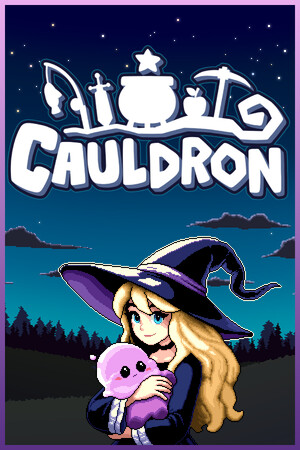
Cauldron
Upgrade trees so deep they loop back around, minigames that mutate into something unrecognisable by hour three, and a 92% Steam rating that a solo developer earned entirely on gameplay feel. Worth a serious look.
GamerScout Verdict
Solid buy for fans of incremental games who want their idle loop to feel mechanically earned rather than just cosmetically busy.
Compare Prices(8 stores)
Every store in this table quotes us in euros, so the EUR figure is the price the seller actually set, not our arithmetic — which is why EUR is also the currency we rank in. We only list an offer here when the store gives us its price in euros, so nothing in this table is a number we invented.
Pick USD, PLN, GBP, CAD or AUD in the header and we convert from EUR at the European Central Bank reference rate — converted amounts are prefixed with ~. Your bank or the store may apply a different rate at checkout. We never hide offers based on where you are: everyone sees this whole table.
We may earn a commission when you buy games through links on this page — at no extra cost to you. It never affects our rankings or verdicts.
Price History
Screenshots & Media
About Cauldron
My usual instinct when a game pitches itself as an idle-RPG hybrid is to assume one half exists purely to dress up the other. Cauldron, built solo by Peter Regg under the SleepyDad Games banner, earns some real credit by refusing that trade-off: the minigames here are the levelling system, full stop, and that single design decision does a lot of heavy lifting. The setup puts you in control of Nyx, a novice witch who wakes to a fog-covered grid-map. Every dark square hiding an enemy fight is also a lock on new territory, new party members, and new minigames. The minigames themselves, think apple-catching that starts trivial and eventually tilts toward bullet-hell territory, fishing where you track blue fish while dodging red ones, mining, ice-breaking, cover five resource types that feed directly back into a Cauldron upgrade tree. Your five best personal scores in each minigame set the rate at which idle auto-collection ticks up while you are away. The strategic implication is real: investing in a minigame upgrade to increase apple yield is not flavour, it is the economy behind your party's Talent Point budget. That tight coupling between active play and passive accumulation is the reason the community keeps running it up past 100-hour play sessions. The combat layer is turn-based and auto-battlable from Mode 2 onward, which is the right call because fights get slow without it. What does matter in combat is party composition across 20-plus heroes, each with individual skill trees, and the Talent Points you pour into damage, defense, and stamina. Defense type resistances are poorly explained and several reviewers have flagged this specifically: you will hit a wall, feel stuck, then discover you were ignoring an elemental resist chart buried in a sub-menu. Beyond Standard mode the game opens Tougher Enemies (double HP, cheaper Cauldron upgrades), Pacifist, Idle, Double Trouble (doubled enemy waves, two items per hero), and Evil (four items per hero, harder stat scaling), which is a genuine progression of challenge rather than a cosmetic difficulty toggle. Spirit Points earned from biome village challenges let you stack permanent party-wide buffs, and that is where the late-game optimisation that fans of incremental games will recognise starts to feel satisfying rather than rote. The weaknesses are real and worth naming. Burnout is a documented risk: the core minigame loop does not radically diversify even as the numbers scale exponentially, and players who do not connect with one or two of the minigame types will feel friction repeatedly. The idle mode requires the game to keep running rather than functioning as a true offline accumulator, so this is not a close-the-client-and-come-back-tomorrow experience. The story, such as it is, wraps up in a few hours with fourth-wall-breaking snark that charms early and wears thin if you come looking for narrative weight. The good news is that free Talent Point resets mean experimentation costs nothing, and the difficulty modifiers exist precisely to let min-maxers and casual players coexist in the same save structure. For strategy and sim players specifically, Cauldron respects the part of the brain that wants to optimise a resource flow. The feedback loop, play minigame well, score feeds idle rate, idle rate funds Talent Points, Talent Points unlock harder map squares, harder squares unlock more minigames, is tight enough that the compulsion does not feel accidental. It is a light-touch system compared to a Paradox grand-strategy, but the underlying logic is sound and the solo developer clearly iterated on it carefully before shipping. The 92% positive rating across over 1,500 Steam reviews reflects a game that delivers on its stated promise rather than a viral fluke.

Strategy & simulation
Tags
System Requirements
Minimum
- OS
- Windows Vista or greater
- Memory
- 4 GB RAM
- DirectX
- Version 10
- Storage
- 200 MB available space
- Graphics
- 256 mb video memory, shader model 3.0+
- Processor
- 2 Ghz
Keep exploring
Community Discussion
Be the first to comment on Cauldron.
Reviews & Ratings
No ratings available
Game Info
- Developer
- SleepyDad Games
- Publisher
- Caketown Interactive
- Release Date
- May 21, 2025