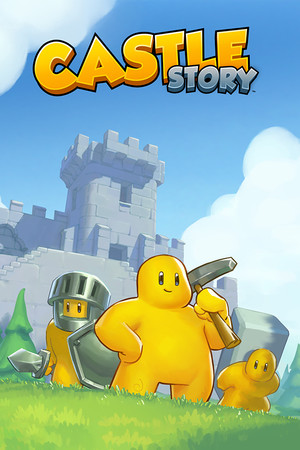
Castle Story
A colony-sim RTS that asks you to build, mine, and fortify floating voxel islands while fending off waves of Corruptrons - charming concept, uneven execution, but genuinely rewarding once it clicks.
GamerScout Verdict
Best for patient builder-strategists who can push past a rough tutorial to find the genuine structural physics and wave defense underneath.
Compare Prices(5 stores)
Every store in this table quotes us in euros, so the EUR figure is the price the seller actually set, not our arithmetic — which is why EUR is also the currency we rank in. We only list an offer here when the store gives us its price in euros, so nothing in this table is a number we invented.
Pick USD, PLN, GBP, CAD or AUD in the header and we convert from EUR at the European Central Bank reference rate — converted amounts are prefixed with ~. Your bank or the store may apply a different rate at checkout. We never hide offers based on where you are: everyone sees this whole table.
We may earn a commission when you buy games through links on this page — at no extra cost to you. It never affects our rankings or verdicts.
Price History
Screenshots & Media
About Castle Story
My first instinct when sitting down with Castle Story was to treat it like a lightweight RTS with a sandbox twist, something to knock around for a couple of sessions before moving on. A few hours in, I was still digging quarries into floating rock shelves and arguing with my Bricktrons about whether they should be hauling stone or standing next to a crystal getting punched by a stone golem. That friction is the whole experience in miniature: a game with real strategic bones buried under rough onboarding. The core loop puts you in charge of small squads of workers called Bricktrons. You queue up jobs - mine this vein, haul those planks, erect that wall section - and they go off to do it, in theory. Resource gathering feeds construction, construction feeds defense, and the physics engine means a poorly engineered tower will literally collapse if you mine out its foundation. That structural simulation is the single most interesting design decision in the game. Planning load-bearing walls before an enemy catapult run is a legitimately strategic problem, and it separates Castle Story from pure sandbox toys. Catapults, explosive barrels, and terrain traps round out the offensive toolkit, so the combat layer has more going on than it first appears. The trouble is getting there. The tutorial has well-documented problems: in-game text that does not pause the action, UI labels that contradict what the manual calls the same menu, and pie-menu nested inside pie-menu navigation that can genuinely obscure options off-screen. The worker AI compounds the issue. Bricktrons will occasionally idle near threats they should be attacking, get boxed in by their own stockpiles, or simply lose track of a task after a pathfinding hiccup. For a strategy player used to precise APM and reliable unit commands, that sloppiness is maddening in the early hours. The fix, frustratingly, is experience - once you understand the queueing system and stop over-assigning tasks, the AI behaves far more predictably. It rewards micromanagement literacy rather than punishing its absence gracefully. Mode variety helps with longevity. Survival tasks you with protecting a home crystal across escalating Corruptron waves, which applies enough pressure to make every build decision feel consequential. Sandbox strips the pressure entirely for pure construction. The multiplayer side adds a Conquest PvP mode and a Co-op Invasion mode, both of which benefit from cross-platform support across PC, Mac, and Linux. The Steam Workshop keeps a steady trickle of community maps flowing in, which matters for a title whose developer has since wound down active operations. Post-launch patches are no longer arriving, so what you see is what you get. Community-made maps do carry a performance caveat on larger builds, worth knowing before you load a 500-hour megalith someone uploaded. For a strategy player weighing the decision: the depth here is real but shallow-rooted. It does not have the systemic complexity of a full colony sim, nor the tight RTS pacing of a competitive title. What it offers is a specific, tactile pleasure - watching a wall you designed brick by brick hold a wave back because you thought ahead about choke points and catapult arcs. The overall Steam reception sits in Mixed territory at 55 percent positive across several thousand reviews, which is an honest signal. The game does things no other title does in quite this way, and at its price point the ceiling for disappointment is low. Approach it as a patient builder who enjoys iterative problem-solving, not as someone looking for a polished RTS experience with reliable AI.

Strategy & simulation
Tags
System Requirements
Minimum
- OS
- 7 and newer, 64-bit
- Memory
- 6 GB RAM
- DirectX
- Version 11
- Storage
- 1700 MB available space
- Graphics
- nVidia GeForce 440 512MB, Radeon HD 4450 512MB, Intel HD 3000
- Processor
- Intel or AMD Dual-Core, 2.2 GHz+
Recommended
- OS
- 7 and newer, 64-bit
- Memory
- 8 GB RAM
- DirectX
- Version 11
- Storage
- 1700 MB available space
- Graphics
- nVidia GeForce 660 1024MB or better, AMD Radeon HD 7790 1024MB or better
- Processor
- Intel or AMD Quad-Core, 2.8 GHz+
Keep exploring
Community Discussion
Be the first to comment on Castle Story.
Reviews & Ratings
No ratings available
Game Info
- Developer
- Sauropod Studio
- Publisher
- Sauropod Studio
- Release Date
- Aug 17, 2017