
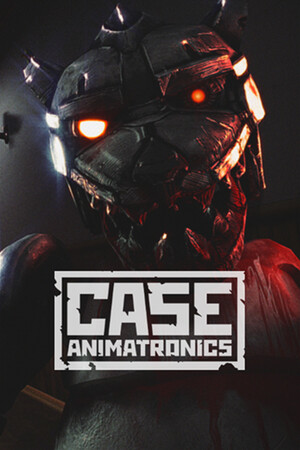
CASE: Animatronics
Survive one night in a pitch-dark police station with three very different killer robots on your tail - if the inconsistent AI and skeleton-thin runtime don't chase you off first.
GamerScout Verdict
Worth a discounted run for short-horror fans who can stomach janky AI and a one-to-two hour ceiling with zero epilogue.
Compare Prices(5 stores)
Every store in this table quotes us in euros, so the EUR figure is the price the seller actually set, not our arithmetic — which is why EUR is also the currency we rank in. We only list an offer here when the store gives us its price in euros, so nothing in this table is a number we invented.
Pick USD, PLN, GBP, CAD or AUD in the header and we convert from EUR at the European Central Bank reference rate — converted amounts are prefixed with ~. Your bank or the store may apply a different rate at checkout. We never hide offers based on where you are: everyone sees this whole table.
We may earn a commission when you buy games through links on this page — at no extra cost to you. It never affects our rankings or verdicts.
Price History
Screenshots & Media
About CASE: Animatronics
I went into CASE: Animatronics genuinely curious about its core pitch: take the static camera-room formula that Five Nights at Freddy's popularized and stretch it into a fully free-roaming first-person stealth game. That is a legitimate design idea, and the developers at Walnut LLC knew it - internal dev notes cite Outlast, Alien Isolation, and Amnesia as structural references, with the animatronic hook layered on top. The ambition is there. The execution, unfortunately, keeps tripping over itself. You play as Detective John Bishop, trapped overnight in his own police department after a hacker named Scott remotely kills the power and locks every exit. Your only tools are a flashlight and a tablet that lets you check security camera feeds. The tablet mechanic is the game's most interesting system: you can carry it passively in your off-hand while exploring hallways, or zoom it to full-screen to track enemy positions across the building. Managing its battery life and finding charging stations adds a small but real layer of tension to every room transition. The three animatronics - Wolf, Cat, and Owl - each operate on distinct logic. The Wolf patrols openly and reacts to your flashlight beam; the Cat crawls through ventilation shafts and drops from ceilings; the Owl does not move at all until you look away, pulling directly from the SCP-173 playbook. On paper that is a solid trio of threat archetypes. In practice, the camera system is unreliable enough that you will occasionally watch a clear hallway on the tablet while a hulking robot is already standing in it. The difficulty curve is the game's biggest practical problem. Checkpoints are placed before unskippable dialogue cutscenes, so every death sends you through the same voice lines again. The voice acting itself is, charitably, a product of a small indie budget - unintentionally funny in spots, immersion-breaking in others. The AI swings wildly between passive and omniscient with no clear tell for which mode you are in on a given run. Players who enjoy working out enemy patrol patterns through repetition will find something to chew on; everyone else will hit a wall fast and quit. The overall runtime sits somewhere between one and two hours depending on RNG keycard spawns and which animatronic the game decides to send after you - that is genuinely short even for the horror genre. The atmosphere deserves some credit. Flickering lighting, directional audio cues from clanking metal joints, and the visual design of the animatronics themselves - particularly the Cat, with its missing eye and vent-crawling silhouette - create genuine dread during the early sections before you learn the layout. The hiding mechanic, which lets you crouch inside lockers and under desks, works cleanly and gives you an actual exhale moment when a robot stomps past. Steam's all-time review aggregate sits in mixed territory overall, though more recent reviews skew notably more positive, suggesting the game has found its audience among fans of short, punishing horror experiences who know what they are buying. For anyone expecting a full horror adventure with branching objectives or meaningful story payoff, the ending is going to land like a hard cut to a logo screen - because that is exactly what it is. No resolution, no epilogue. If you are a horror completionist hunting a short, cheap fright with a gimmick that almost works, CASE: Animatronics delivers enough scares to justify a discounted session. Just do not expect the depth of its inspirations.

Strategy & simulation
Tags
System Requirements
Minimum
- OS
- Windows 7
- Memory
- 512 MB RAM
- DirectX
- Version 10
- Storage
- 1 GB available space
- Graphics
- NVIDIA GeForce GTX 560 1GB / Radeon R7 250X 1GB
- Processor
- Intel Core2 Quad Q8400
Recommended
- OS
- Windows 7
- Memory
- 2 GB RAM
- DirectX
- Version 10
- Storage
- 2 GB available space
- Graphics
- NVIDIA GeForce GTX 660 Ti 2GB
- Processor
- Intel Core i5 3470
Keep exploring
Community Discussion
Be the first to comment on CASE: Animatronics.
Reviews & Ratings
No ratings available
Game Info
- Developer
- Walnut LLC
- Publisher
- Walnut LLC
- Release Date
- Aug 3, 2016