
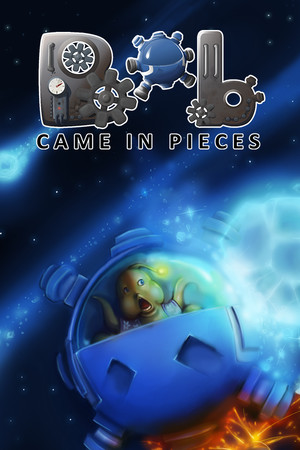
Bob Came in Pieces
A short, wholesome physics puzzler where rebuilding your ship IS the puzzle - clever for a lazy afternoon, but don't expect it to last the weekend.
GamerScout Verdict
Best for casual puzzle fans who enjoy tinkering with builds, but expect a 3-4 hour ride, not a marathon.
Compare Prices(4 stores)
Every store in this table quotes us in euros, so the EUR figure is the price the seller actually set, not our arithmetic — which is why EUR is also the currency we rank in. We only list an offer here when the store gives us its price in euros, so nothing in this table is a number we invented.
Pick USD, PLN, GBP, CAD or AUD in the header and we convert from EUR at the European Central Bank reference rate — converted amounts are prefixed with ~. Your bank or the store may apply a different rate at checkout. We never hide offers based on where you are: everyone sees this whole table.
We may earn a commission when you buy games through links on this page — at no extra cost to you. It never affects our rankings or verdicts.
Price History
Screenshots & Media
About Bob Came in Pieces
I have a soft spot for the kind of game that asks almost nothing of you narratively and then quietly earns your respect through pure mechanical honesty. Bob Came in Pieces is exactly that. Swedish indie studio Ludosity's debut release puts you in the cockpit of a blob-like alien office worker whose spaceship has been scattered across a strange planet. The framing is deliberately slight - dry intercom messages, a few in-engine cutscenes - and it works precisely because it never pretends to be more than a frame for the puzzles underneath. The core loop is modular in a genuinely interesting way. At configuration pads scattered through each of the game's 14 chapters, you open the Ship Builder and rearrange your vessel using the pieces you've collected: thrusters, push-pull beams, tube extensions, and grabber tools that can be rotated, repositioned, and assigned to custom controls. Weight and balance matter. A heavier, asymmetrical build is great for ramming crates aside but a nightmare for threading through narrow passages; a stripped-down, light configuration lets you dart and maneuver but won't budge heavy gates. The game rewards thinking about your ship as a tool shaped for each specific problem rather than as a fixed vehicle you pilot. Saving multiple ship layouts and swapping between them at pads adds a satisfying meta-layer - by the end you have a small library of purpose-built configurations ready to deploy. Physics puzzles involve pushing boulders, pressing switches, activating mechanisms, and reaching portals, and the variety across 14 chapters holds up well enough that the game rarely repeats itself in ways that feel lazy. There are no enemies and no death states - getting wedged in terrain sends you back to the last pad, which keeps the experience low-stress and genuinely pleasant. The soundtrack and gentle visual palette (lush jungle sections, icy caverns, blustery canyon stages) give the whole thing a quietly warm quality that reviewers at the time kept reaching for words like "adorable" to capture. That's not inaccurate. Rock, Paper, Shotgun called out "the music, the art, the gentle nature" specifically, and it still holds. The honest caveats are real, though. Average playtime data suggests most players see around three to four hours of content, and the 14-chapter structure means the experience ends just as the Ship Builder is getting fully interesting. Controller support is only partial, and some players found that loading up a heavily customized ship makes handling go from tricky to genuinely frustrating. The controls have a Lunar Lander heritage - momentum and rotation rather than direct steering - and if that style doesn't click with you early, the later chapters won't convert you. There is replay structure here in the form of silver and gold time-trial challenges on every level, with Steam leaderboards attached, so speedrunners who want to optimize ship designs for pace will find more than one playthrough's worth of material. But for everyone else, this is a compact, self-contained little thing.

Indie & narrative
Tags
System Requirements
Minimum
- OS
- Windows XP/Vista/7
- Sound
- Windows compatible sound card
- Memory
- 1GB System RAM (2GB recommended with Vista/7)
- Graphics
- 128mb video RAM and at least Shader Model 2.0
- DirectX®
- 9.0c
- Processor
- 2.4 Ghz or equivalent processor
- Hard Drive
- 500MB of free space
Keep exploring
Community Discussion
Be the first to comment on Bob Came in Pieces.
Reviews & Ratings
Game Info
- Developer
- Ludosity
- Publisher
- Ludosity
- Release Date
- Jan 22, 2010