
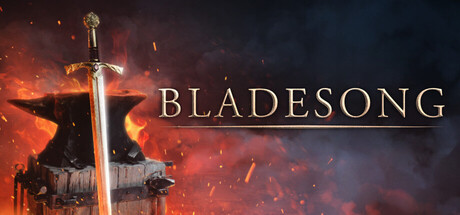
Bladesong
If you have ever wanted to obsess over blade geometry and hilt ratios instead of saving the world, Bladesong is the Early Access title that actually delivers on that promise, grimdark story included.
GamerScout Verdict
Built for players who want to obsess over blade geometry and hilt physics; go in knowing the story is text-heavy and the shop sim layer is still arriving via updates.
Compare Prices(9 stores)
Every store in this table quotes us in euros, so the EUR figure is the price the seller actually set, not our arithmetic — which is why EUR is also the currency we rank in. We only list an offer here when the store gives us its price in euros, so nothing in this table is a number we invented.
Pick USD, PLN, GBP, CAD or AUD in the header and we convert from EUR at the European Central Bank reference rate — converted amounts are prefixed with ~. Your bank or the store may apply a different rate at checkout. We never hide offers based on where you are: everyone sees this whole table.
We may earn a commission when you buy games through links on this page — at no extra cost to you. It never affects our rankings or verdicts.
Price History
Screenshots & Media
About Bladesong
I went into Bladesong expecting a shallow crafting gimmick dressed up with fantasy window-dressing. What I found instead was one of the more carefully constructed simulation loops to land in Early Access this year, built around a forge editor that genuinely earns its confidence. The freeform blade-shaping tools let you control length, width, curvature, cross-section profile, and edge geometry independently, while the modular hilt system layers pommel, grip, and guard components on top. You are balancing real physics-derived stats: a heavier blade needs counterweight at the pommel, a narrow tip trades piercing performance against overall rigidity. Customer commissions in Story Mode specify those parameters explicitly, so every order is a small optimisation puzzle. Over 150 sword parts and 30-plus materials are already in the game, covering everything from iron and leather to obsidian and bone, and the studio has confirmed twisted blades, broken fullers, and additional part-morphing options are still incoming before the 1.0 release planned for 2027. The two-mode structure is worth understanding before you decide how to approach this. Creative Mode is a pure sandbox: no commission deadlines, no economy, just the forge editor and access to the full part library. It is where the community spends most of its visible energy, sharing designs via the Magic Words export system and competing in community challenges. Story Mode wraps the same crafting loop inside a text-heavy RPG campaign set in Eren Keep, a fortress city governed by an authoritarian figure called the Masked King. You play as a broke swordsmith clawing toward entry into the city, taking commissions to earn materials and reputation while the story peels back layers of faction intrigue, missing orphans, and a resistance forming in the shadows. Chapter 2, titled The Shattered Mask, dropped in April 2026 as a free update and introduced two new factions, the Anointed and the Houndsburg League, alongside a new Replication Commissions challenge type and permanent forge upgrades. That cadence suggests SUN AND SERPENT is treating Early Access seriously rather than using it as a funding vehicle. Now for the honest part. The story delivery is almost entirely text-based. You forge a sword, then click through paragraphs of prose to advance the narrative, then forge another sword. The tonal shift between the tactile satisfaction of the editor and the static illustrated backgrounds of the story screens is jarring every single time. Reviewers across the board flagged this, and they are right to. Players who grew up on Disco Elysium-style text adventures will find the writing competent and the world-building genuinely imaginative, with lore about supernatural creatures called choristers and a pantheon of absent gods called the Voices. Players expecting the spatial immersion of wandering your own smithy, chatting up walk-in customers, or managing a visible shop floor will be disappointed by what is currently available. Those features, including a Shop Floor expansion and forge room decorations, are on the roadmap but not yet present. Control friction is also a real complaint. Some reviewers reported inconsistent click registration on interactive text commands, requiring multiple clicks to execute basic actions. That is the kind of rough edge that belongs in Early Access but should not be dismissed as minor if it interrupts the forging flow repeatedly. On the performance side, the editor itself can cause frame dips on lower-spec machines during complex shaping operations, while everything outside the forge runs on static backgrounds with minimal GPU demand. The tutorial is clear and respectful: it walks you from raw ingot to finished blade without assuming prior knowledge, and the learning curve for basic commissions is shallow enough that a newcomer can fill their first order within twenty minutes. Mastering balance ratings and intricate cross-section work takes considerably longer, which is exactly how it should be. Steam players have responded warmly, with the overall review rating sitting at Overwhelmingly Positive across over a thousand reviews. That enthusiasm reflects the genuine novelty of the premise done well rather than any forgiving grading curve. There is simply nothing else on PC right now that treats sword geometry as its primary design discipline. The Early Access roadmap is credible, the developer communication is active, and Chapter 2 proved the studio can ship meaningful content updates on a reasonable timeline. Go in knowing you are buying a sword-design engine first and a narrative RPG sim second, and the gap between expectation and reality closes considerably.

Strategy & simulation
Tags
System Requirements
Minimum
- OS
- Requires a 64-bit processor and operating system. Windows 10
- Memory
- 8 GB RAM
- DirectX
- Version 11
- Storage
- 5 GB available space
- Graphics
- NVIDIA GeForce GTX 1050 / AMD Radeon RX 580
- Processor
- Intel Core i5-7500 / AMD Ryzen 5 1600
Recommended
Requires a 64-bit processor and operating system
Keep exploring
Community Discussion
Be the first to comment on Bladesong.
Reviews & Ratings
No ratings available
Game Info
- Developer
- SUN AND SERPENT creations
- Publisher
- Mythwright
- Release Date
- Jan 22, 2026