Beyond Blue
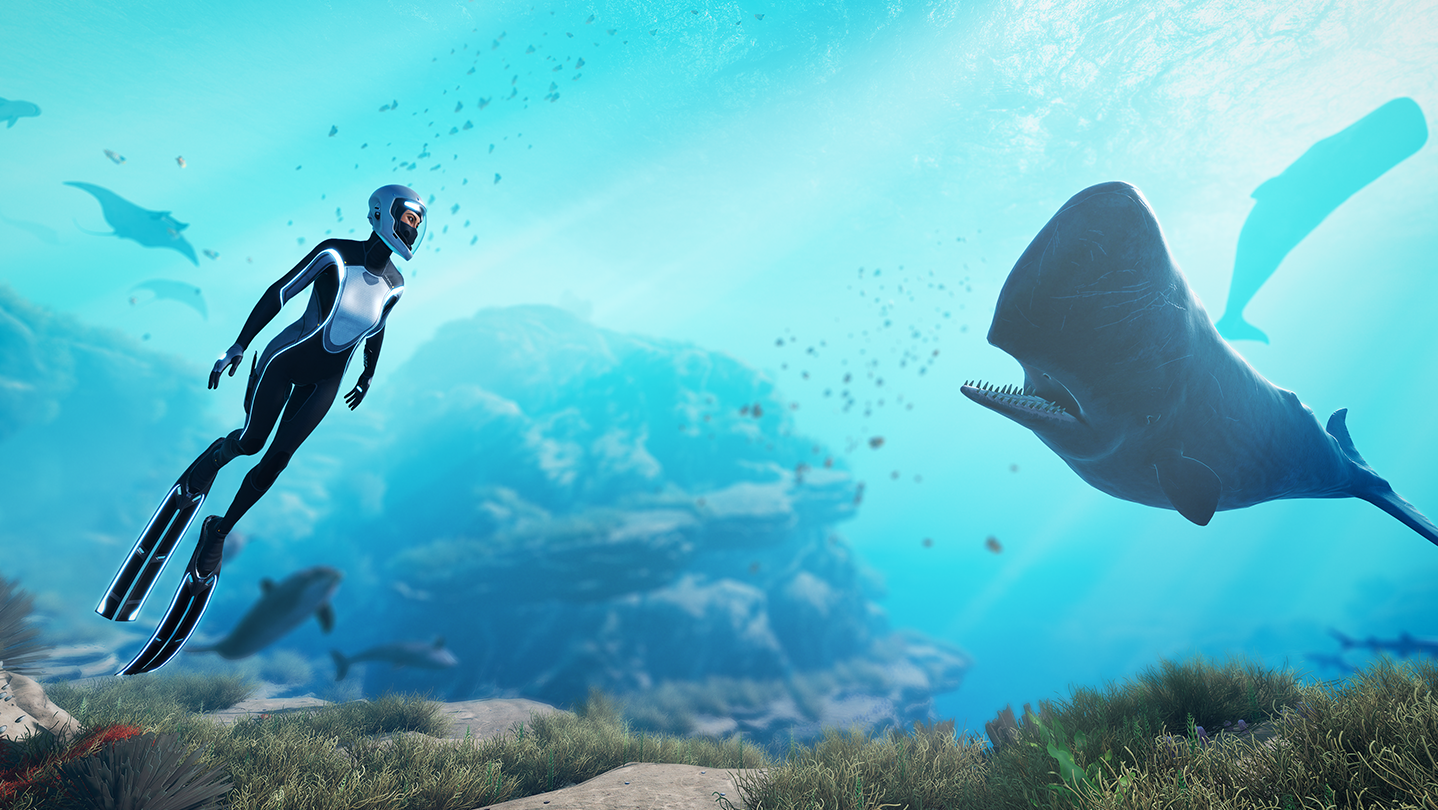
A meditative ocean exploration sim where you follow marine researcher Mirai into deep-sea environments backed by BBC Studios documentary footage. Short, pretty, and deliberately unhurried.
GamerScout Verdict
Best for players wanting a calm, visually rich ocean experience - not for anyone expecting meaningful gameplay systems or replayability.
Compare Prices(6 stores)
Every store in this table quotes us in euros, so the EUR figure is the price the seller actually set, not our arithmetic — which is why EUR is also the currency we rank in. We only list an offer here when the store gives us its price in euros, so nothing in this table is a number we invented.
Pick USD, PLN, GBP, CAD or AUD in the header and we convert from EUR at the European Central Bank reference rate — converted amounts are prefixed with ~. Your bank or the store may apply a different rate at checkout. We never hide offers based on where you are: everyone sees this whole table.
We may earn a commission when you buy games through links on this page — at no extra cost to you. It never affects our rankings or verdicts.
Price History
Screenshots & Media
About Beyond Blue
Beyond Blue is a narrative-driven ocean exploration game developed by E-Line Media, set in the near future. You play as Mirai, a marine scientist on a research crew cataloguing deep-sea life. Each dive sends you gliding through bioluminescent waters, scanning whale pods, cataloguing creatures, and piecing together a personal story told through audio logs and crew conversations. It is not a survival game, not an action game, and not a grand strategic undertaking. Call it an interactive documentary with light puzzle scaffolding, because that is the most accurate description. From a systems perspective, there is not a lot here to unpack. You have a dive propulsion tool, a scanning mechanic, and a ping sonar to locate tagged animals. The loop is: descend, explore, scan creatures to unlock educational entries, resurface, watch a short BBC Studios ocean clip, repeat. The BBC partnership is the headline feature, and honestly it delivers. The footage is stunning and the narration is authoritative. For a strategy-and-sim player used to dense decision trees, the gameplay itself will feel thin, but that is a deliberate design choice rather than an oversight. E-Line pitched this as an educational experience first, game second. The depth-of-decision-making question that normally drives my recommendations is answered quickly here: there is almost none. You cannot fail a dive, resources are not tracked in any meaningful way, and creature encounters do not branch. Where Beyond Blue succeeds is in environmental storytelling and audio design. The sound mix for the deep ocean sequences is genuinely impressive, and the whale encounter set pieces are the kind of thing you remember weeks later. If you care about world-building through environmental craft rather than mechanical complexity, the game earns its runtime. What does not work as well is pacing and scope. The main campaign runs roughly three to four hours depending on how thoroughly you scan the ocean floor. For a game presenting itself as exploration, the playable zones are fairly contained and linear. There is no open-world sandbox, no procedural generation, and no mod ecosystem to extend replayability. The AI governing creature movement is serviceable as spectacle but not sophisticated in any behavioral sense. Once the credits roll there is minimal reason to return unless you missed a few collectible scan entries. The Metacritic score sitting at 72 reflects exactly this split: critics respected the presentation, questioned the substance. Who should pick this up? Genuinely, it is a strong recommendation for players who need a low-stress decompression experience between heavier titles, for marine biology enthusiasts who want something interactive alongside a documentary binge, and for younger or newer players who find traditional game mechanics intimidating. The absence of fail states and the gentle pacing make it approachable in a way most games in any genre are not. For core sim players expecting depth commensurate with the ocean setting, manage expectations accordingly. Think of it as a very polished museum exhibit you can move through at your own speed, rather than a simulator that models the ecology of the sea.

Strategy & simulation
Tags
System Requirements
Minimum
- Processor
- Intel Core i5-4460 / AMD FX-6300 @ 3.5 GHz or equivalent
- Memory
- 4 GB RAM
- Graphics
- NVIDIA GeForce GTX 670 or AMD R9 270 (2GB VRAM with Shader Model 5.0 or better)
- DirectX
- Version 11 S…
Recommended
Requires a 64-bit processor and operating system
Keep exploring
Community Discussion
Be the first to comment on Beyond Blue.
Reviews & Ratings
Game Info
- Developer
- E-Line Media
- Publisher
- E-Line Media
- Release Date
- Jun 11, 2020