
Beat Hazard
A twin-stick arcade shooter that procedurally generates its levels from your own music library. Your playlist is the game.
GamerScout Verdict
Best for score-chasers with a decent music library who want a short, intense session that rewards dynamic audio.
Compare Prices(6 stores)
Every store in this table quotes us in euros, so the EUR figure is the price the seller actually set, not our arithmetic — which is why EUR is also the currency we rank in. We only list an offer here when the store gives us its price in euros, so nothing in this table is a number we invented.
Pick USD, PLN, GBP, CAD or AUD in the header and we convert from EUR at the European Central Bank reference rate — converted amounts are prefixed with ~. Your bank or the store may apply a different rate at checkout. We never hide offers based on where you are: everyone sees this whole table.
We may earn a commission when you buy games through links on this page — at no extra cost to you. It never affects our rankings or verdicts.
Price History
Screenshots & Media
About Beat Hazard
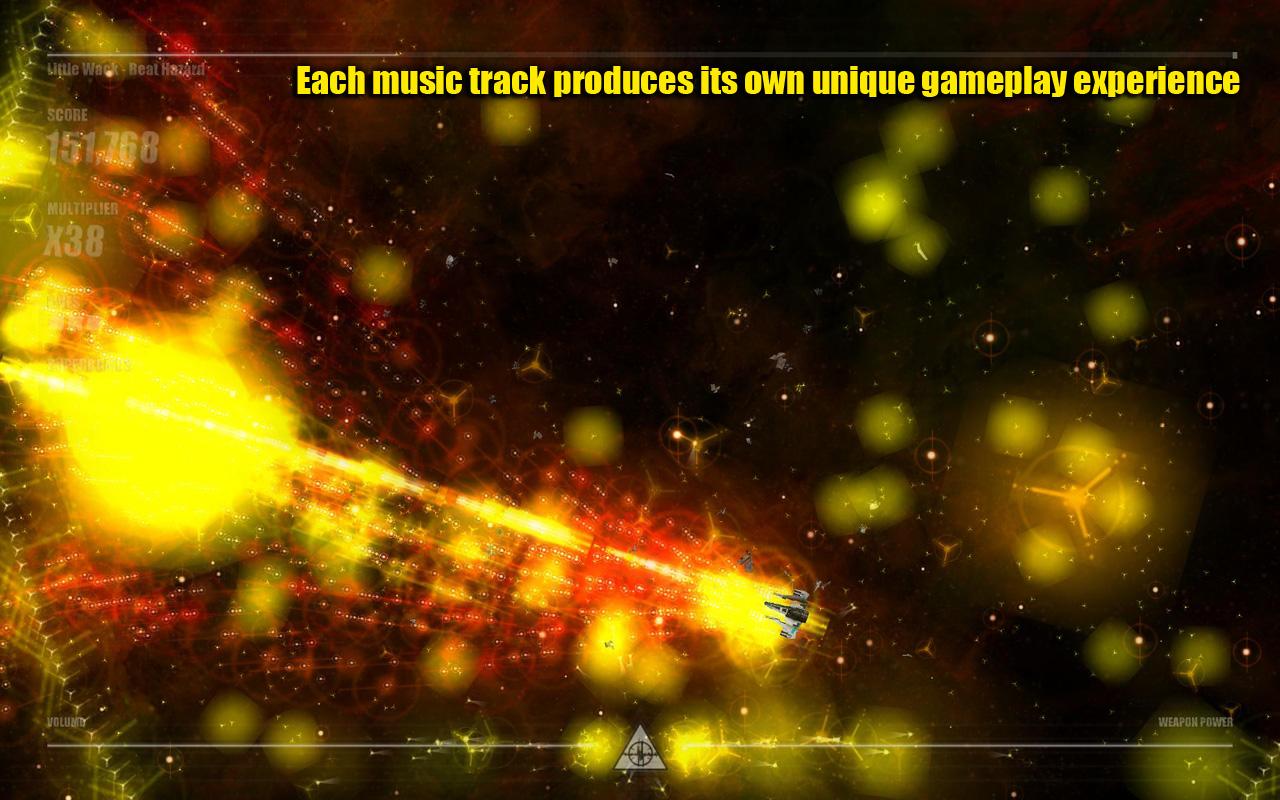
Beat Hazard is a twin-stick space shooter from Cold Beam Games, a one-person studio, released in 2010 and still sitting at 95% positive on Steam after more than seven thousand reviews. That number is not an accident. The core idea is beautifully simple: you feed it your local music files, and the game builds an enemy wave, a boss structure, and a light show around whatever the audio is doing at that exact moment. A quiet acoustic intro means sparse, manageable threats. A bass drop means the screen fills with chaos and the bloom effects push your monitor toward self-immolation. The shooting itself is classic arcade fare. You pilot a small ship, enemies spiral in from the edges, and you dodge and fire in all directions. There are power-ups that amplify your weapon and your score multiplier, and the visual intensity scales with those pickups until the whole screen becomes a strobing, saturated mess that is somehow still readable. It is genuinely hard to explain how Cold Beam pulled off that balance. The game feels punishing at high difficulty settings and generous enough at lower ones that newcomers can just enjoy the spectacle. A perks system carries progress between sessions, slowly unlocking passive bonuses that make your ship more survivable over time. Where Beat Hazard earns its reputation is in the way it makes you hear your own music differently. You will put on a song you have heard five hundred times and suddenly notice the sub-bass kick that floods the arena with enemies, or the bridge where the track goes quiet and the game gives you three seconds of eerie, almost meditative emptiness before the chorus detonates. It is a genuinely good trick. The procedural interpretation is not perfect, and very sparse or very lo-fi recordings can produce anticlimactic sessions, but most tracks with dynamic range translate into something worth playing through. The soundtrack mode also supports streaming services via the Cold Beam plugin system, which extends the library considerably beyond local files. The weaknesses are real. Visually, the bloom and color saturation are relentless, and while there is a photosensitivity warning, light-sensitive players should treat that warning as an absolute barrier rather than a gentle advisory. The enemy variety is limited across long sessions, and once you understand the handful of formation types the game throws at you, the strategic layer flattens out. This was never designed as a deep mechanical experience. It is a mood toy, a score-chaser, and an excuse to sit with your music and let it do something physical to a game world. On those terms it holds up remarkably well for a title this old. For what it is, a hand-built indie project that took a single clever concept and executed it with care and obvious love, Beat Hazard deserves the attention it still gets. If you have a local music library with real dynamic range, if you want something that respects a ten-minute session as much as a two-hour one, and if you have any nostalgia for the era of arcade shooters that rewarded pattern recognition over elaborate storylines, this one will not waste your time.

Indie & narrative
Tags
System Requirements
Minimum
- Processor
- 2.0GHz processor
- Memory
- 512+MB of RAM Hard Drive: 40+MB of free hard drive space
- Graphics
- 256MB of video memory Sound: DirectX-compatible sound DirectX®: 9 or later
DLC & Add-ons for Beat Hazard3
Expansions, DLC packs and add-on content for this game. Click any item to see store offers.
Keep exploring
Community Discussion
Be the first to comment on Beat Hazard.
Reviews & Ratings
Game Info
- Developer
- Cold Beam Games
- Publisher
- Cold Beam Games
- Release Date
- Apr 15, 2010