
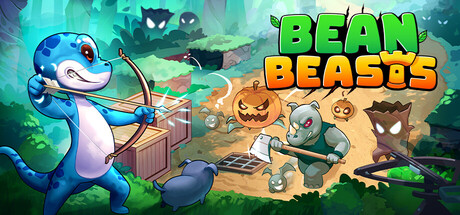
Bean Beasts
Tower defense with a creature-collector twist: 10 evolving companions, 12 trap types, five elemental damage categories, and boss fights that will punish any loadout you didn't think through.
GamerScout Verdict
Ideal for tower defense fans who want creature-collector depth; the boss difficulty spikes and unlock gating are real but survivable with the right loadout prep.
Compare Prices(3 stores)
Every store in this table quotes us in euros, so the EUR figure is the price the seller actually set, not our arithmetic — which is why EUR is also the currency we rank in. We only list an offer here when the store gives us its price in euros, so nothing in this table is a number we invented.
Pick USD, PLN, GBP, CAD or AUD in the header and we convert from EUR at the European Central Bank reference rate — converted amounts are prefixed with ~. Your bank or the store may apply a different rate at checkout. We never hide offers based on where you are: everyone sees this whole table.
We may earn a commission when you buy games through links on this page — at no extra cost to you. It never affects our rankings or verdicts.
Price History
Screenshots & Media
About Bean Beasts
My internal checklist for evaluating a tower defense game runs long: does the resource economy create genuine trade-offs each wave, do units have enough mechanical identity to make roster decisions matter, and does late-game difficulty scale through smart design rather than raw stat inflation? Bean Beasts, a solo-developed indie released in August 2025, clears most of those bars and stumbles on only one of them in a way that's worth understanding before you commit. The strategic layer is busier than the pixel art lets on. You are managing two parallel economies simultaneously: an energy pool that funds crossbows, spike traps, barrier-forming boxes, and other hardware, and a separate bean currency used exclusively to deploy and level up your creature companions. Waves telegraph their pathing with arrow indicators before launch, which rewards pre-placement thinking, but enemy variety keeps that planning honest. Swift enemies outrun slow-firing cannons, box-destroyers reroute your carefully built kill corridors, and flying units ignore ground defenses entirely. The wall-redirect mechanic, where you actively reshape enemy paths using placeable obstacles, adds a spatial puzzle element that separates Bean Beasts from passive placement games. Across 40 handcrafted levels spread over five biomes, that combination stays consistently engaging. The ten Bean Beasts themselves are the most interesting decision space in the game. Each has three evolution stages unlocked through earned XP, a unique special ability that charges per round, and a secondary attack that changes character at higher tiers. Critically, the game also features 21 player-triggered abilities, five elemental damage types, and seven status effects, meaning your loadout selection before a stage is a real strategic problem, not a cosmetic one. Elemental resistances on certain enemy types force you to rotate your companion selection rather than defaulting to a single overpowered setup. The 12 trap types each offer two upgrade branches, so the build-order question of when to invest resources into a Beast versus a trap upgrade is present on nearly every wave. That is the kind of compounding decision-making that keeps strategy players returning. Two friction points deserve direct mention. First, the difficulty unlock system is counterintuitive: certain items are locked behind higher difficulty tiers, which means choosing the easiest setting can actually leave you under-equipped for the scaling enemy waves. The game does not explain this relationship clearly upfront, and newer players hitting a wall in the mid-campaign should check whether they have been playing below the threshold that unlocks better tools. Second, the boss encounters are where community opinion splits most visibly. Most reviewers found them memorably challenging; a subset found them disproportionately punishing relative to the preceding level design, particularly when the music loop repeats across multiple failed attempts. Both criticisms are real, but neither makes the game unplayable. The four difficulty options, from a beginner-accessible entry level up to the fittingly named Beast Mode, plus eight separate Endless Mode maps for score-chasing, provide enough structural range to accommodate most tolerance levels. For a debut title from a single developer, the overall content volume and mechanical polish are genuinely notable.

Strategy & simulation
Tags
System Requirements
Minimum
- OS
- Windows 7, 8/8.1, 10
- Memory
- 2 GB RAM
- Storage
- 1500 MB available space
- Graphics
- OpenGL 2.0 Compatible, ATI, Nvidia or Intel HD
- Processor
- Dual Core CPU
Recommended
- OS
- Windows 7, 8/8.1, 10
- Memory
- 4 GB RAM
- Storage
- 1500 MB available space
- Graphics
- OpenGL 2.0 Compatible, ATI, Nvidia or Intel HD
- Processor
- Dual Core CPU
Keep exploring
Community Discussion
Be the first to comment on Bean Beasts.
Reviews & Ratings
No ratings available
Game Info
- Developer
- Anxious Noob
- Publisher
- Anxious Noob
- Release Date
- Aug 21, 2025