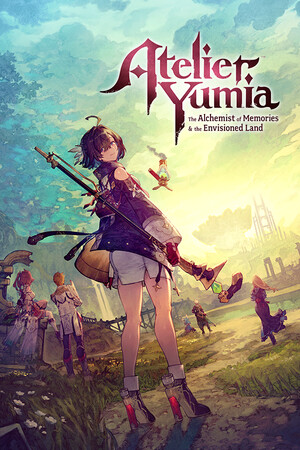
Atelier Yumia: The Alchemist of Memories & the Envisioned Land Ultimate Edition
Darker, more dramatic, and fully open-world for the first time: Yumia is the Atelier series betting everything on a reinvention, and it mostly pays off for patient crafters who don't mind a breezy combat loop.
GamerScout Verdict
Best for JRPG fans who want a crafting-rich open world with emotional stakes; series purists should brace for a lighter synthesis system and breezy combat.
Compare Prices(7 stores)
Every store in this table quotes us in euros, so the EUR figure is the price the seller actually set, not our arithmetic — which is why EUR is also the currency we rank in. We only list an offer here when the store gives us its price in euros, so nothing in this table is a number we invented.
Pick USD, PLN, GBP, CAD or AUD in the header and we convert from EUR at the European Central Bank reference rate — converted amounts are prefixed with ~. Your bank or the store may apply a different rate at checkout. We never hide offers based on where you are: everyone sees this whole table.
We may earn a commission when you buy games through links on this page — at no extra cost to you. It never affects our rankings or verdicts.
Price History
Screenshots & Media
About Atelier Yumia: The Alchemist of Memories & the Envisioned Land Ultimate Edition
My first impression of Atelier Yumia was relief. After years of cozy, consequence-free alchemy adventures, this opener actually has weight to it. Yumia Liessfeldt is an alchemist in a world that despises her for it. NPCs call her a witch, threaten to report her, and tell her to stay quiet. The fallen Aladissian Empire serves as a ruined backdrop for a story about inherited trauma, forbidden knowledge, and the question of whether the sins of the past define the present. That is a richer premise than most of the series has attempted, and the theme of memory runs deeper than a title card would suggest. Alchemy itself is tied to mana as the residual memory of everything that once existed, so the lore and the gameplay systems speak the same language. The villains have genuine backstories, even if critics are right that they don't get enough screen time to fully land. The shift to a fully seamless open world is the biggest structural change in the franchise's history. You can walk from one edge of the map to the other without a single loading screen, gathering materials along the way and using Yumia's triple-jump and gun-staff to reach ingredients stuck on cliff faces or high ledges. The classic Atelier loop of explore, gather, synthesize, and return is intact but stretched across a much larger canvas. The pioneering system adds a literal checklist of area goals, which is either satisfying or exhausting depending on your tolerance for open-world housekeeping. Honest warning: if you bounced off Ubisoft-style completion maps, the pioneer goals will test your patience in the late game. Synthesis is still the heart of everything. The new Resonance system rewards thoughtful material selection: certain ingredients expand a resonance field, hitting thresholds unlocks additional material slots, and Trait Crystals let you socket targeted bonuses into gear. You can also perform Simple Synthesis directly in the field to craft bullets for the staff, bandages, or exploration tools without trekking back to the atelier. Synthesized items can transform into weapons mid-combat, which sounds odd but works cleanly in practice. The system has a steep initial learning curve, and on normal difficulty the game never forces you to understand it deeply, which is both a blessing for newcomers and a frustration for crafting veterans who want the math to matter. Combat is fully real-time and built around an inner and outer ring around each enemy. Melee skills fire from the inner ring, ranged skills from the outer, and items have different effects depending on which ring you use them from. Swapping characters mid-fight, timing a Precision Counter off a dodge, and building toward Mana Surge at level 50 adds enough texture that early fights feel snappier than Ryza's system. The problem is repetition. Skill cooldowns mean you end up running similar rotations, normal difficulty is too easy to encourage synthesis investment, and enemy targeting in multi-enemy encounters is fiddly. The base-building system gets mixed marks across the board as well, functional enough, occasionally charming when party members comment on your furniture choices, but rarely essential. For newcomers, this is arguably the best entry point the series has ever offered. No prior knowledge required, the pacing is generous, and the emotional core of Yumia's story hits more consistently than any Ryza arc. For series veterans, the tradeoffs are real: the synthesis system is slightly shallower than the Mysterious sub-series, combat will feel casual unless you push the difficulty, and the open-world structure occasionally dilutes the intimacy that made the Arland and Dusk games feel so personal. The soundtrack and visuals punch well above the budget, though. Gust once again delivers region-distinct music that shifts mood perfectly, and the environments range from ruined gothic grandeur to genuinely beautiful fantasy biomes. Stick with it past the tutorial hump. The payoff for mastering Resonance synthesis and seeing the memory-thread of the story close up is exactly the kind of reward this series has always promised.

RPGs
Tags
System Requirements
Minimum
- OS
- Windows® 10, Windows® 11 64bit
- Processor
- Intel Core i3 8100 以上, AMD Ryzen 3 3200G 以上
- Memory
- 8 GB RAM
- Graphics
- NVIDIA GeForce GTX 1650 以上, AMD Radeon RX 570 以上, VRA…
Recommended
- OS
- Windows® 10, Windows® 11 64bit
- Processor
- Intel Core i7 8700 or better, AMD Ryzen 5 3600 or better
- Memory
- 16 GB RAM
- Graphics
- NVIDIA GeForce RTX 206…
Keep exploring
Community Discussion
Be the first to comment on Atelier Yumia: The Alchemist of Memories & the Envisioned Land Ultimate Edition.
Reviews & Ratings
No ratings available
Game Info
- Developer
- KOEI TECMO GAMES CO., LTD.
- Publisher
- KOEI TECMO GAMES CO., LTD.
- Release Date
- Mar 20, 2025