
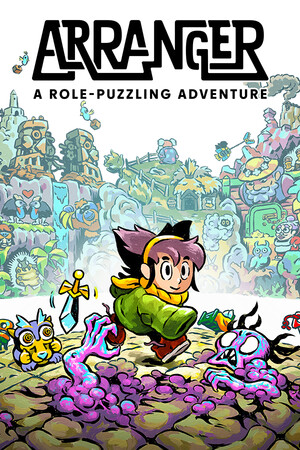
Arranger: A Role-Puzzling Adventure
A four-to-six-hour puzzle-adventure that turns the sliding-block genre inside out, and somehow makes movement itself feel like a metaphor. Worth every quiet minute.
GamerScout Verdict
Best for puzzle fans who want a handcrafted, idea-dense adventure that knows exactly when to end and trusts you to keep up.
Compare Prices(5 stores)
Every store in this table quotes us in euros, so the EUR figure is the price the seller actually set, not our arithmetic — which is why EUR is also the currency we rank in. We only list an offer here when the store gives us its price in euros, so nothing in this table is a number we invented.
Pick USD, PLN, GBP, CAD or AUD in the header and we convert from EUR at the European Central Bank reference rate — converted amounts are prefixed with ~. Your bank or the store may apply a different rate at checkout. We never hide offers based on where you are: everyone sees this whole table.
We may earn a commission when you buy games through links on this page — at no extra cost to you. It never affects our rankings or verdicts.
Price History
Screenshots & Media
About Arranger: A Role-Puzzling Adventure
My first few minutes with Arranger pulled the same trick on me that the best small games do: it handed me a mechanic so simple I almost dismissed it, then slowly revealed I had no idea how deep it went. Jemma does not walk through the world. She slides the entire row or column beneath her, dragging every unlocked object along with her across a grid that wraps at its edges, Rubik's-cube style. Walk into a wall and you reappear on the opposite side, pulling anything in your path with you. That single, elegant rule is the whole game, and Furniture and Mattress LLC spends its runtime finding astonishing things to do with it. Combat works the same way: there are no attack buttons, no health bars, no weapon stats. Killing a Static-bound enemy means sliding a sword into it from the right angle, which usually requires repositioning yourself across several connected rows first. Boss fights are just particularly devious puzzle configurations wearing a monster costume. Each region layers a new wrinkle onto the core loop without ever tutorializing it explicitly: rafts in the fishing village of Merritton that redefine where the grid's perimeter sits, teleporting doorways that can themselves be shifted, grappling hooks, laser-triggered barriers, and at least one sequence involving controlling two characters on diverging paths simultaneously. The game trusts you to figure it out by looking, which is a kind of respect most puzzle games forget to offer. Where Arranger earns its indie-darling reputation is in how cleanly the mechanic mirrors the story. Jemma has always rearranged the world around her without meaning to, and the people of her hometown mostly resent her for it. The writing leans into this with light, genuinely funny dialogue, the kind where a scientist spends an entire quest heckling their own past decisions. There is also a skip option on almost every puzzle, no fail states, and a Buddy Mode that lets a small child join as a floating fairy without disrupting anything. The difficulty curve is tuned generously: never so hard it breaks the mood, never so easy it loses the satisfaction of that delayed click when a solution finally resolves. The criticisms are real but limited. The runtime is short, somewhere between four and six hours on the main path with optional temple puzzles off the beaten track if you want them. Several reviewers, and I share this feeling, noticed that new mechanics arrive and then disappear before they have been fully explored. The narrative wraps up with a heavier hand than the breezy tone earns, and some of the story threads stay visibly loose. There is no hint system either, which occasionally means staring at a room until something clicks. None of this breaks the experience. It just means you finish the game wanting ten more hours of it rather than feeling satisfied you have seen everything the mechanic can do. The soundscape deserves its own sentence. The OST is soft and purposeful, and the foley design, the subtle scraping of shifting tiles, the gentle splash as Jemma crosses water, sits exactly where ambient sound should: noticed only when you are wearing headphones and paying attention. It is the audio equivalent of a hand-drawn detail in the corner of a frame you almost missed.

Indie & narrative
Tags
System Requirements
Minimum
- OS
- Windows 7 or later
- Memory
- 4 GB RAM
- Storage
- 6.4 GB available space
- Graphics
- GeForce GTX 560 Ti or Radeon HD 7750
- Processor
- Intel Core i5-6500 or AMD FX-Series FX-4300
Keep exploring
Community Discussion
Be the first to comment on Arranger: A Role-Puzzling Adventure.
Reviews & Ratings
Game Info
- Developer
- Furniture & Mattress LLC
- Publisher
- Furniture & Mattress LLC
- Release Date
- Jul 25, 2024