
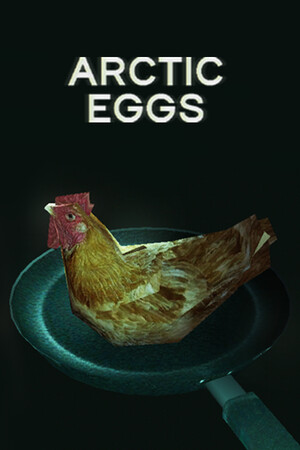
Arctic Eggs
Forget your next two hours of plans: this bleak, low-poly Antarctic cooking sim will take them, and you will thank it for doing so.
GamerScout Verdict
Worth it for anyone who can stomach a short, weird, physics-frustrating masterwork of atmosphere over content volume.
Compare Prices(5 stores)
Every store in this table quotes us in euros, so the EUR figure is the price the seller actually set, not our arithmetic — which is why EUR is also the currency we rank in. We only list an offer here when the store gives us its price in euros, so nothing in this table is a number we invented.
Pick USD, PLN, GBP, CAD or AUD in the header and we convert from EUR at the European Central Bank reference rate — converted amounts are prefixed with ~. Your bank or the store may apply a different rate at checkout. We never hide offers based on where you are: everyone sees this whole table.
We may earn a commission when you buy games through links on this page — at no extra cost to you. It never affects our rankings or verdicts.
Price History
Screenshots & Media
About Arctic Eggs
My spreadsheet instincts kicked in the moment I realized Arctic Eggs has exactly 34 people to feed and only requires you to satisfy 27 of them to reach the endgame. That seven-person buffer is a small mercy baked into a game that otherwise commits to its own weird logic with zero apology. You play as a Poultry Prepper sentenced to cook for the fog-wrapped residents of a dystopian Antarctic city in 2091, overseen by a deity-like figure called the Saint of Six Stomachs who has outlawed chickens entirely. Armed guards pace beside caged hens. You carry a frying pan. The gap between those two facts is where the entire tone lives. The core mechanic is a single frying pan controlled entirely by mouse movement. You tilt, rock, and flick to generate heat and flip your ingredients, with no spatula and no safety net. Drop your food out of the pan and the challenge resets. The developer described it as a cooking take on Getting Over It, and that comparison earns its keep: the physics feel intentionally slippery, with mouse sensitivity adjustable via scroll wheel, and the learning curve runs steep for the first ten minutes before clicking into something that feels almost meditative. Once you internalize the wrist-flick needed to flip an egg cleanly, the game starts escalating: cigarettes, live cockroaches, tinned fish cooked tin-and-all, beer bottles, stingrays, and eventually live ammunition that, crucially, does not need to stay in the pan. Each new ingredient carries its own cooking behavior, forcing you to re-learn your pan control from scratch. Hard mode swaps the curved pan for a flat griddle, which sounds minor until your first flip sends everything sideways. Finishing the main run unlocks a Sandbox mode for free-form experimentation. The atmosphere is where Arctic Eggs earns its overwhelmingly positive reception on Steam. The low-poly art runs a deliberate hazy filter over everything, character models undulate in ways that read as unsettling rather than unpolished, and dialogue text visibly backspaces and corrects itself mid-sentence as NPCs speak. The writing pulls in multiple tonal directions at once: a man mourns spending his twenties raising a stingray, a fisherman describes watching his son replace every organ mechanically, and a recurring question - can you fry eggs on top of Mount Everest - functions less as a punchline and more as the game's philosophical spine. Critics at Destructoid, Polygon, and TheGamer each called the egg-flipping mechanic genuinely novel, which is not a sentence you expect to type about a 2024 indie release. The criticisms worth knowing: the physics engine can occasionally betray you, with food clipping through the pan on aggressive flicks or launching into the air during framerate stutters. These moments are frustrating precisely because the game's difficulty is tight enough that a single bad physics frame resets a long attempt. The runtime is honest about being short - two to three hours for a first playthrough - and the lack of leaderboards or multiplayer means replayability rests entirely on Hard mode and Sandbox tinkering. Mac support is also effectively broken for anything running macOS Catalina or later, so Linux and Windows are the reliable platforms here. For a strategy-minded player the game has less decision depth than I usually chase, but it scratches a different itch: pure read-and-react problem solving under chaotic physical constraints, wrapped in one of the strangest and most coherent fictional worlds built for a sub-three-hour experience in recent memory. If you typically judge a game's value by hours-per-dollar, Arctic Eggs will feel thin. If you judge it by how long it occupies space in your head after the credits roll, the math works out differently.

Strategy & simulation
Tags
System Requirements
Minimum
- OS
- Windows 7 and up
- Memory
- 4 GB RAM
- Storage
- 1 GB available space
- Graphics
- NVIDIA GeForce GT 1030 or newer
- Processor
- ntel® Core™ i5-3470 or newer
Keep exploring
Community Discussion
Be the first to comment on Arctic Eggs.
Reviews & Ratings
No ratings available
Game Info
- Developer
- The Water Museum
- Publisher
- CRITICAL REFLEX
- Release Date
- May 16, 2024