
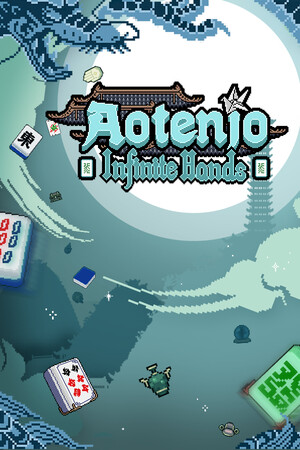
Aotenjo: Infinite Hands
If Balatro left a Mahjong-shaped hole in your rotation, Aotenjo fills it with 185 artifacts, 100-plus patterns, and a scoring system that rewards obsessive tile manipulation over raw luck.
GamerScout Verdict
Strong pick for Balatro fans open to Mahjong's tile logic, with the caveat that Early Access artifact balance still needs work.
Compare Prices(6 stores)
Every store in this table quotes us in euros, so the EUR figure is the price the seller actually set, not our arithmetic — which is why EUR is also the currency we rank in. We only list an offer here when the store gives us its price in euros, so nothing in this table is a number we invented.
Pick USD, PLN, GBP, CAD or AUD in the header and we convert from EUR at the European Central Bank reference rate — converted amounts are prefixed with ~. Your bank or the store may apply a different rate at checkout. We never hide offers based on where you are: everyone sees this whole table.
We may earn a commission when you buy games through links on this page — at no extra cost to you. It never affects our rankings or verdicts.
Price History
Screenshots & Media
About Aotenjo: Infinite Hands
I have a spreadsheet for most roguelikes I play, tracking synergy tiers and run-ending combos. Aotenjo: Infinite Hands earned its own tab faster than most, because the decision space here is genuinely wider than it first appears. This is a Balatro-adjacent tile-building roguelike built on Mahjong foundations, and it pulls that premise off more thoughtfully than the genre-mash pitch might suggest. The core loop works like this: each round you have four turns to build a cumulative Mahjong hand, drawing from a wall of tiles and discarding strategically to hit a target score. Scoring runs on a Fan-and-Fu system, where Fan is your multiplier and Fu is the base you are multiplying against. Unlike poker hands in Balatro, every tile you meld across all four turns contributes to the final score, which means compounding strong hands round over round is the whole game. Patterns, the game's equivalent of poker hand rankings, unlock progressively as you play them, so early runs feel deliberately small while later runs open up rare combos like Nine Gates or Big Winds that feel like pulling off a heist. Gadgets let you nudge tile values up or down by one pip or swap numbers across suits, giving you surgical control over a wall that starts at 136 tiles or more depending on your deck. The six starting decks each import a different regional ruleset, loosely based on Japanese Riichi, MCR, or Cantonese Mahjong, which is either exciting depth or an intimidating learning cliff depending on your tolerance for memorizing two distinct hand-validity systems. More decks are planned as the Early Access roadmap plays out. For the newcomer question, which I always take seriously: yes, you can learn this without ever touching real Mahjong. The tutorial covers sequences, triplets, and pairs at a workable pace, and hovering over any pattern shows a visual breakdown of what you are building toward. What the tutorial underserves is the Fan-Fu relationship, the role of the Aotenjo bonus for overkill scoring thresholds, and some mid-game status effects like corrupted tiles that initially appear with almost no explanation. Experienced players have flagged these tooltip gaps in community feedback, and the developer has shipped post-launch patches addressing difficulty spikes and boss balance, which is an encouraging sign for a team in active Early Access development. The artifact pool is where the depth lives, and also where the roughest edges are. With 185 artifacts in the current build, synergy hunting is genuinely compelling, but a meaningful portion of them have activation conditions so narrow that they rarely fire in practice. Critically, artifact upgrades are grouped by element type, so leveling up your yaku (hand patterns) means accepting bundles of three upgrades at once rather than cherry-picking, which reduces the precision of your build compared to what Balatro players might expect. Tile removal is available more freely than in a standard poker deck-builder, which is a welcome concession given you are working with 136-plus tiles rather than 52 cards, but it does not fully solve the wall-management problem at the higher difficulty settings. Steam user sentiment sits around 87 percent positive, which reflects an audience that finds the moment-to-moment play genuinely satisfying even while acknowledging rough corners. The presentation is calm, the tile-click audio is tactile, and the seeded run generation keeps individual runs feeling distinct. This is still Early Access software with tooltip gaps, some unclear boss descriptions, and an artifact roster that needs further balance passes. But the bones are solid, the scoring system rewards learning, and the developer is actively iterating. If you have any Mahjong literacy at all, the ceiling here is high. If you have none, the floor is lower than the tutorial implies, but not so low that a patient player cannot climb it.

Strategy & simulation
Tags
System Requirements
Minimum
- OS
- Windows 7, 10/11
- Memory
- 2 GB RAM
- Storage
- 400 MB available space
- Processor
- 2.0 GHz
Recommended
- OS
- Windows 7, 10/11
- Memory
- 4 GB RAM
- Storage
- 400 MB available space
- Processor
- 2.0 GHz
Keep exploring
Community Discussion
Be the first to comment on Aotenjo: Infinite Hands.
Reviews & Ratings
No ratings available
Game Info
- Developer
- XO Cat
- Publisher
- XD
- Release Date
- Jan 19, 2025