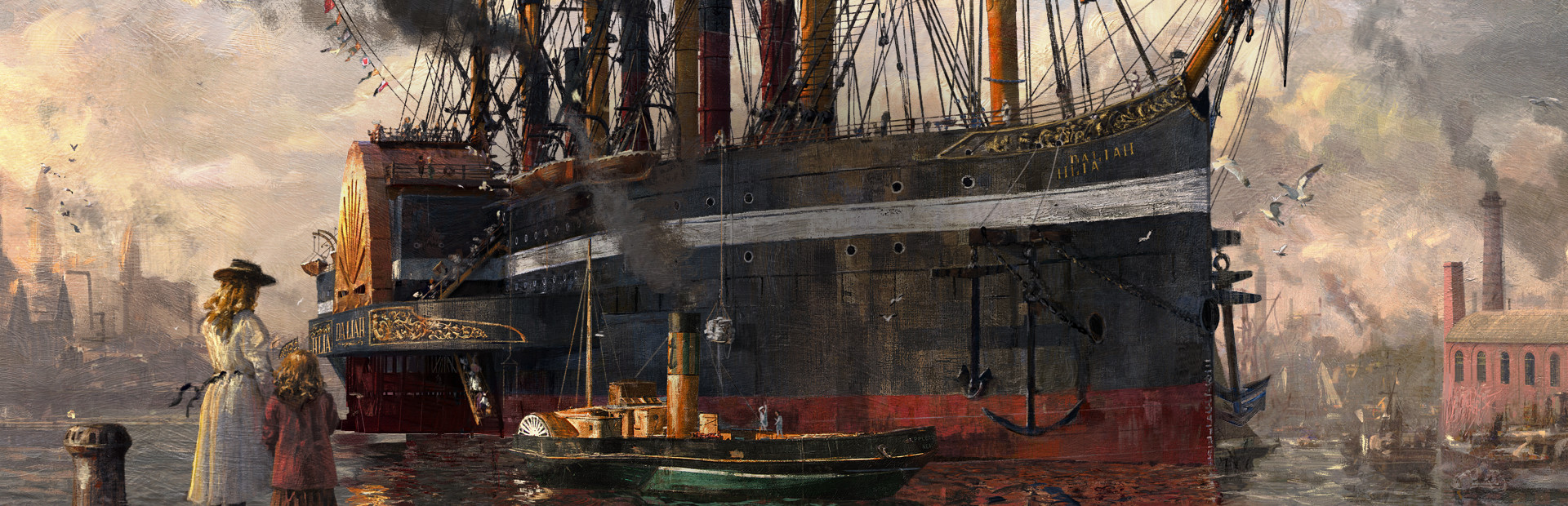
Anno 1800
A production-chain obsessive's paradise that will devour your evenings one trade route at a time - start the campaign if you value your sleep schedule.
GamerScout Verdict
Best for city-builder and sim fans who want deep logistics puzzles - buy with at least one season pass for the full picture.
Compare Prices(7 stores)
Every store in this table quotes us in euros, so the EUR figure is the price the seller actually set, not our arithmetic — which is why EUR is also the currency we rank in. We only list an offer here when the store gives us its price in euros, so nothing in this table is a number we invented.
Pick USD, PLN, GBP, CAD or AUD in the header and we convert from EUR at the European Central Bank reference rate — converted amounts are prefixed with ~. Your bank or the store may apply a different rate at checkout. We never hide offers based on where you are: everyone sees this whole table.
We may earn a commission when you buy games through links on this page — at no extra cost to you. It never affects our rankings or verdicts.
Price History
Screenshots & Media
About Anno 1800
My first session with Anno 1800 was supposed to be two hours of light city planning. Six hours later I had a coal-powered steel mill feeding a shipyard, a New World colony propping up my Old World beer supply, and absolutely no idea how late it was. That loop - need a resource, build its production chain, discover the chain needs three supporting buildings, colonise a new island to find the right soil fertility, then wire it all together with trade routes - is the engine that makes this game so difficult to walk away from. As a sim specialist I can tell you the production chains here are legitimately deep: farmers need fish and work clothes before they'll level up to workers, workers want sausages and bread, artisans demand canned goods and sewing machines, and each new population tier unlocks buildings that open entirely new supply puzzles. The blueprint planning tool, which lets you ghost-place an entire district before committing resources, is one of the better quality-of-life decisions the series has ever made. The dual-world structure is where Anno 1800 separates itself from a standard island city-builder. Your Old World metropolis and your New World colony are not independent - they are a single economic organism. The New World produces rum, cotton, and eventually cigars that your Old World investors demand, so you are constantly spinning up trade routes across both maps and watching your cargo ships shuttle goods back and forth. Managing travel times and ship capacity turns into a satisfying logistics puzzle by the mid-game, and setting up automated trade routes with condition triggers is the kind of systems design that rewards players who actually read the interface. The randomly generated sandbox mode, alongside the structured story campaign, gives you two very different entry points depending on whether you prefer directed objectives or blank-canvas empire building. Honestly though, Anno 1800 has some rough edges worth flagging. The campaign story is weak - the characters are over-voiced and the plot exists primarily to hand-hold you through mechanics, not to tell anything interesting. AI opponents on the shared map negotiate and bark dialogue constantly, and the chatter becomes genuinely irritating over long sessions. Naval combat is functional but thin; if you come in expecting anything resembling a fleet tactics layer, you will be disappointed. The diplomacy system similarly lacks the bite you'd want from a game that markets itself on geopolitical choice. These are not deal-breakers, but they do mean the game's best version is the one where you mute the AI voices and treat conflict as a secondary concern to logistics optimisation. For newcomers to the genre, I will make the case that the campaign is a genuinely competent tutorial dressed up as a story mode. It walks you through production ratios, workforce tiers, expedition mechanics, and island colonisation without ever stopping to recite a dry manual at you. Eighteen hours in the campaign is enough to build the mental model you need to tackle sandbox mode confidently. The difficulty sliders are granular - you can separately tune AI aggression, natural disasters, production accidents, and financial pressure - so even a first-timer can dial in an experience that stays challenging without spiralling into chaos. Veterans, meanwhile, can stack all the DLC seasons (four of them, covering everything from the Arctic to the Enbesa region) onto a single sandbox game and spend hundreds of hours optimising population ratios that most people will never see. The one legitimate community gripe that has persisted since launch is the DLC model. Four full season passes and a catalogue of cosmetic additions means the complete experience carries a substantial price tag, and the base game alone can start to feel content-thin once you hit the investor tier. Buying in during a sale with at least one or two season passes is the smarter play here. The core systems are among the best in class for this style of city-builder, but the full depth only reveals itself when the expansion content is in the mix.

Strategy & simulation
Tags
System Requirements
Minimum
1080p Low Preset - 60 FPS CPU: Intel i5-4460 - 3.2 Ghz, AMD Ryzen3 1200 - 3.1 Ghz GPU: Nvidia GTX 670 - 2GB, AMD Radeon R9 270X - 2GB RAM: 8GB
Recommended
- OS
- Windows 10(64-bit versions only)
- Processor
- Intel i5 4690k, AMD Ryzen 5 1400
- Memory
- 8 GB RAM
- Graphics
- NVIDIA GeForce 970 GTX or AMD Radeon RX 480 (…
DLC & Add-ons for Anno 18001
Expansions, DLC packs and add-on content for this game. Click any item to see store offers.
Keep exploring
Community Discussion
Be the first to comment on Anno 1800.
Reviews & Ratings
Game Info
- Developer
- Ubisoft Mainz
- Publisher
- Ubisoft
- Release Date
- Apr 16, 2019