
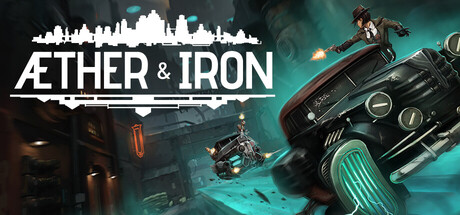
Aether & Iron
Noir, floating cars, and a smuggler's dice roll standing between New York City and oblivion - Aether & Iron earns its 15-20 hours with sharp writing and a combat system you won't find anywhere else.
GamerScout Verdict
Best for Disco Elysium fans who want their noir choices backed by tactical car combat and a fully voiced cast.
Compare Prices(3 stores)
Every store in this table quotes us in euros, so the EUR figure is the price the seller actually set, not our arithmetic — which is why EUR is also the currency we rank in. We only list an offer here when the store gives us its price in euros, so nothing in this table is a number we invented.
Pick USD, PLN, GBP, CAD or AUD in the header and we convert from EUR at the European Central Bank reference rate — converted amounts are prefixed with ~. Your bank or the store may apply a different rate at checkout. We never hide offers based on where you are: everyone sees this whole table.
We may earn a commission when you buy games through links on this page — at no extra cost to you. It never affects our rankings or verdicts.
Price History
Screenshots & Media
About Aether & Iron
My spreadsheet instincts kicked in about forty minutes into Aether & Iron, the moment I realized the Brass, Smarts, and Hustle skill trees each pull double duty - shaping both your dialogue dice rolls and your vehicle loadout in combat. That kind of mechanical overlap is exactly where build decisions live or die, and it is both the most interesting design choice in the game and, fairly often, its biggest source of friction. The setup: you are Gia Randazzo, a disgraced smuggler working the Lowers of a gravity-defying alternate 1930s New York. The city floats in layers - the wealthy Uppers above, the near-lawless Lowers below, and a fog of corrupt Barons running their island fiefdoms in between. The writing team includes veterans with credits on Mass Effect and Far Cry, and it shows. The world feels considered rather than slapped together, with factions and power structures that have internal logic. The story runs roughly 15 to 20 hours across a prologue, three acts, and a finale - lean by CRPG standards, but the pacing rarely drags because the game moves fast and the fully voiced cast is strong throughout. On the strategy side, the piece that sets this apart is the turn-based vehicular combat. Fights happen on hardlight highways at speed, using a grid-based road system where action point costs are asymmetric - moving forward costs more than weaving back through traffic, which creates real positional tension. You can control up to three friendly vehicles, with each car configurable in a garage across six component slots covering engine, repulsors, and four weapon mounts. Ram an enemy into a lane closure and watch their car vaporize. Fire a rear-mounted cannon after a bootlegger turn. As the acts progress, the arenas fill up with falling debris, aether storms, and traffic hazards that demand you treat every move as a calculated decision rather than just cycling through attacks. On that front, the system delivers. Some critics have flagged genuine launch bugs and clunky garage menus, and the action point asymmetry initially feels counterintuitive - but the developers have been active with patches, and the underlying design is clever enough to be worth working through. Outside combat, the game plays like a dialogue-heavy visual novel with skill checks. Conversations resolve on 2d6 rolls, with your party members contributing passive bonuses depending on who you have in tow. Three build archetypes emerge naturally: smooth-talking Hustle builds, analytical Smarts builds, and hard-edged Brass builds for the enforcers. The catch the RPGFan crowd will notice is that the skill tree is shared between conversation and combat, so a character spec'd hard into Gumshoe and Grease Monkey might find their vehicle builds soft in the late acts when minimum success thresholds for dice rolls climb well above 14. Respec items exist, but it is a tension that a follow-up should iron out. Side content is also thin - mostly optional character quests rather than sprawling open world diversions - so players hunting systemic depth over narrative will hit the ceiling faster than they might like. For the audience most likely to love this: if Disco Elysium's approach to skill checks and noir atmosphere clicked with you but you wanted something with more kinetic tactical combat instead of pure walking and talking, Aether & Iron fills that gap in a way nothing else currently does. The comparison to Disco Elysium is apt in tone and structure, though this game adds genuine vehicular tactics where ZA/UM's title abstained from combat entirely. The hand-drawn art is gorgeous and the Christopher Tin soundtrack ties the whole decopunk mood together. There are rough edges - some mechanics like the Heat stat and contraband smuggling feel underdeveloped by the midgame - but the core loop of dice-driven conversation followed by positional car combat is distinctive enough that those gaps read as the cost of a bold debut rather than a broken game.

Strategy & simulation
Tags
System Requirements
Minimum
- OS
- Windows 10 or newer, 64-bit
- Memory
- 8 GB RAM
- DirectX
- Version 11
- Storage
- 15 GB available space
- Graphics
- GeForce GTX 950 / Radeon R X 460
- Processor
- AMD FX 8300 / Intel Core i3 8300
- VR Support
- None
Recommended
- OS
- Windows 10 or newer, 64-bit
- Memory
- 16 GB RAM
- DirectX
- Version 11
- Storage
- 15 GB available space
- Graphics
- Radeon R9 280 / GeForce GTX 1650
- Processor
- Ryzen 5 1600X / Intel Core i5 8600K
- VR Support
- None
Keep exploring
Community Discussion
Be the first to comment on Aether & Iron.
Reviews & Ratings
No ratings available
Game Info
- Developer
- Seismic Squirrel
- Publisher
- Seismic Squirrel
- Release Date
- Mar 30, 2026