ADIOS Amigos: Galactic Explorers
Fuel math meets couch chaos: a physics-driven space roguelite where optimal trajectories and asteroid-based break-ins coexist with four-player split-screen absurdity. Solo players are welcome, but this one really shines with bodies on the couch.
GamerScout Verdict
Best for couch co-op fans who want physics-driven chaos with an accessible on-ramp, as long as everyone is in the same room.
Compare Prices(2 stores)
Every store in this table quotes us in euros, so the EUR figure is the price the seller actually set, not our arithmetic — which is why EUR is also the currency we rank in. We only list an offer here when the store gives us its price in euros, so nothing in this table is a number we invented.
Pick USD, PLN, GBP, CAD or AUD in the header and we convert from EUR at the European Central Bank reference rate — converted amounts are prefixed with ~. Your bank or the store may apply a different rate at checkout. We never hide offers based on where you are: everyone sees this whole table.
We may earn a commission when you buy games through links on this page — at no extra cost to you. It never affects our rankings or verdicts.
Price History
Screenshots & Media
About ADIOS Amigos: Galactic Explorers
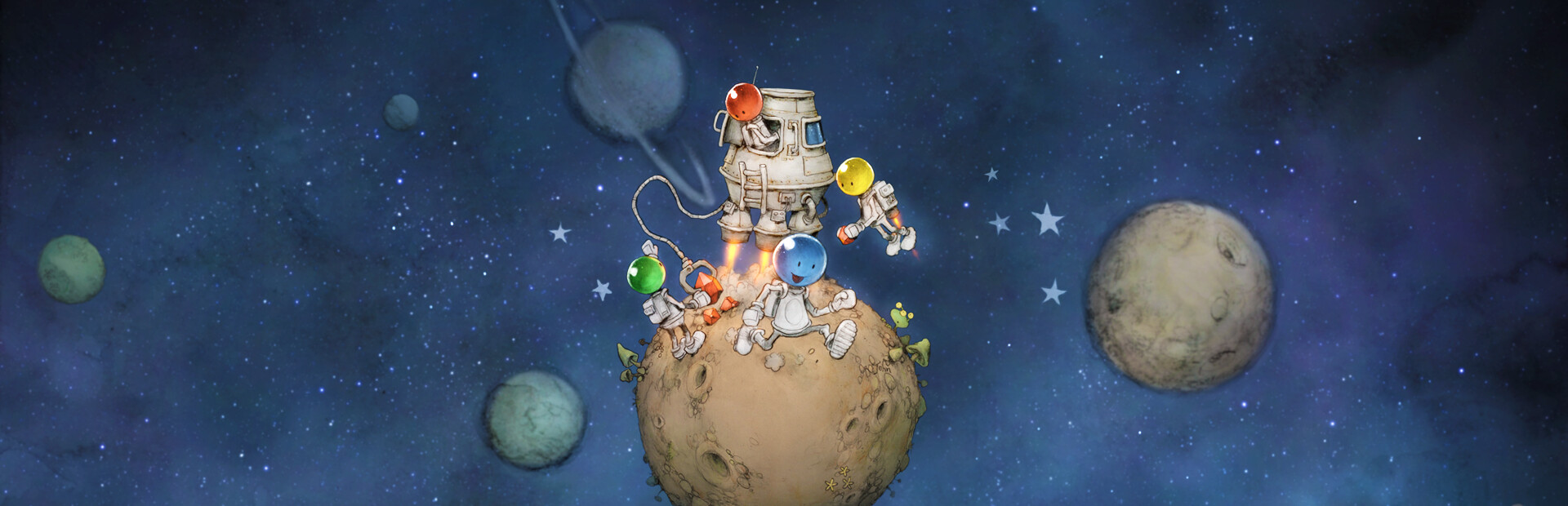
My first instinct when I loaded ADIOS Amigos was to check whether the orbital mechanics were real or decorative window dressing. They are real, and that single fact separates this game from roughly 90% of the 2D space-exploration genre. The simulation models gravity, temperature, atmospheric resistance, and asteroid trajectories across entire procedurally generated solar systems, and it does not cheat. Nudge a space rock off course early in a run and it may come crashing into the planet you were planning to land on ten minutes later. That kind of systemic cause-and-effect is usually reserved for Kerbal Space Program screenshots posted by aerospace students, not hand-drawn indie co-op games with saxophone solos on the soundtrack. The core gameplay loop has you piloting a battered ship through procedurally generated solar systems, rationing fuel by plotting efficient orbital paths, exiting the ship on foot to explore planets and space stations in micro-gravity, and scavenging artifacts, power-ups, and whatever else the universe throws at you. There are three campaigns that can be run solo or cooperatively, and the dynamic split-screen for up to four local players holds up better than most couch co-op implementations I have tested. The game self-describes as an "Explore 'Em Up", which is accurate: the structure is closer to FTL's run-based pressure than to a freeform sandbox, but the physics system gives you real agency over how creatively you meet, or spectacularly fail, each challenge. The accessibility angle deserves a full paragraph because it is handled unusually well for a simulation-heavy title. Rookie Mode simplifies the control scheme and adds guardrails against the most lethal beginner errors, which means a parent and a seven-year-old can share a session without one of them spending the whole time watching the other crash into the sun. Skill-floor differences between players stop being a session-killer. That said, the game does not hold your hand on the physics side once you push into harder runs; understanding orbital insertion, fuel burn rates, and gravitational assists is what separates a good run from a spectacular one, and the UI is genuinely friendly about surfacing that information without oversimplifying it. Where the game falls short is mostly a structural issue. There is no online multiplayer, which is the loudest complaint in community discussions, and it is a fair one. If your co-op roster is distributed across different cities, you are playing solo. Some players have also reported stability issues on later runs, particularly around the six-light-year mark, which is worth knowing before a long session. The mod ecosystem is essentially nonexistent, so do not expect community campaigns or new content to extend the game the way a Paradox title would. What you get is what is in the box, and the box has a defined ceiling on replayability once you have cleared all three campaigns and internalized the physics toolkit. For strategy and simulation players who typically require spreadsheet depth, this will feel lightweight but not dismissible. The decision-making around fuel conservation and trajectory planning scratches a genuine resource-optimization itch, and the physics sandbox generates emergent situations that no designer scripted. The Steam community carries a 93% positive rating on user reviews, which is a strong signal from a small but enthusiastic player base. Come in for the couch co-op, stay for the moment you accidentally redirect an asteroid into your own ship and have to EVA in the debris field to fix the engine.

Strategy & simulation
Tags
System Requirements
Minimum
- OS
- Windows 7 64-bit
- Memory
- 4 GB RAM
- DirectX
- Version 11
- Storage
- 2 GB available space
- Graphics
- DirectX 11 capable GPU minimum 2GB
- Processor
- 2.0 Ghz Dual Core
Recommended
- OS
- Windows 10 64-bit
- Memory
- 8 GB RAM
- DirectX
- Version 11
- Storage
- 2 GB available space
- Graphics
- GeForce GTX 1060
- Processor
- 3.0 GHz Quad Core
Keep exploring
Community Discussion
Be the first to comment on ADIOS Amigos: Galactic Explorers.
Reviews & Ratings
No ratings available
Game Info
- Developer
- Cosmic Picnic
- Publisher
- Cosmic Picnic
- Release Date
- Sep 12, 2018