
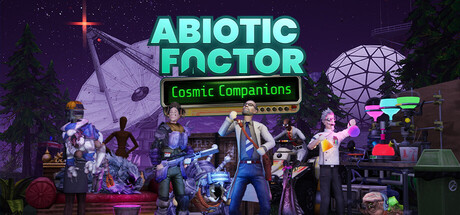
Abiotic Factor
Survival crafting where your weapons are a stapler, a standing lamp, and bad decisions: Abiotic Factor is the co-op science-disaster game that makes every other genre entry feel underdressed.
GamerScout Verdict
Best for co-op survival fans who want RPG-depth progression wrapped in Half-Life atmosphere, with three friends and patience for rough late-game pacing.
Compare Prices(9 stores)
Every store in this table quotes us in euros, so the EUR figure is the price the seller actually set, not our arithmetic — which is why EUR is also the currency we rank in. We only list an offer here when the store gives us its price in euros, so nothing in this table is a number we invented.
Pick USD, PLN, GBP, CAD or AUD in the header and we convert from EUR at the European Central Bank reference rate — converted amounts are prefixed with ~. Your bank or the store may apply a different rate at checkout. We never hide offers based on where you are: everyone sees this whole table.
We may earn a commission when you buy games through links on this page — at no extra cost to you. It never affects our rankings or verdicts.
Price History
Screenshots & Media
About Abiotic Factor
I spent my first hour in Abiotic Factor doing what my character is supposed to do: rifling through desk drawers, smashing vending machines for nutrition, and watching a security robot stomp past while I crouched behind a filing cabinet. That opening crawl through the Office Sector of the GATE Cascade Research Facility sets the tone perfectly. You are not a soldier. You are a scientist, and the game never lets you forget it. The job system is where the depth starts. At character creation you pick a PhD specialization that functions as a soft class: Structural Engineer leans into base construction and turret placement, Culinary Researcher gets a cooking head start, Defense Analyst prioritizes ranged accuracy and reloading, IT Specialist hacks electronic doors and opens facility shortcuts nobody else can reach. Layered on top are positive and negative Traits that permanently buff or debuff your scientist, and the combinatorics here are genuinely interesting. Take the narcolepsy debuff to bank extra trait points, and you have built a person with real character flaws rather than a stat-optimized blob. Skills then grow organically: sneak more and your stealth improves, cook more and you unlock new recipes, land enough ranged hits and you eventually become the party's clutch sniper. It is about as close to a Runescape-style progression system as a survival game has gotten, and it works. The crafting is the real star. Early-game improvisation from office supplies, a kitchen knife lashed to a standing lamp with duct tape becomes a serviceable spear, gives way to electrified blades, makeshift crossbows, disc launchers built from air compressor components, and eventually laser-adjacent gear pulled from containment sectors. Recipes unlock at a satisfying cadence, and the materials you find genuinely feel like they belong in the finished item rather than being arbitrary resource tokens. Base building is equally flexible: the Engineer turns corridors into kill zones with turrets, electric fences, and automated doors, but you can set up a perfectly functional camp in a cafeteria or swimming pool without that specialization. The daily nighttime power-down, which sends security robots on patrol and forces you to manage flashlights and temperature, adds a soft clock to every session without turning the game into a punishing grind-or-die loop. Co-op for up to six players is where all of this comes together, with proximity chat amplifying the emergent comedy of one person panic-cooking alien meat while another barricades a door with office furniture. Solo is viable but slower and lonelier in ways the game does not fully paper over. The honest caveats: combat is the weakest system. Enemies of the same type have variable health pools that feel inconsistent, incoming damage is sometimes poorly telegraphed, and the melee feedback has a soft, unsatisfying quality that reviewers across the board have flagged. More critically, the back quarter of the campaign, once you reach the reactor area, loses some of the early game's tight pacing. Resource collection becomes more repetitive, enemy health bloats, and the frequency of exciting new recipe discoveries drops off sharply. The final chapters were also criticized at launch for feeling rushed, though Deep Field Games has a demonstrated track record of meaningful post-launch updates. The tutorial is minimal to the point of being vague about several systems, which means new players will be relying on community guides or co-op companions to fill the gaps. Running on Unreal Engine 5 also means the CPU ask for hosting a multiplayer session is not trivial. For strategy and sim players who usually sit out the survival genre, Abiotic Factor is worth a closer look than the genre tag suggests. The job-and-traits character builder, the multi-layered skill progression, the base defense logistics, and the interconnected seven-sector map that rewards players who understand its shortcuts all scratch the same itch as a well-designed progression system in a much more mechanical genre. The community sitting at an overwhelmingly positive rating across tens of thousands of reviews is not noise. Approach it with one or two friends, pick Engineer for your first run, and resist the urge to rush the critical path.

Strategy & simulation
Tags
System Requirements
Minimum
- OS
- Windows 10 or later
- Memory
- 8 GB RAM
- DirectX
- Version 11
- Network
- Broadband Internet connection
- Storage
- 10 GB available space
- Graphics
- GeForce GTX 1660 or AMD Radeon RX 5600 XT
- Processor
- i5-9th Gen CPU or similar
Recommended
- OS
- Windows 10 or later
- Memory
- 16 GB RAM
- DirectX
- Version 12
- Network
- Broadband Internet connection
- Storage
- 10 GB available space
- Graphics
- GeForce RTX 3070 or AMD Radeon RX 6700 XT or better
- Processor
- i5-11th Gen CPU or similar
Keep exploring
Community Discussion
Be the first to comment on Abiotic Factor.
Reviews & Ratings
No ratings available
Game Info
- Developer
- Deep Field Games
- Publisher
- Playstack
- Release Date
- Jul 22, 2025


