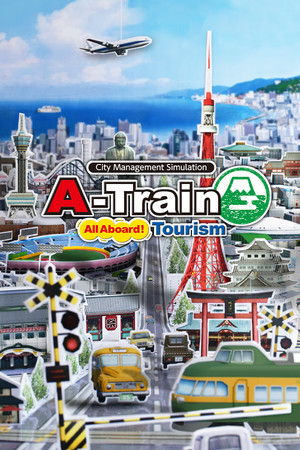
A-Train: All Aboard! Tourism
If timetabling six express trains around a single junction while managing land prices and tourist footfall sounds like a weekend well spent, this Japanese conglomerate sim will sink its hooks in deep. Everyone else: approach with caution.
GamerScout Verdict
Built for transport sim veterans who want economic depth over accessibility; novices should budget time for a rough but rewarding learning curve.
Compare Prices(5 stores)
Every store in this table quotes us in euros, so the EUR figure is the price the seller actually set, not our arithmetic — which is why EUR is also the currency we rank in. We only list an offer here when the store gives us its price in euros, so nothing in this table is a number we invented.
Pick USD, PLN, GBP, CAD or AUD in the header and we convert from EUR at the European Central Bank reference rate — converted amounts are prefixed with ~. Your bank or the store may apply a different rate at checkout. We never hide offers based on where you are: everyone sees this whole table.
We may earn a commission when you buy games through links on this page — at no extra cost to you. It never affects our rankings or verdicts.
Price History
Screenshots & Media
About A-Train: All Aboard! Tourism
I run Paradox campaigns with colour-coded spreadsheets, so when a sim promises genuine economic depth underneath a tile-based map, I pay attention. A-Train: All Aboard! Tourism is not the breezy city-builder its anime aesthetic suggests. It puts you in the president's chair of a Japanese railroad conglomerate, and the expectation is that you understand the job. Ticket revenue alone will not carry you. The real money flows from buying undeveloped land near future stations, watching population density climb as your rail service matures, then selling parcels or installing subsidiaries, amusement parks, hotels, residential towers, to feed demand back into the network. That loop, once it clicks, is genuinely satisfying in a way that Transport Tycoon or Railway Empire rarely achieves at the same level of granularity. The scheduling system is where the game earns its niche reputation and, depending on your tolerance, either its highest praise or its loudest criticism. Unlike signal-based competitors, A-Train uses a pure timetable model. You specify departure times, platform assignments, loop counts, and how long each vehicle waits at each stop. Express and semi-express trains can share the same corridor if your departure windows are tight enough. When a perfectly tuned network hums along and land values ripple outward from every station, it feels like watching a simulation prove an urban-planning thesis in real time. When a single mis-scheduled loop puts a 3-car consist back at the terminus two hours late and blocks everything behind it, you will feel every second of that delay in your gut. The timetable system rewards patience and spreadsheet thinking; it punishes guesswork with cascading gridlock that costs real in-game currency to untangle. The eight scenarios, two of them tutorials, each drop you into a different Japanese city and time period with distinct objectives: hit a profit threshold, grow a city to a target population, or funnel a set number of tourists through a region in a single fiscal year. The tourist mechanics add a useful strategic wrinkle. Routing tourists through forced transfers at intermediate stations inflates passenger counts at otherwise sleepy stops, accelerating development in areas you want to densify. It is slightly absurd from a realism standpoint but it is a legitimate lever, and finding those levers is exactly the kind of depth that keeps this style of sim compelling across multiple playthroughs. Scenario creation and sharing with other players extends the content further, though English-language community output for this title is thin compared to its Japanese domestic following. Now, the honest warnings. The PC port inherits control DNA from a console-first release, and mouse-and-keyboard input feels grafted on rather than native. Key remapping is absent. The UI layers menus inside menus in a way that will disorient anyone expecting the clean layout of a modern Western sim. The two tutorial scenarios introduce mechanics gradually but lock away configuration options that experienced players will want immediately, skipping straight to a standard scenario sidesteps this, but the game does not make that obvious. The recommended system specs are also notably high for how the game looks, which has generated community grumbling. Steam user sentiment sits around 72 percent positive across roughly 180 reviews, which is an honest reflection of a title that rewards a specific kind of player while frustrating everyone adjacent to that profile. A newcomer willing to read a community guide, accept the clunky input, and commit to understanding the schedule-based logic will find a sim with decision-making depth that the genre rarely matches at this level of economic realism.

Strategy & simulation
Tags
System Requirements
Minimum
- OS
- Windows 11 / 10 / 8.1 compatible (all 64bit)
- Memory
- 8 GB RAM
- DirectX
- Version 11
- Storage
- 12 GB available space
- Graphics
- Intel HD Graphics 4600 or higher (*You can play without a graphics card)
- Processor
- Intel Core i5-4440 @3.10GHz or higher
- Sound Card
- Supports Direct Sound
Recommended
- OS
- Windows 11、10、8.1(all 64bit)
- Memory
- 16 GB RAM
- DirectX
- Version 11
- Storage
- 16 GB available space
- Graphics
- NVIDIA GeForce GT 1030 or higher (VRAM 2GB or higher)
- Processor
- Intel Core i7-8700K @3.70GHz or higher
Keep exploring
Community Discussion
Be the first to comment on A-Train: All Aboard! Tourism.
Reviews & Ratings
No ratings available
Game Info
- Developer
- ARTDINK
- Publisher
- KOMODO
- Release Date
- Dec 7, 2021