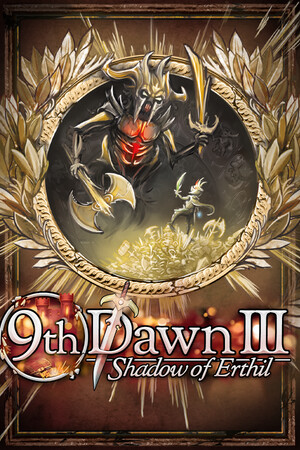
9th Dawn III
One person built this entire sprawling dungeon crawler, and that context colors everything: the rough edges, the addictive loot loop, and a soundtrack that quietly earns its keep.
GamerScout Verdict
Built for players who miss when RPGs made you earn every skill level and didn't mind if the story was thin.
Compare Prices(4 stores)
Every store in this table quotes us in euros, so the EUR figure is the price the seller actually set, not our arithmetic — which is why EUR is also the currency we rank in. We only list an offer here when the store gives us its price in euros, so nothing in this table is a number we invented.
Pick USD, PLN, GBP, CAD or AUD in the header and we convert from EUR at the European Central Bank reference rate — converted amounts are prefixed with ~. Your bank or the store may apply a different rate at checkout. We never hide offers based on where you are: everyone sees this whole table.
We may earn a commission when you buy games through links on this page — at no extra cost to you. It never affects our rankings or verdicts.
Price History
Screenshots & Media
About 9th Dawn III
My first hour with 9th Dawn III started exactly where solo passion projects tend to hide their ambition: in a sewer, killing rats, wondering what I'd gotten myself into. Push past that opening and the world of Cedaltia gradually unfolds into something genuinely surprising for a one-person production. The game is a top-down, pixel-art action RPG dungeon crawler that pulls its DNA from old Ultima titles and early Runescape, where you level skills by using them rather than through a fixed class at character creation. Want to play a battlemage? Swing heavy swords and cast spells until both skill lines grow on their own. Prefer a ranged rogue? Grab a bow, practice sneaking, and the build shapes itself. That open-ended progression is the game's warmest quality, and it rewards players who like watching numbers tick upward organically rather than following an optimised build guide. The activity list reads like a one-person developer trying to say yes to every RPG feature simultaneously. Beyond the main quest, you can mine ore and smelt weapons through an armour smithing tree, gather reagents for alchemy, cook food for stat buffs, fish, capture and tame creatures from the game's roster of monsters using a bait-and-trap system, and collect cards for Fyued, an in-game card game with a deck of its own. Completionists get an extra nudge: crafting enough of any single item category awards a Mastery bonus in XP, gold or materials, and clearing dungeons to one hundred percent completion carries tangible rewards. For a certain kind of player, that feedback loop is irresistible. For another, it will read as relentless busywork dressed in pixel art. The honest criticism deserves equal space. Combat is the weakest link. The twin-stick system, where the right stick or mouse aims your attacks into clusters of enemies, works fine mechanically, but the enemies themselves behave predictably: charge, swing, repeat. Dungeons respawn every enemy the moment you cross a floor transition, which keeps grind sessions grinding but dulls the sense of conquest. The story is a meandering excuse to push you from one settlement to the next, tonally wobbly between earnest prophecy and light-hearted filler quests. The in-game map offers little navigational clarity, and fast travel costs enough in-world currency to feel punishing rather than convenient. These aren't dealbreakers so much as honest reflections of a solo build with finite development hours. What lingers, and what critics divided on almost every other quality tend to agree on, is the soundtrack. Every piece of music in this game was composed by the same person who coded and drew it all. It is not a large score, but the wilderness themes carry a forlorn adventurousness that fits the mood better than a licensed OST from a larger budget ever quite would. The pixel art, depending on your tolerance for 8-bit aesthetics, either reads as charming retro craft or rough Flash-era work. Both reactions are fair. If you grew up with top-down RPGs of the early 2000s, the visual style lands as nostalgic shorthand; if you didn't, it may feel undercooked. The local co-op option, playable alongside a second controller, adds an underappreciated dimension for couch sessions without changing the core experience much. Steam's player community leans warmly positive, and those who click with the pacing tend to clock significant hours before surfacing.

Indie & narrative
Tags
System Requirements
Minimum
- OS
- Windows 7
- Memory
- 1 GB RAM
- Storage
- 750 MB available space
- Graphics
- Integrated graphics
- Processor
- Pentium 4 or better
- Sound Card
- Integrated
Recommended
- OS
- Windows 10
- Memory
- 2 GB RAM
- Storage
- 750 MB available space
- Graphics
- NVidia 680 or higher
- Processor
- Intel I5
- Sound Card
- Integrated
Keep exploring
Community Discussion
Be the first to comment on 9th Dawn III.
Reviews & Ratings
No ratings available
Game Info
- Developer
- Valorware
- Publisher
- Valorware
- Release Date
- Oct 5, 2020