4 Elements
Match-3 with a twist that actually earns the label: guiding elemental energy through maze-like boards gives Playrix's 2008 casual puzzler more tactical bite than Bejeweled clones.
GamerScout Verdict
Best for casual puzzle fans who want a 2-4 hour match-3 with just enough tactical bite to feel earned.
Compare Prices(4 stores)
Every store in this table quotes us in euros, so the EUR figure is the price the seller actually set, not our arithmetic — which is why EUR is also the currency we rank in. We only list an offer here when the store gives us its price in euros, so nothing in this table is a number we invented.
Pick USD, PLN, GBP, CAD or AUD in the header and we convert from EUR at the European Central Bank reference rate — converted amounts are prefixed with ~. Your bank or the store may apply a different rate at checkout. We never hide offers based on where you are: everyone sees this whole table.
We may earn a commission when you buy games through links on this page — at no extra cost to you. It never affects our rankings or verdicts.
Price History
Screenshots & Media
About 4 Elements
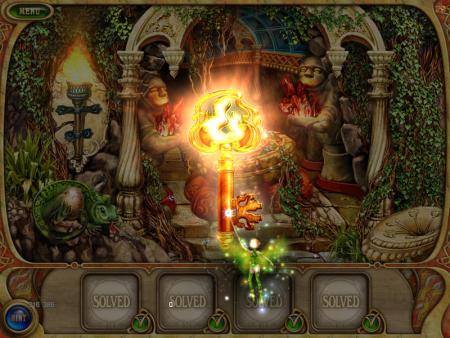
I picked this up expecting another gem-swapper I'd forget in an hour, and the core mechanic caught me off guard. Rather than simply clearing a board, the goal in 4 Elements is to guide a stream of magical energy from one end of each level to an altar at the other. Clearing chains of three or more colour-matched tiles literally clears the path for that energy to flow, which makes every swap feel purposeful rather than random. The board scrolls as levels grow larger, and four colour-coded power-ups charge up as you match their corresponding gems: a spade for a single tile, a bomb for area clears, a swap to reposition two tiles, and a reshuffle to reorganise the whole grid. Chaining bigger combos charges them faster and produces satisfying explosions, so there is a constant low-level optimisation loop running underneath the casual exterior. The structure across the game's four books (Earth, Water, Fire, Air) alternates between the match-3 levels and two types of interlude puzzles: hidden-object scenes where you assemble scattered item pieces and use them on the environment to uncover a book key, and spot-the-difference comparisons between illustrated fantasy cards. The hidden-object sections are reasonably well designed, not the lazy pixel-hunts that plague cheaper entries in the genre. The spot-the-difference rounds are quick and breezy. Both modes serve as palate cleansers, though some players will find the interruptions to the tile gameplay more annoying than welcome. If you are here purely for match-3 flow, the interlude pacing is a fair criticism. The difficulty curve is gentle in the first two books and ramps up noticeably later, where the boards widen and the timer becomes a real factor. The randomness of incoming gem colours is the game's most frustrating design choice: on certain later levels the RNG can starve you of the colour you need just as you approach the altar, forcing a restart through no fault of your own. The game does not get truly stuck (a fairy helper reshuffles the board if chains dry up completely), but that timer-versus-luck tension will irritate players who prefer skill-only puzzles. Replay value is limited; once each level is complete there is little reason to return unless you are chasing achievement scores. For what it is, a polished 2008 casual puzzler released before the genre calcified into mobile free-to-play templates, 4 Elements holds up. The art has a warm, hand-illustrated fantasy quality, the background music is unobtrusive, and the fairy guide keeps the experience beginner-friendly without being condescending. The game sits comfortably in a two-to-four hour completion window, which fits a low-pressure weekend afternoon better than it fits a dedicated gaming session. Families with younger children will find the difficulty accessible; adult puzzle fans will find enough tactical depth in the larger boards to stay interested, if not challenged.

Catch-all
Tags
System Requirements
Minimum
- Processor
- 1GHz or better
- Memory
- 256+ MB
- Graphics
- 64 MB/16-bit Graphics Card DirectX®: DirectX 8.0 or higher Hard Drive: 62+ MB Space Free Sound: 16-bit Sound card
Keep exploring
Community Discussion
Be the first to comment on 4 Elements.
Reviews & Ratings
No ratings available
Game Info
- Developer
- Playrix Entertainment
- Publisher
- Playrix Entertainment
- Release Date
- Sep 3, 2008