LEGO® Voyagers
If your usual co-op diet runs on headshots and ranked anxiety, LEGO Voyagers is the palette cleanser you didn't know you needed. Four to five hours, strictly two-player, no solo option, no excuses.
Veredicto de GamerScout
Worth it if you have the right co-op partner lined up; too short and too gentle for anyone hunting mechanical depth.
Comparar precios(6 tiendas)
Todas las tiendas de esta tabla nos dan el precio en euros, así que la cifra en EUR es el precio que fijó el vendedor, no un cálculo nuestro, y por eso EUR es también la moneda en la que calculamos el ranking. Solo incluimos aquí una oferta cuando la tienda nos da su precio en euros, de modo que ninguna cifra de esta tabla es inventada por nosotros.
Elige USD, PLN, GBP, CAD o AUD en la cabecera y convertimos desde EUR con el tipo de cambio de referencia del Banco Central Europeo — los importes convertidos llevan el prefijo ~. Tu banco o la tienda pueden aplicar un tipo distinto al pagar. Nunca ocultamos ofertas según dónde estés: todo el mundo ve esta tabla completa.
We may earn a commission when you buy games through links on this page — at no extra cost to you. It never affects our rankings or verdicts.
Historial de precios
Capturas y multimedia
Acerca de LEGO® Voyagers
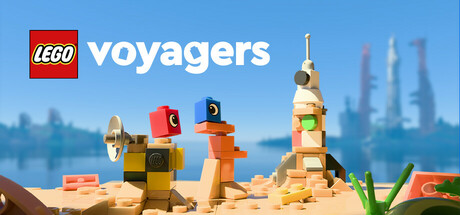
I'm going to be upfront: puzzle-platformers with no combat, no ranked ladder, and no killcam are not my home turf. But I played LEGO Voyagers start to finish with a friend over two sessions, and the thing that stuck with me isn't the puzzles - it's how efficiently the game gets two people actually communicating. Not through a ping wheel or a voice channel, but through physics and necessity. You play as Red or Blue, a pair of single 1x1 LEGO bricks with one expressive eye, and you roll, tumble, snap, and build your way through a dialogue-free story across environments that shift from autumnal nature trails to industrial spaces and eventually a spaceship launch. The whole world is built from real LEGO piece types - the developers reportedly verified every setpiece could be recreated with physical bricks - and the lighting makes it all look genuinely beautiful in motion. The core loop is physics-based co-op puzzle-platforming. Movement is chunky by design: you're a cuboid, not a person, and rolling against steps and edges has real resistance. It takes maybe twenty minutes to click with the controls and then it mostly stops being an issue, though the building segments can get fiddly later on when the multi-step button interactions for snapping, placing, and lifting bricks start overlapping in ways the game doesn't clearly communicate. The puzzles themselves are a mixed bag. The highlights are the split-vehicle sections, where each player controls one half of a boat or truck - one steers, one handles propulsion - and you have to coordinate in real time to navigate semi-open environments. Those feel genuinely designed for two brains. The lowlights are the bridge-building filler sections that show up a few times too many through the back half, where you're basically just stacking loose pieces across a gap again. There's also an isometric camera that occasionally makes depth perception a guessing game, which produces some annoying missed jumps. A fast respawn system catches most of the frustration before it lands, which is the right call for this audience. Runtime is the obvious sticking point for anyone making a value calculation. Most players will finish in four to five hours. There is a cosmetic rocket customization at the end, but that's not replay content in any meaningful sense. The Friend Pass system - one owner can invite someone who doesn't own the game to play for free - softens the entry cost calculation and is worth knowing about before you check out. No crossplay between platforms at launch, which is a real nuisance if your co-op partner is on a different storefront. Who is this actually for? The honest answer is: someone with a specific co-op partner in mind. Parent and kid, couple, close friend who isn't a regular gamer. The difficulty ceiling is low enough that a complete non-gamer can follow along without hitting a wall, and the no-dialogue storytelling is surprisingly effective at generating actual in-session conversation between players. It was nominated for Best Family Game at The Game Awards 2025, and that framing is accurate. If you came here hoping it competes with the mechanical depth of It Takes Two or Split Fiction, it doesn't. It knows it doesn't. It's a shorter, quieter, more atmospheric thing, and within that scope it mostly succeeds.

Shooters
Etiquetas
Requisitos del sistema
Mínimos
- OS
- Windows 10
- Memory
- 8 GB RAM
- Graphics
- NVIDIA GeForce GTX 560 Ti, 1 GB or AMD Radeon HD 6990, 2 GB or Intel Arc A310, 4 GB
- Processor
- Intel Core i5-650 or AMD Athlon II X4 650
Recomendados
- OS
- Windows 10
- Memory
- 8 GB RAM
- Graphics
- NVIDIA GeForce GTX 1060, 6 GB or AMD Radeon RX 5500, 4 GB or Intel Arc A380, 6 GB
- Processor
- Intel Core i5-2550K or AMD Ryzen 3 1200
Sigue explorando
Community Discussion
Be the first to comment on LEGO® Voyagers.
Reseñas y valoraciones
No hay valoraciones disponibles
Información del juego
- Desarrolladora
- Light Brick Studio
- Distribuidora
- Annapurna Interactive
- Fecha de lanzamiento
- 15 sept 2025