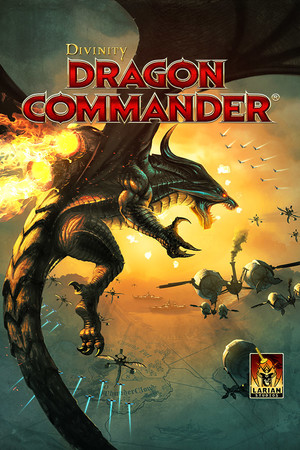
Compara los precios de Divinity: Dragon Commander en tiendas de claves de confianza y encuentra la mejor oferta. Desarrollado por Larian Studios. Publicado por Larian Studios. Lanzado el 6/8/2013. Disponible en PC. Géneros: Action, RPG, Strategy. Puntuación Metacritic: 76/100.

Four genres bolted onto one jetpack-wearing dragon - and somehow Larian made it work. Genre purists will find every layer too shallow; everyone else will find the whole greater than its parts.

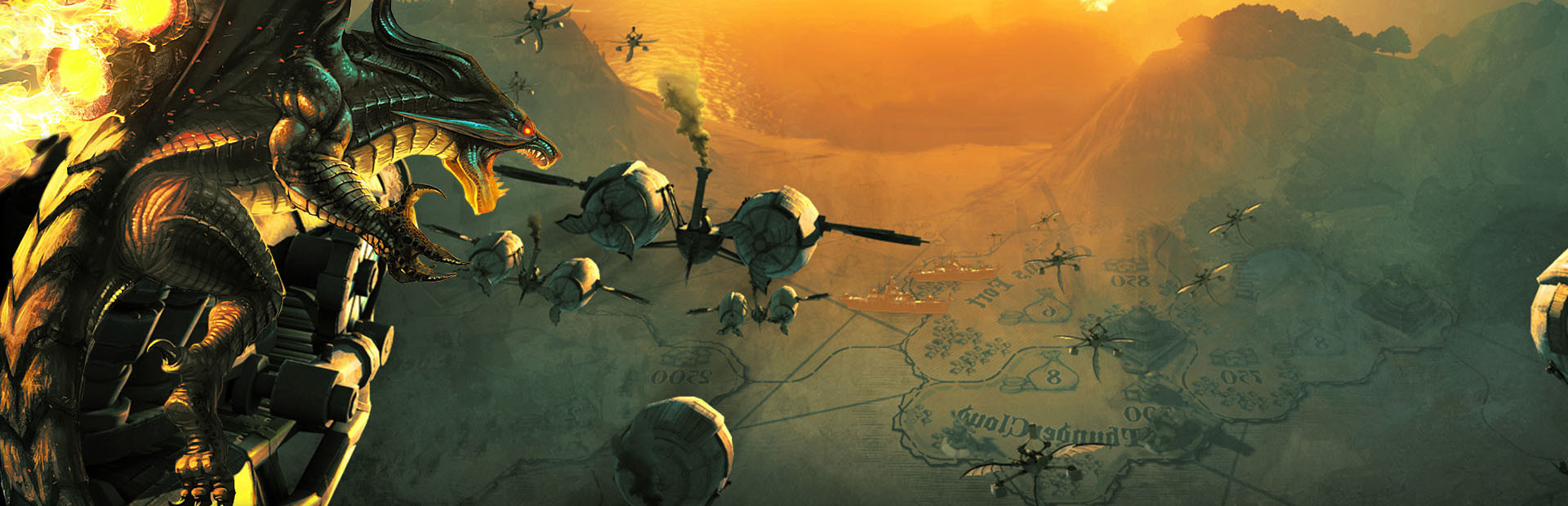
I keep a mental list of games that should not function and yet do. Divinity: Dragon Commander sits near the top of that list. Larian released this in 2013 as something critics genuinely struggled to categorize - part Risk-style board game, part turn-based campaign, part RTS, part political RPG, with a dragon-in-a-jetpack action layer jammed into the middle of all of it. My spreadsheet instincts flagged the whole thing as a structural disaster. They were wrong. The game runs on three interlocking phases. Between turns you walk the corridors of your airship, the Raven, talking to generals, racial ambassadors, and potential wives - each with their own agendas and gameplay payoffs. Political decisions here are not cosmetic: siding with the dwarves on industrial policy affects their combat auto-resolve bonus, their card contributions, and how readily their recruits fill your armies. The questions range from military doctrine to social legislation, with a dry humor that was clearly Larian testing material they would later perfect in Original Sin 2 and Baldur's Gate 3. That shipboard layer is the strongest part of the game, and it is the part no comparable title has since attempted at this scale. The turn-based world map operates like a streamlined Risk board - provinces produce gold and research points, card draws let you sabotage enemy supply lines or boost your own troop counts, and naval chokepoints matter enormously. Ironclads and later Juggernauts sitting in sea lanes are a surprisingly elegant strategic wrinkle. When two stacks clash the game drops into real-time battles, and this is where the depth ceiling becomes visible. Recruits are the single resource, generated by capturing Recruitment Citadels on fixed construction sites. The first two minutes of any engagement are often decisive: whoever grabs more citadels faster controls the economic snowball. Skilled players short-circuit this by transforming into dragon form early, harassing the enemy's expansion with fireball volleys while troopers secure ground. Choose your dragon type at the start - the Mountain Dragon is the community recommendation for new players given its early access to Acid Shot and Blood Leech abilities - and upgrade it consistently, because a well-specced dragon can carry battles that the AI treats as hopeless. The honest critique is that each individual layer is thinner than a dedicated genre entry. The RTS lacks the unit-counter depth of a StarCraft or even an older Command and Conquer. The turn-based map is nowhere near a Paradox game's complexity. The RPG aboard the Raven offers branching consequences but limited re-resolution compared to a full CRPG. The AI across all phases has real weaknesses - experienced players report that a properly specced dragon largely neutralizes the RTS challenge on normal difficulty, and the chapter transitions that strip your accumulated gold and cards are a genuine frustration. Stability at launch was rocky, and while patches addressed major crashes, some players still report technical hiccups on modern hardware. Here is why I would still point strategy newcomers toward this title, though: the shallowness is feature-adjacent for anyone who is not already a genre expert. You can slow RTS battles down via the numpad, adjust difficulty mid-campaign, and the Raven sequences ease you into the card-and-diplomacy loop with enough wit that the tutorial gaps feel manageable. If you bounced off Paradox games because the entry cost was too steep, Dragon Commander's hybrid structure gives you a political simulation, a territory map, and RTS action all in one lighter package - with the added option to turn into a dragon and personally incinerate the problem. Multiplayer dragon-versus-dragon battles also add a dimension the single-player cannot fully replicate, since anti-air units suddenly become critical investments when a human opponent can pop into dragon form unpredictably. The game has dated, but its structural ambition has not aged badly. Diego, Scout Team

Divinity: Dragon Commander

Divinity: Dragon Commander

6 ago 2013Larian Studios
GamerScout opina

Four genres bolted onto one jetpack-wearing dragon - and somehow Larian made it work. Genre purists will find every layer too shallow; everyone else will find the whole greater than its parts.

PC
Steam Deck PlayableProtonDB Gold
Mejor precio disponible
€0.00
en N/A
Mínimo histórico: €5.50

Comparar precios(0 tiendas)

Cargando precios...

We may earn a commission when you buy games through links on this page — at no extra cost to you. It never affects our rankings or verdicts.

Historial de precios

Historical low
€5.5023 Jun 2026
Keyshops
€4.03€9.09€14.15€19.218 Jun13 Jun18 Jun23 Jun28 Jun
Tracking prices since 8 Jun 2026
Create alert

Capturas y multimedia

Acerca de Divinity: Dragon Commander

I keep a mental list of games that should not function and yet do. Divinity: Dragon Commander sits near the top of that list. Larian released this in 2013 as something critics genuinely struggled to categorize - part Risk-style board game, part turn-based campaign, part RTS, part political RPG, with a dragon-in-a-jetpack action layer jammed into the middle of all of it. My spreadsheet instincts flagged the whole thing as a structural disaster. They were wrong. The game runs on three interlocking phases. Between turns you walk the corridors of your airship, the Raven, talking to generals, racial ambassadors, and potential wives - each with their own agendas and gameplay payoffs. Political decisions here are not cosmetic: siding with the dwarves on industrial policy affects their combat auto-resolve bonus, their card contributions, and how readily their recruits fill your armies. The questions range from military doctrine to social legislation, with a dry humor that was clearly Larian testing material they would later perfect in Original Sin 2 and Baldur's Gate 3. That shipboard layer is the strongest part of the game, and it is the part no comparable title has since attempted at this scale. The turn-based world map operates like a streamlined Risk board - provinces produce gold and research points, card draws let you sabotage enemy supply lines or boost your own troop counts, and naval chokepoints matter enormously. Ironclads and later Juggernauts sitting in sea lanes are a surprisingly elegant strategic wrinkle. When two stacks clash the game drops into real-time battles, and this is where the depth ceiling becomes visible. Recruits are the single resource, generated by capturing Recruitment Citadels on fixed construction sites. The first two minutes of any engagement are often decisive: whoever grabs more citadels faster controls the economic snowball. Skilled players short-circuit this by transforming into dragon form early, harassing the enemy's expansion with fireball volleys while troopers secure ground. Choose your dragon type at the start - the Mountain Dragon is the community recommendation for new players given its early access to Acid Shot and Blood Leech abilities - and upgrade it consistently, because a well-specced dragon can carry battles that the AI treats as hopeless. The honest critique is that each individual layer is thinner than a dedicated genre entry. The RTS lacks the unit-counter depth of a StarCraft or even an older Command and Conquer. The turn-based map is nowhere near a Paradox game's complexity. The RPG aboard the Raven offers branching consequences but limited re-resolution compared to a full CRPG. The AI across all phases has real weaknesses - experienced players report that a properly specced dragon largely neutralizes the RTS challenge on normal difficulty, and the chapter transitions that strip your accumulated gold and cards are a genuine frustration. Stability at launch was rocky, and while patches addressed major crashes, some players still report technical hiccups on modern hardware. Here is why I would still point strategy newcomers toward this title, though: the shallowness is feature-adjacent for anyone who is not already a genre expert. You can slow RTS battles down via the numpad, adjust difficulty mid-campaign, and the Raven sequences ease you into the card-and-diplomacy loop with enough wit that the tutorial gaps feel manageable. If you bounced off Paradox games because the entry cost was too steep, Dragon Commander's hybrid structure gives you a political simulation, a territory map, and RTS action all in one lighter package - with the added option to turn into a dragon and personally incinerate the problem. Multiplayer dragon-versus-dragon battles also add a dimension the single-player cannot fully replicate, since anti-air units suddenly become critical investments when a human opponent can pop into dragon form unpredictably. The game has dated, but its structural ambition has not aged badly.

Diego
Diego · Scout Team

Strategy & simulation

Etiquetas

singleplayermultiplayerachievementstrading-cardscloud-savestier:aaaPolitical SimulationDragon CombatHybrid StrategyTurn-Based World MapCard-Based MechanicsRTS-LiteFaction RelationsAirship CampaignSteampunk Fantasy

Requisitos del sistema

Mínimos

OS
Windows XP SP3
Sound
DirectX9c compliant
Memory
2 GB RAM
Graphics
NVIDIA® GeForce® 8800 GT (512 MB) or ATI™ Radeon™ HD 4850
DirectX®
9.0c
Processor
Intel Core2 Duo E6600 or equivalent
Hard Drive
15 GB HD space
Other Requirements
Broadband Internet connection

Recomendados

OS
Windows 7 SP1
Sound
DirectX9c compliant, 5.1 surround sound
Memory
4 GB RAM
Graphics
NVIDIA® GeForce® GTX 550 ti 1GB ram or or ATI™ Radeon™ HD 6XXX
DirectX®
9.0c
Processor
Intel i5 2400
Hard Drive
30 GB HD space
Other Requirements
Broadband Internet connection

Sigue explorando

Community Discussion

Be the first to comment on Divinity: Dragon Commander.

Reseñas y valoraciones

Metacritic
76

Información del juego

Desarrolladora
Larian Studios
Distribuidora
Larian Studios
Fecha de lanzamiento
6 ago 2013

Alerta de precio

¡Recibe un aviso cuando el precio baje de tu objetivo!

Crear alerta

Más de Larian Studios

Compra mejor: guías útiles

¿Buscas más? Mira juegos como Divinity: Dragon Commander →

Preguntas frecuentes sobre Divinity: Dragon Commander

¿Cuánto cuesta Divinity: Dragon Commander?

El precio de Divinity: Dragon Commander cambia a menudo y varía según la tienda, la edición y la región. La tabla de precios en vivo de esta página compara las ofertas más baratas en stock de tiendas de claves de confianza como Eneba y Kinguin, para que siempre veas el precio más bajo actual antes de comprar.

¿Dónde puedo comprar Divinity: Dragon Commander más barato?

Compara los precios de Divinity: Dragon Commander en todas las tiendas verificadas en la tabla de precios de esta página. Listamos las ofertas de claves y tiendas más baratas en stock, actualizadas con frecuencia, para que siempre veas la mejor oferta actual antes de comprar.

¿En qué plataformas está disponible Divinity: Dragon Commander?

Divinity: Dragon Commander está disponible en PC.

¿Cuándo se lanzó Divinity: Dragon Commander?

Divinity: Dragon Commander se lanzó el 6 de agosto de 2013.

¿Quién desarrolló Divinity: Dragon Commander?

Divinity: Dragon Commander fue desarrollado por Larian Studios.

¿Merece la pena comprar Divinity: Dragon Commander?

Divinity: Dragon Commander tiene una puntuación Metacritic de 76/100, lo que lo convierte en uno de los títulos destacados de Action. Mira las reseñas completas, las valoraciones y los tiempos de duración en esta página para decidir.