Worbital
Worms crossed with an RTS, scaled up to a solar system, and run in real-time. Satisfying when a gravity-curved railgun shot lands perfectly; frustrating when the online lobby is a ghost town.
GamerScout Verdict
Best for Worms fans and couch PvP groups; solo players banking on online matchmaking will find an empty lobby.
Compare Prices(6 stores)
Every store in this table quotes us in euros, so the EUR figure is the price the seller actually set, not our arithmetic — which is why EUR is also the currency we rank in. We only list an offer here when the store gives us its price in euros, so nothing in this table is a number we invented.
Pick USD, PLN, GBP, CAD or AUD in the header and we convert from EUR at the European Central Bank reference rate — converted amounts are prefixed with ~. Your bank or the store may apply a different rate at checkout. We never hide offers based on where you are: everyone sees this whole table.
We may earn a commission when you buy games through links on this page — at no extra cost to you. It never affects our rankings or verdicts.
Price History
Screenshots & Media
About Worbital
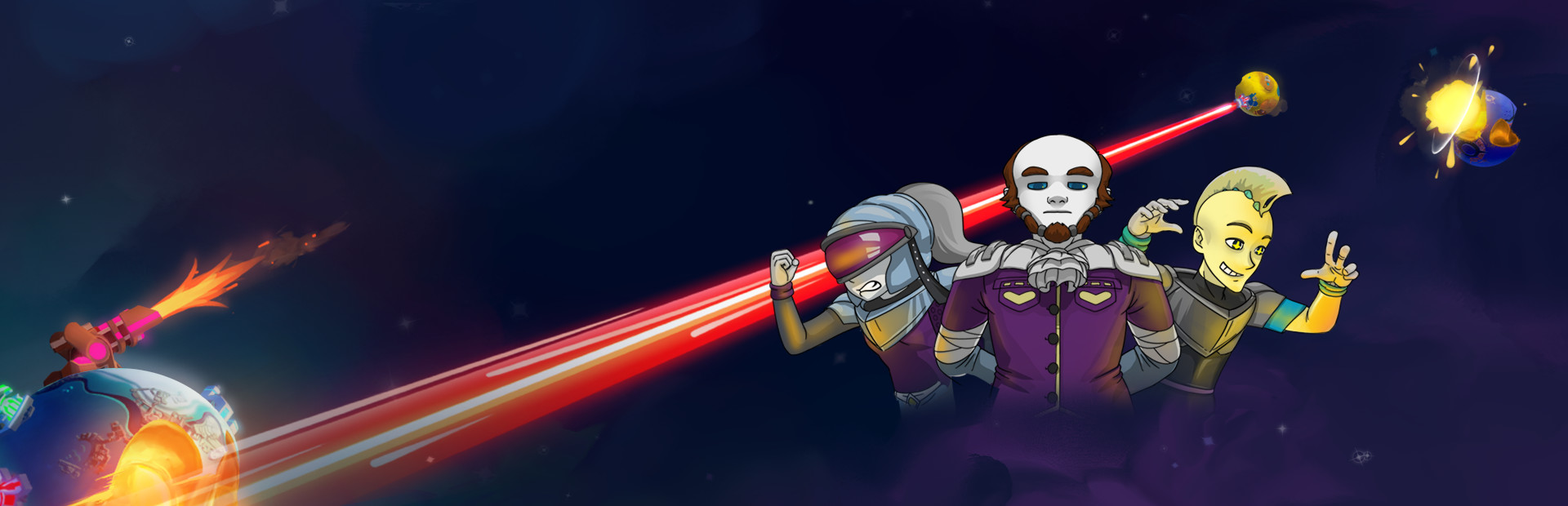
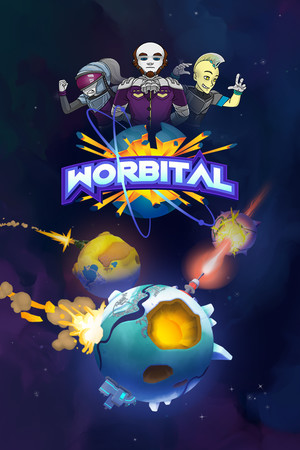
My first reaction to Worbital was that someone took the core concept of Worms, asked "what if the battlefield was an entire solar system and nothing waited for your turn," and then actually shipped it. That pitch alone kept me in for several hours before I started noticing the cracks. This is a real-time artillery strategy game where each player commands a planet orbiting a star, bolts weapons onto its surface, and tries to crack open everyone else's core before their own gets exposed. The mechanics are genuinely clever. Each planet has eight build slots, and because your world is constantly rotating on its axis and orbiting the sun, a turret facing the enemy right now might be on the dark side in thirty seconds. That rotating-platform tension is the game's strongest hook. Weapon selection leans into it hard: railguns and spread cannons follow gravitational arcs and can slingshot around other celestial bodies for trick shots, while lasers cut straight but only fire during a narrow window of line-of-sight. Magnet guns deflect incoming projectiles, Gatling cannons chew through missiles, and the Glacier gun can freeze an enemy turret solid while you reposition. Three factions, Terrene, Lucid, and Celestial, each bring their own toolbox, and the Lucid faction's ability to physically shove planets around is the kind of absurd power that makes local multiplayer genuinely chaotic. Currency (called Dark Matter, earned purely through play) funds upgrades, new slots, and cosmetics, so there is no pay-to-win angle to worry about. The campaign across all three factions tops out at roughly four missions each, and that brevity is actually a net positive. It functions the way a good StarCraft campaign does: teaching you the tool set at a sustainable pace without overstaying its welcome. The story itself is thin, basically three governors who hate each other, and reviewers across the board noted the text-box narrative is mostly skippable. What matters is that by the time you hit skirmish mode or multiplayer, you have a working mental model of how gravitational arcs interact with your loadout choices. Here is where I have to be straight with you: the online population is thin. Multiple reviews across platforms noted that matchmaking regularly returned nobody. If you are buying this game for ranked online matches against strangers, your expectations need to be calibrated accordingly. The local split-screen mode for up to four players (controllers required) is where the PvP actually lives, and in that context it is a solid couch game. Weapon balance has some rough patches too. Short-range options feel situational to the point of being ignored, and once players find a loadout strategy that works, they tend to run it for the entire campaign without much pressure to adapt. The AI can also swing between passive and punishingly accurate in ways that feel inconsistent rather than difficulty-scaled. Performance is a non-issue. Low-poly art style means this runs on modest hardware without complaint, and on a decent rig the explosion physics and projectile trails look properly spectacular in higher resolutions. Mouse and keyboard controls are solid and clean, no complaints there. The game shipped with post-launch content updates that added weapons to each faction, including the Partycle Ball, Bouncer, and Waste Missile, which shows the developer was paying attention to the arsenal depth problem after release. Bottom line on who this is actually for: Worms fans who want something faster and more spatial, couch PvP groups who can fill four controller slots, and anyone who wants a low-cost indie that plays differently from everything else in the genre. Solo players grinding ranked online can keep looking.

Shooters
Tags
System Requirements
Minimum
- OS
- Windows 10
- Memory
- 4 GB RAM
- DirectX
- Version 11
- Network
- Broadband Internet connection
- Storage
- 2 GB available space
- Graphics
- AMD HD 7700 Series, 1 GB VRAM or Nvidia/Intel equivalent
- Processor
- Intel quad core or AMD equivalent
Recommended
Requires a 64-bit processor and operating system
Keep exploring
Community Discussion
Be the first to comment on Worbital.
Reviews & Ratings
Game Info
- Developer
- Team Jolly Roger
- Publisher
- Team Jolly Roger
- Release Date
- Jan 31, 2019