
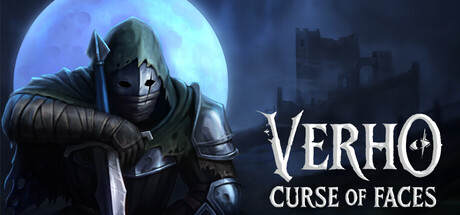
Verho - Curse of Faces
If you have spent years wondering whether anyone would ever nail the King's Field formula, Verho - Curse of Faces is the answer you stopped expecting. A dark, first-person RPG built around masks, mortality, and exploration that bites hard and rarely apologises for it.
GamerScout Verdict
Best for fans of old-school first-person dungeon crawlers who want atmosphere and exploration over hand-holding or modern combat fluidity.
Compare Prices(4 stores)
Every store in this table quotes us in euros, so the EUR figure is the price the seller actually set, not our arithmetic — which is why EUR is also the currency we rank in. We only list an offer here when the store gives us its price in euros, so nothing in this table is a number we invented.
Pick USD, PLN, GBP, CAD or AUD in the header and we convert from EUR at the European Central Bank reference rate — converted amounts are prefixed with ~. Your bank or the store may apply a different rate at checkout. We never hide offers based on where you are: everyone sees this whole table.
We may earn a commission when you buy games through links on this page — at no extra cost to you. It never affects our rankings or verdicts.
Price History
Screenshots & Media
About Verho - Curse of Faces
I put my first hour into Verho convinced I was going to bounce off it. The retro polygonal visuals, the complete absence of a map or quest journal, and a death that dumps you back at a hard save rather than respawning you at a gentle bonfire all felt like deliberate provocations. Then something clicked. The land of Yariv stopped feeling like a technical limitation and started feeling like a place: ruined castles with genuine internal logic, dank underground corridors that connect to foggy wilderness in ways you piece together by memory, scattered notes that flesh out 264 years of masked, sundered civilisation. Kasur Games built a smaller world than most RPGs dare, but every corner of it earns its square footage. The hook is the mask system. Rather than picking a class from a menu, you select a mask at the start, which sets your opening stats toward melee, agility, or spellcasting. Crucially, you are not locked in. Every level-up grants three points to distribute freely across your stats, so a sword-and-board start can drift into a hybrid caster if you find enough intelligence-scaling weapons along the way. Magic users should brace for a loot drought in the mid-game: strength and dexterity builds get fed consistently, while good int-scaling gear arrives in force only toward the end. That imbalance is real and worth knowing before you commit to a wand-waving playthrough. Combat itself is deliberate and weighty, with charge attacks, precise timing windows, and very few defensive options beyond backstepping, jumping, and a handful of shields that the community is divided on. There is no armour system either, so hitpoint investment is essentially mandatory regardless of build. Flying and fast enemies can feel more annoying than threatening, and certain foes clip through geometry in ways that are hard to call intentional. The developers have been patching steadily since launch, so the roughest edges are slowly being sanded down. Where Verho genuinely shines is in the quality of its exploration and its worldbuilding density. Yariv feels coherent in a way that most first-person indie RPGs fumble: the areas connect with internal logic, rewards for curiosity are real (weapons, spells, and lore, not just filler consumables), and the atmosphere of oppression is consistent without tipping into monotony. The narrative delivery is environmental and minimal: you read scattered notes, infer history from architecture, and piece together the curse from NPC fragments. It does not match the narrative ambition of something like Disco Elysium, and anyone hoping for branching dialogue trees or meaningful moral choices will be disappointed. The writing in item descriptions and environmental details rewards close reading, but the voiced NPC dialogue is uneven, with a subdued delivery style that clashes with the otherwise bleak, confident tone. No map and no quest log are not bugs here, they are design statements. You remember routes or you retrace them. You pay attention to dialogue or you wander. I find that friction mostly pleasurable, but it will not be for everyone. On replayability: the flexible build system and the density of secrets mean a second run genuinely reveals things the first one missed. Weapons you lacked the stats to equip, hidden passages you rolled past, environmental puzzles solved by items you never thought to read the description of. For an indie at this price point, the replay argument is solid. The save-point structure, where saving respawns all enemies, creates a grind loop that can feel tedious if you hit a wall, but also functions as a reliable catch-up mechanism when a new area is destroying you. Verho - Curse of Faces is rough, occasionally frustrating, and aesthetically committed to a 32-bit era that some players will simply find ugly. It also has the most convincing sense of dark-fantasy place I have encountered in an indie RPG in years, and a systems-light combat loop that rewards patience and positioning over button timing. The writing needs a stricter editor and the balance needs another patch cycle, but the bones here are exactly right.

RPGs
Tags
System Requirements
Minimum
- OS
- 7
- Memory
- 4 GB RAM
- Storage
- 8 GB available space
- Graphics
- Graphics: NVIDIA® GeForce GTX 470 (1Gb VRAM) / ATI Radeon TM HD 6870 (1Gb VRAM)
- Processor
- AMD Phenom(tm) 8450 Triple-Core Processor (3 CPUs), ~2.1GHz or Intel Core 2 Duo E8400 @ 3.0 GHz
- Sound Card
- DirectX 11 sound device
Recommended
- OS
- 10
- Memory
- 8 GB RAM
- Storage
- 8 GB available space
- Graphics
- Graphics: NVIDIA GeForce GTX 970
- Processor
- Intel Core i5-8400, 4.0 GHz
- Sound Card
- DirectX 11 sound device
Keep exploring
Community Discussion
Be the first to comment on Verho - Curse of Faces.
Reviews & Ratings
No ratings available
Game Info
- Developer
- Kasur Games
- Publisher
- CobraTekku Games
- Release Date
- Nov 10, 2025