
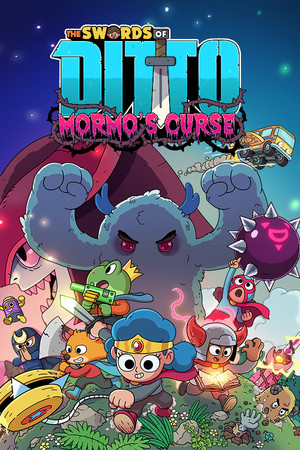
The Swords of Ditto: Mormo's Curse
Charming enough to make you forget you are grinding the same dungeon loop for the third time, but the co-op couch is where this one actually lives.
GamerScout Verdict
Best for couch co-op fans who want a breezy Zelda-flavored roguelite with charm to spare and not much mechanical bite.
Compare Prices(4 stores)
Every store in this table quotes us in euros, so the EUR figure is the price the seller actually set, not our arithmetic — which is why EUR is also the currency we rank in. We only list an offer here when the store gives us its price in euros, so nothing in this table is a number we invented.
Pick USD, PLN, GBP, CAD or AUD in the header and we convert from EUR at the European Central Bank reference rate — converted amounts are prefixed with ~. Your bank or the store may apply a different rate at checkout. We never hide offers based on where you are: everyone sees this whole table.
We may earn a commission when you buy games through links on this page — at no extra cost to you. It never affects our rankings or verdicts.
Price History
Screenshots & Media
About The Swords of Ditto: Mormo's Curse
I came into Swords of Ditto expecting a tight roguelite with a Devolver stamp of quality control. What I got was something messier, softer, and honestly more interesting than I was prepared for, even if it never fully delivers on its own premise. The structure is straightforward: each run spans roughly five or six hours, you play a procedurally generated hero chosen every 100 years to defeat the witch Mormo, and you clear four dungeons before taking her on. Your sword level carries over between runs, which sounds like meaningful progression until you realize the enemies scale with you and you lose most of the tools you worked to acquire. That tension between persistence and reset is the game's central design problem, and it never quite resolves it. The roguelite loop feels half-committed. Weapon variety ranges from bows and bombs to weirder toys like a golf club you use on both enemies and environmental puzzles, or a yo-yo that deals continuous damage. The sticker system lets you slot stat buffs into gear slots, and Mormo throws a random curse modifier at you each new generation to keep things from going completely stale. These systems layer on top of each other in ways that take a full run or two to click, and the onboarding is rough enough that first-timers will spend time confused before anything starts making sense. Combat is the weakest leg of the table. The three-hit sword combo does the heavy lifting in almost every encounter, and while the toy weapons add situational color, critics and players have consistently called out that the secondary arsenal rarely makes a meaningful dent on damage output. Dodge rolling keeps things from becoming completely passive, and enemy variety is solid enough to demand some adaptation run to run. But anyone expecting tight action design will find it too shallow, and anyone expecting deep roguelite build expression will find it too shallow from the other direction. The procedurally generated dungeons have the same problem: the overworld and dungeon layouts can start to feel like rooms stitched together without much craft behind the seams, especially compared to the handcrafted Zelda games it is clearly chasing. Where the game earns its Metacritic 74 is in presentation and co-op. The art style is genuinely great, pastel colors, chunky outlines, enemies that are somehow adorable and threatening, and a kazoo-heavy soundtrack that sticks in your head after you put the controller down. The writing has a specific brand of snarky humor that lands more often than it misses. More importantly, the local co-op slot turns a repetitive solo grind into something much more enjoyable. Puzzle rooms designed for two players, a familiar top-down layout that makes it easy for a less experienced partner to contribute, and the procedural structure keeping sessions from feeling pre-solved all combine to make this one of the better couch co-op options in the indie roguelite space. The Mormo's Curse update removed the punishing original time limit and stripped out the hardcore permadeath from the lower difficulty modes, making this version substantially more approachable than what launched in 2018. If you are buying this solo and you want mechanical depth, the game is going to frustrate you around the second or third run. If you have someone to sit next to and you both enjoy top-down action-adventure with some progression texture, this punches well above its weight. Manage expectations on the combat and the dungeon design, and what remains is a genuinely charming, occasionally surprising package.

Shooters
Tags
System Requirements
Minimum
- OS
- Windows 7/8/8.1/10 x86/x64
- Memory
- 4 GB RAM
- DirectX
- Version 9.0c
- Storage
- 1 GB available space
- Graphics
- Intel HD 4000
- Processor
- Intel Core i5-3210M (2 * 2500) or equivalent
Recommended
- OS
- Windows 7/8/8.1/10 x64
- Memory
- 8 GB RAM
- DirectX
- Version 9.0c
- Storage
- 1 GB available space
- Graphics
- GeForce GTX 460 (1024 MB) or Radeon HD 6850 (1024 MB)
- Processor
- Intel Pentium G3250 (2 * 3200) or AMD Phenom 9850 Quad-Core (4 * 2500) or equivalent
Keep exploring
Community Discussion
Be the first to comment on The Swords of Ditto: Mormo's Curse.
Reviews & Ratings
Game Info
- Developer
- onebitbeyond
- Publisher
- Devolver Digital
- Release Date
- Apr 24, 2018