Super Blood Hockey
Blades of Steel by way of a dystopian prison yard: four-player local chaos that runs deep enough to keep you up managing inmate diets between periods.
GamerScout Verdict
Lock-in purchase for couch PvP nights; solo players will enjoy franchise mode but will feel the missing online multiplayer hard.
Compare Prices(6 stores)
Every store in this table quotes us in euros, so the EUR figure is the price the seller actually set, not our arithmetic — which is why EUR is also the currency we rank in. We only list an offer here when the store gives us its price in euros, so nothing in this table is a number we invented.
Pick USD, PLN, GBP, CAD or AUD in the header and we convert from EUR at the European Central Bank reference rate — converted amounts are prefixed with ~. Your bank or the store may apply a different rate at checkout. We never hide offers based on where you are: everyone sees this whole table.
We may earn a commission when you buy games through links on this page — at no extra cost to you. It never affects our rankings or verdicts.
Price History
Screenshots & Media
About Super Blood Hockey
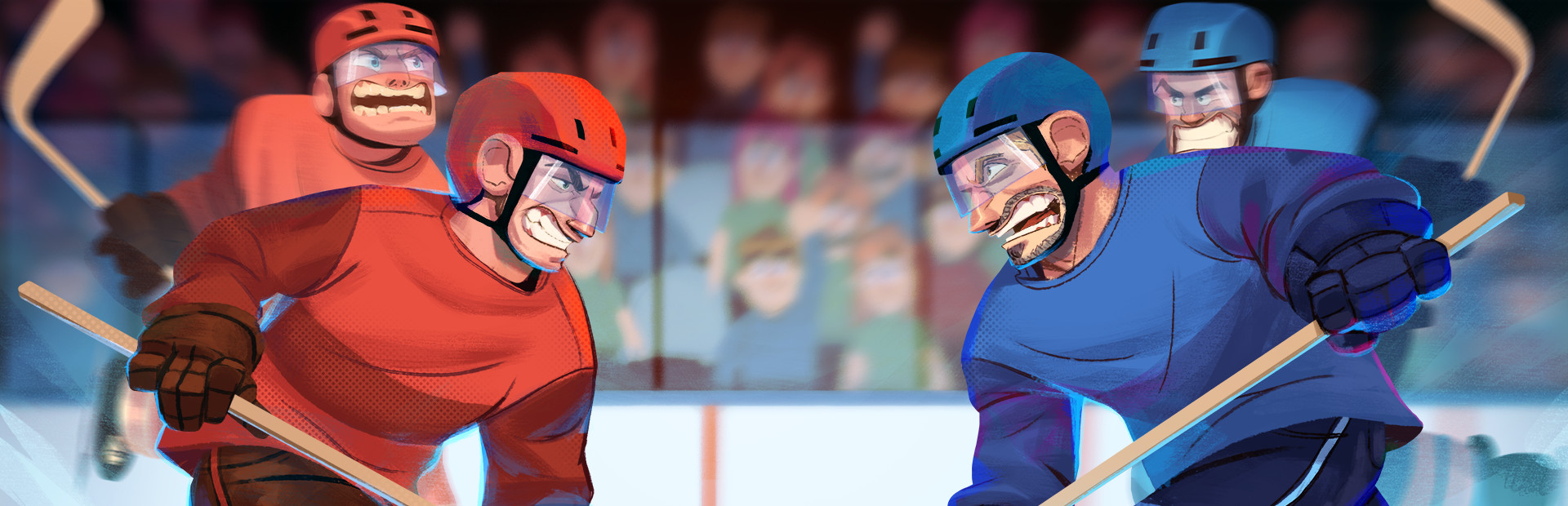
My first instinct with Super Blood Hockey was to treat it as a novelty, a gore-soaked throwback you pull out at a party and put back on the shelf an hour later. I was wrong, and the franchise mode is why. Solo players who expect a quick laugh and log off will miss the part that actually bites back. On the ice it's 5-on-5 top-down arcade hockey clearly descended from the NES Ice Hockey template: pass, shoot, check, switch player. Four buttons. The three skater archetypes, enforcer, sniper, and playmaker, have real trade-offs in speed, hitting power, and accuracy, so roster composition matters before the puck drops. Scored goals demand patience. Spam the shoot button and the AI will farm you; the viable path is positioning, one-timers, and angled placement shots that require holding charge and flicking direction. The goalie is genuinely difficult to beat, which splits opinion, but I find it respects the sport more than most arcade titles bother to. Charged power shots go wide constantly at first, and that initial difficulty spike has turned off players who expected an easy mode to feel like one. It doesn't. Even on easy the CPU keeps you honest. The combat layer is where the game earns its name. Checking the same opponent repeatedly triggers a full line brawl, all ten skaters dropping gloves simultaneously. The winning team earns a power play, not a penalty, which is a sharp design inversion. Injuries on the losing side range from cosmically funny minor wounds to actual in-game deaths, the dead player's body left convulsing on the ice while play resumes around it. The fighting controls are the weakest link here; tracking which of your players is brawling in the chaos is harder than it should be, and the mechanic feels underdeveloped relative to how often it happens. Franchise mode is the unexpected hook. You recruit a team of prison inmates, fund the operation by selling a kidney in the opening cutscene, then micromanage diet, training load, black-market pharmaceuticals, and healthcare decisions across a season of roughly 30 days. Players accumulate brain damage as a tracked stat. That absurdist management layer has a low-key Punch Club energy to it, and the dark satire lands because the writing keeps a straight face. The AI in franchise solo play is inconsistent, liable to hand you automatic goals one match and aggressively trap you the next, which caps the solo ceiling. There is no online multiplayer, a gap multiple reviewers flagged since launch, and that limitation has never been addressed. For local co-op up to four players, the conversation changes completely. The chaos on screen becomes a feature, the difficulty becomes a shared puzzle, and the injury text becomes running comedy. If you have a couch and three people willing to pick up controllers, this is one of the better low-barrier competitive experiences at this price tier. Solo players who want depth past the franchise loop will hit a wall. Online-only households should look elsewhere entirely.

Shooters
Tags
System Requirements
Minimum
- OS
- Windows XP (SP3), Windows Vista (SP2), Windows 7, Windows 8, Windows 10
- Memory
- 2 GB RAM
- DirectX
- Version 9.0c
- Storage
- 300 MB available space
- Graphics
- GeForce 8800 or equivalent.
- Processor
- 2.0 GHz Dual Core Processor
- Sound Card
- DirectX 9.0c compatible.
Keep exploring
Community Discussion
Be the first to comment on Super Blood Hockey.
Reviews & Ratings
No ratings available
Game Info
- Developer
- Loren Lemcke
- Publisher
- Loren Lemcke
- Release Date
- Aug 17, 2017