Stage Presence
Your mic is the only controller here, and the game will happily accept you reading a phone book as a "song" - funny for one session, thin as a party trick after that.
GamerScout Verdict
Worth one chaotic party session in VR with friends; solo players will hit the content ceiling in under an hour.
Compare Prices(7 stores)
Every store in this table quotes us in euros, so the EUR figure is the price the seller actually set, not our arithmetic — which is why EUR is also the currency we rank in. We only list an offer here when the store gives us its price in euros, so nothing in this table is a number we invented.
Pick USD, PLN, GBP, CAD or AUD in the header and we convert from EUR at the European Central Bank reference rate — converted amounts are prefixed with ~. Your bank or the store may apply a different rate at checkout. We never hide offers based on where you are: everyone sees this whole table.
We may earn a commission when you buy games through links on this page — at no extra cost to you. It never affects our rankings or verdicts.
Price History
Screenshots & Media
About Stage Presence
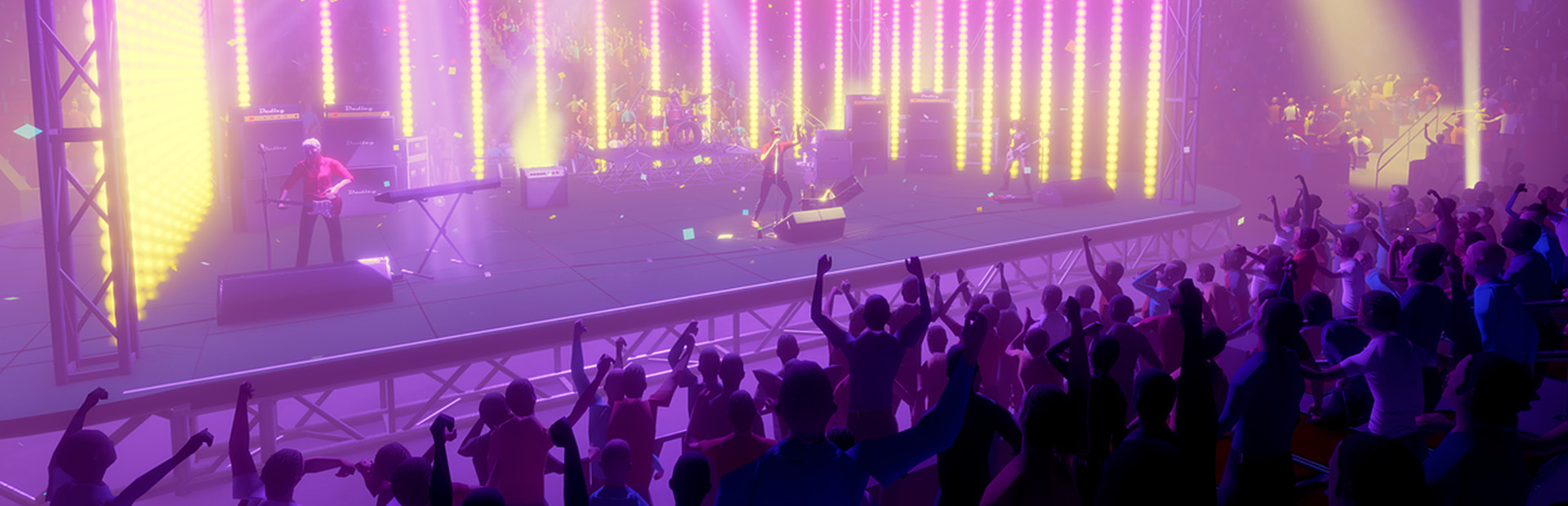
I came to Stage Presence expecting something with the same competitive pull that keeps rhythm game players grinding leaderboards at 2am. What I found instead is a novelty act that burns bright for about thirty minutes and then quietly dims. The core loop puts you on stage as a vocalist whose band's gear has catastrophically failed, so you improvise at the microphone while your crew fixes things behind you. Pitch variance and volume are what the game's detection actually tracks, not melody or rhythm - which means the system genuinely cannot tell if you are belting a power ballad or reciting your grocery list. Reviewers noted that reading anything aloud would register as a valid performance, and that mechanical hole undercuts the whole premise. The campaign runs you through a handful of escalating venues - an arena, a haunted cathedral, an exploding moon base - each with a hostile crowd that throws bottles, shines laser pens, and eventually mutates into demons if you fail to hold their attention. The props and consumables you unlock between rounds add some texture: Cool Shades block the laser penalty while boosting melodic-singing points, a Smashable Guitar bumps crowd mood, and the BASS DROP is exactly what it sounds like. There are four difficulty modes covering Easy through Hard plus a Freeplay option for zero-stakes sessions. The Survival mode asks you to hold the crowd indefinitely rather than for a fixed timer, and there is a Karaoke mode that lets you load a local music file - though the folder navigation is cramped and the mode itself is unscored, more of a self-amusement option than a proper gameplay addition. The multiplayer angle is honestly the best argument for owning this. Drop-In Multiplayer lets other players join your show as crowd members, arming them with laser pens, glowsticks, bottles, and flares to either cheer you toward your score target or actively bury you. In a party setting with friends on voice chat, that adversarial crowd loop has genuine comedy value. Outside of that context, the solo game runs out of things to say very quickly. Flat-screen play feels especially thin because VR is clearly where the concept was designed to live - the stage-fright feedback loop works far better with a headset on. Steam reviews landed at a mixed 60 percent across a small sample, which tracks with the "funny once" consensus across third-party coverage. The game functions reliably enough, but there is very little depth beneath the surface layer, and the content ceiling is low. If you have a VR headset, a working mic, and a group of friends willing to take turns humiliating the person on stage, Stage Presence earns its runtime as a party game and nothing more. Solo players or anyone hoping for an actual rhythm game should look elsewhere - there is no skill progression worth chasing here, and the leaderboard for "least hated singer on the planet" is not going to hold your attention the way a proper score-attack game would. The idea is clever. The execution is thin.

Shooters
Tags
System Requirements
Minimum
- OS
- Windows 10
- Memory
- 8 GB RAM
- DirectX
- Version 11
- Storage
- 2 GB available space
- Graphics
- GTX 970
- Processor
- Intel i5-4690K
- Sound Card
- N/A
- VR Support
- SteamVR. Standing or Room Scale
Recommended
- OS
- Windows 10
- Memory
- 16 GB RAM
- DirectX
- Version 12
- Network
- Broadband Internet connection
- Storage
- 2 GB available space
- Graphics
- GTX 1070
- Processor
- Intel i5-4690K
- Sound Card
- N/A
Keep exploring
Community Discussion
Be the first to comment on Stage Presence.
Reviews & Ratings
No ratings available
Game Info
- Developer
- Sea Green Games
- Publisher
- tinyBuild
- Release Date
- Feb 28, 2017