
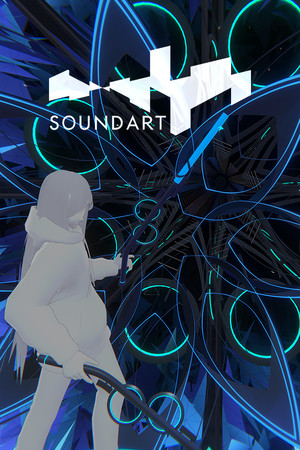
Compare SOUNDART prices across 50+ stores and find the best deal. Developed by MercuryStudio. Published by PLAYISM. Released on 4/2/2020. Available on PC. Genres: Action, Casual, Indie, Sports.

If your music library is your most prized possession and you own a VR headset, SOUNDART turns any track you already own into a neon-drenched arm workout. The catch: it trades competitive precision for pure vibe.

My first thought putting SOUNDART on was that someone had mashed a kaleidoscope, a drumline, and a fitness app into a single VR session, and honestly that description still holds up. You stand in place facing a large eight-petal flower formation and use your motion controllers as percussive sticks, hitting cubes that flow toward you in sync with the beat, cycling through three distinct strike types: pound (straight down), swing (lateral), and thrust (forward jab, saved for the big musical moments with matching flash effects). That core loop sounds thin on paper, but in practice the arm movement stacks up fast, and the end-of-session calorie and hand-travel distance readouts are a fun little bonus that the game tracks. The headline hook is the music system. SOUNDART accepts MP3, WAV, OGG, and AIFF files directly from your hard drive, instantly generates a playable chart from whatever you drop in, and reportedly works best with rock and pop. That is genuinely impressive out of the box and sidesteps the DLC treadmill other rhythm games put you on. The bundled library runs close to 40 tracks, which is a respectable starting point. The problem that multiple reviewers flag, and that I think is worth being straight about, is that procedurally generated charts are inherently looser than hand-authored ones. Notes do not always land on the beats you expect, and the hit window is wide enough that you rarely get a clean sense of nailing something versus winging it. If you come from Beat Saber expecting that satisfying crunch of precision, SOUNDART is noticeably softer around the edges. The accessibility angle works in its favour more than it hurts it. Because you only need arm movement and zero floor space, it is a realistic option for smaller play areas where full-body VR is impractical. There is a short built-in tutorial, the difficulty curve is gentle, and a fail state appears to be absent entirely, meaning you can never actually lose a song. Competitive players will find that frustrating; casual riders will love it. There are per-song leaderboards, though how custom music entries get ranked against each other is not well explained in-game. The dance mode, which opens up freestyle gestures at prompted moments, is more of a performance layer for spectators than something that changes your scoring meaningfully. Concert Mode is where SOUNDART shows real character. A second monitor or stream window displays a dynamic camera cut of your avatar playing the game, while you stay locked in first person inside the headset. The default avatar is a robot, but you can swap in any VRM-format model, which the community has taken surprisingly far given the game's modest player count. It is a genuinely fun setup if you stream or want to put on a short show for whoever is in the room with you. Photosensitivity warning applies here: the visuals in modes like Blossom and Urban get busy, strobe-adjacent, and very colourful. Anyone sensitive to that should approach with caution. Bottom line: SOUNDART is not the most polished or mechanically demanding VR rhythm game on the market. It does one thing that most of its rivals still have not fully cracked, which is letting you load any audio file you already own without friction or extra cost. For casual sessions, small play spaces, or content creators wanting a visual spectacle tied to their own playlist, that is real value. For players chasing ranked precision and hand-crafted chart design, the competition still wins. Riley, Scout Team

SOUNDART
ActionCasualIndieSports

SOUNDART

Apr 2, 2020MercuryStudioPLAYISM
GamerScout Says

If your music library is your most prized possession and you own a VR headset, SOUNDART turns any track you already own into a neon-drenched arm workout. The catch: it trades competitive precision for pure vibe.

PC
Best Price Available
0.00
at N/A
Historical low: $3.98

Compare Prices(0 stores)

Loading prices...

We may earn a commission when you buy games through links on this page — at no extra cost to you. It never affects our rankings or verdicts.

Screenshots & Media

Screenshot

About SOUNDART

My first thought putting SOUNDART on was that someone had mashed a kaleidoscope, a drumline, and a fitness app into a single VR session, and honestly that description still holds up. You stand in place facing a large eight-petal flower formation and use your motion controllers as percussive sticks, hitting cubes that flow toward you in sync with the beat, cycling through three distinct strike types: pound (straight down), swing (lateral), and thrust (forward jab, saved for the big musical moments with matching flash effects). That core loop sounds thin on paper, but in practice the arm movement stacks up fast, and the end-of-session calorie and hand-travel distance readouts are a fun little bonus that the game tracks. The headline hook is the music system. SOUNDART accepts MP3, WAV, OGG, and AIFF files directly from your hard drive, instantly generates a playable chart from whatever you drop in, and reportedly works best with rock and pop. That is genuinely impressive out of the box and sidesteps the DLC treadmill other rhythm games put you on. The bundled library runs close to 40 tracks, which is a respectable starting point. The problem that multiple reviewers flag, and that I think is worth being straight about, is that procedurally generated charts are inherently looser than hand-authored ones. Notes do not always land on the beats you expect, and the hit window is wide enough that you rarely get a clean sense of nailing something versus winging it. If you come from Beat Saber expecting that satisfying crunch of precision, SOUNDART is noticeably softer around the edges. The accessibility angle works in its favour more than it hurts it. Because you only need arm movement and zero floor space, it is a realistic option for smaller play areas where full-body VR is impractical. There is a short built-in tutorial, the difficulty curve is gentle, and a fail state appears to be absent entirely, meaning you can never actually lose a song. Competitive players will find that frustrating; casual riders will love it. There are per-song leaderboards, though how custom music entries get ranked against each other is not well explained in-game. The dance mode, which opens up freestyle gestures at prompted moments, is more of a performance layer for spectators than something that changes your scoring meaningfully. Concert Mode is where SOUNDART shows real character. A second monitor or stream window displays a dynamic camera cut of your avatar playing the game, while you stay locked in first person inside the headset. The default avatar is a robot, but you can swap in any VRM-format model, which the community has taken surprisingly far given the game's modest player count. It is a genuinely fun setup if you stream or want to put on a short show for whoever is in the room with you. Photosensitivity warning applies here: the visuals in modes like Blossom and Urban get busy, strobe-adjacent, and very colourful. Anyone sensitive to that should approach with caution. Bottom line: SOUNDART is not the most polished or mechanically demanding VR rhythm game on the market. It does one thing that most of its rivals still have not fully cracked, which is letting you load any audio file you already own without friction or extra cost. For casual sessions, small play spaces, or content creators wanting a visual spectacle tied to their own playlist, that is real value. For players chasing ranked precision and hand-crafted chart design, the competition still wins. Riley, Scout Team

Tags

singleplayerachievementstier:sub-5VR-OnlyProcedural ChartsCustom Music ImportConcert ModeSmall-Space VRArm-Movement WorkoutStreamer-Friendly

Steam Deck & Linux

Steam Deck Unsupported

Valve rates this game Steam Deck Unsupported.

System Requirements

Minimum

OS
Windows 7, 10
Memory
4 GB RAM
Storage
1 GB available space
Graphics
GeForce GTX 970
Processor
Core i5 4590
VR Support
SteamVR

Recommended

OS
Windows 10
Memory
6 GB RAM
Network
Broadband Internet connection
Storage
1 GB available space
Graphics
GeForce GTX 1660 higher
Processor
Core i7 series

Community Discussion

Be the first to comment on SOUNDART.

Reviews & Ratings

No ratings available

Game Info

Developer
MercuryStudio
Publisher
PLAYISM
Release Date
Apr 2, 2020

Price Alert

Get notified when the price drops below your target!

Create Alert

Price History

2026-06-103.98(lowest)

More from MercuryStudio

Buy smarter: helpful guides

Frequently asked questions about SOUNDART

How much does SOUNDART cost?

SOUNDART pricing changes often and varies by store, edition and region. The live price table on this page compares the cheapest in-stock key and store offers across 50+ verified shops, so you always see the current lowest price before you buy.

Where can I buy SOUNDART cheapest?

Compare SOUNDART prices across every verified store in the price table on this page. We list the cheapest in-stock key and store offers, updated regularly, so you always see the best current deal before you buy.

What platforms is SOUNDART available on?

SOUNDART is available on PC.

When was SOUNDART released?

SOUNDART was released on 2 April 2020.

Who developed SOUNDART?

SOUNDART was developed by MercuryStudio and published by PLAYISM.