
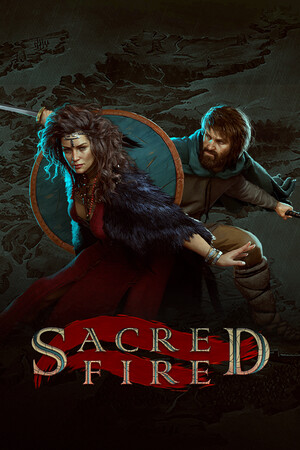
Sacred Fire: A Role Playing Game
Forget stat blocks and loot tables - Sacred Fire makes your character's fear, rage, and willpower the actual combat system, and that single design bet pays off more often than you'd expect from a solo-dev Early Access title.
GamerScout Verdict
Best for narrative RPG fans who want their character's mental state to actually drive combat - approach with Early Access patience.
Compare Prices(7 stores)
Every store in this table quotes us in euros, so the EUR figure is the price the seller actually set, not our arithmetic — which is why EUR is also the currency we rank in. We only list an offer here when the store gives us its price in euros, so nothing in this table is a number we invented.
Pick USD, PLN, GBP, CAD or AUD in the header and we convert from EUR at the European Central Bank reference rate — converted amounts are prefixed with ~. Your bank or the store may apply a different rate at checkout. We never hide offers based on where you are: everyone sees this whole table.
We may earn a commission when you buy games through links on this page — at no extra cost to you. It never affects our rankings or verdicts.
Price History
Screenshots & Media
About Sacred Fire: A Role Playing Game
I went in expecting a glorified visual novel with dice window dressing, and came out genuinely rattled by how well Sacred Fire weaponizes psychology against the player. The premise is tight: you are a Caledonian refugee, an outsider in your own honor-bound tribal culture, caught between Roman legions pushing past Hadrian's Wall and a fractured resistance that can barely stand together long enough to fight. Developer Andrej Vojtas - who is, impressively, the sole designer, writer, coder, and artist behind the project - builds the whole game around one question that more RPGs should ask: what does it feel like to make a hard choice when you are already afraid? The answer is a psychological combat system unlike anything I have seen in the genre. Fear weakens your attacks. Anger powers them up but bleeds your defense and makes you reckless. Willpower, a scarce and precious resource, is what you spend to actually guarantee a dice outcome rather than praying the roll lands. Mindsets (passive thought upgrades), Renown titles, and Goodwill points earned through kindness toward NPCs all feed into a character model where your personality literally shapes your stats. There are five Elite Trait archetypes - Warrior, Leader, Genius, Icon, Friend - that you can mix on character creation, and the game does a reasonable job of making each feel distinct in how conflicts resolve. Rhetorical skill checks land differently from raw aggression, and talking a Roman soldier into a bad decision is genuinely satisfying in a way that just stabbing him is not. The soft-choice system lets you retry text-based decisions up to three times, but each failure bumps your fear or anger meter, which tightens the noose on subsequent rolls. Risky choices, the hard checks like firing an arrow mid-sprint, have no retry; you commit and live with it. The narrative earns its branching structure. Important NPCs can die, relationships shift based on goodwill versus neglect, and story-altering figures in one playthrough may never appear in another. The writing is notably tight, with inner monologue doing most of the heavy lifting - the protagonist's self-reflection reads like someone who has actually processed trauma rather than simply narrated it. Voice acting (featuring Doug Cockle of Witcher fame) adds real weight to key scenes. The five planned endings and three-act structure give the whole thing meaningful shape, and community feedback drove the developer to rebuild the Act 3 epilogue from scratch into fully playable post-siege scenes - a sign of genuine investment in the player experience. One save slot is a deliberate pressure tool, not laziness: it keeps you honest. That said, Sacred Fire is still in Early Access and carries the caveats that come with that. Steam's own developer page notes that the last update was posted over fourteen months ago, which is a legitimate pause point for anyone risk-averse about unfinished games. The tutorial front-loads information aggressively, the flat cutout art style is functional rather than beautiful, and the single-save structure will genuinely frustrate players who want to experiment freely without consequence. This is not a game for people who want to feel powerful - it is a game for people who want to feel conflicted, which is a much smaller (and more interesting) audience. If Disco Elysium made you care about a detective's spiral into self-knowledge, Sacred Fire will speak your language. If you bounced off text-heavy games at the first dice roll, nothing here will convert you. For narrative RPG fans who are comfortable with Early Access and genuinely curious about a combat system built on emotional states rather than weapon types, this is one of the more original designs the indie space has produced.

RPGs
Tags
System Requirements
Minimum
- OS
- Windows 7 64-bit
- Memory
- 4 GB RAM
- DirectX
- Version 10
- Storage
- 2 GB available space
- Graphics
- Intel HD 4400
- Processor
- Intel dual core @ 1.7GHz
Recommended
- OS
- Windows 10 64-bit
- Memory
- 4 GB RAM
- DirectX
- Version 10
- Storage
- 2 GB available space
- Graphics
- NVIDIA GeForce GTX 960 or AMD Radeon R7 370
- Processor
- i5 3.4Ghz
Keep exploring
Community Discussion
Be the first to comment on Sacred Fire: A Role Playing Game.
Reviews & Ratings
No ratings available
Game Info
- Developer
- Poetic
- Publisher
- Iceberg Interactive
- Release Date
- Oct 18, 2021