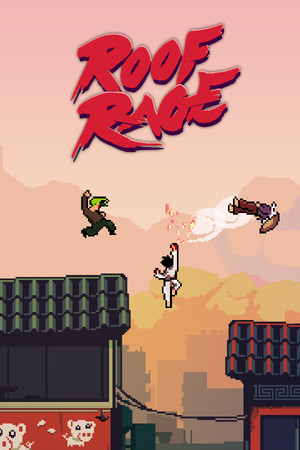
Roof Rage
If your couch needs a brawler that can fit eight bodies and actually has mechanical teeth, Roof Rage punches well above its price tag - just don't expect a healthy online population to carry you solo.
GamerScout Verdict
Best for local multiplayer nights - the traditional fighter mechanics add real depth, but the online population is too small to sustain solo play.
Compare Prices(7 stores)
Every store in this table quotes us in euros, so the EUR figure is the price the seller actually set, not our arithmetic — which is why EUR is also the currency we rank in. We only list an offer here when the store gives us its price in euros, so nothing in this table is a number we invented.
Pick USD, PLN, GBP, CAD or AUD in the header and we convert from EUR at the European Central Bank reference rate — converted amounts are prefixed with ~. Your bank or the store may apply a different rate at checkout. We never hide offers based on where you are: everyone sees this whole table.
We may earn a commission when you buy games through links on this page — at no extra cost to you. It never affects our rankings or verdicts.
Price History
Screenshots & Media
About Roof Rage
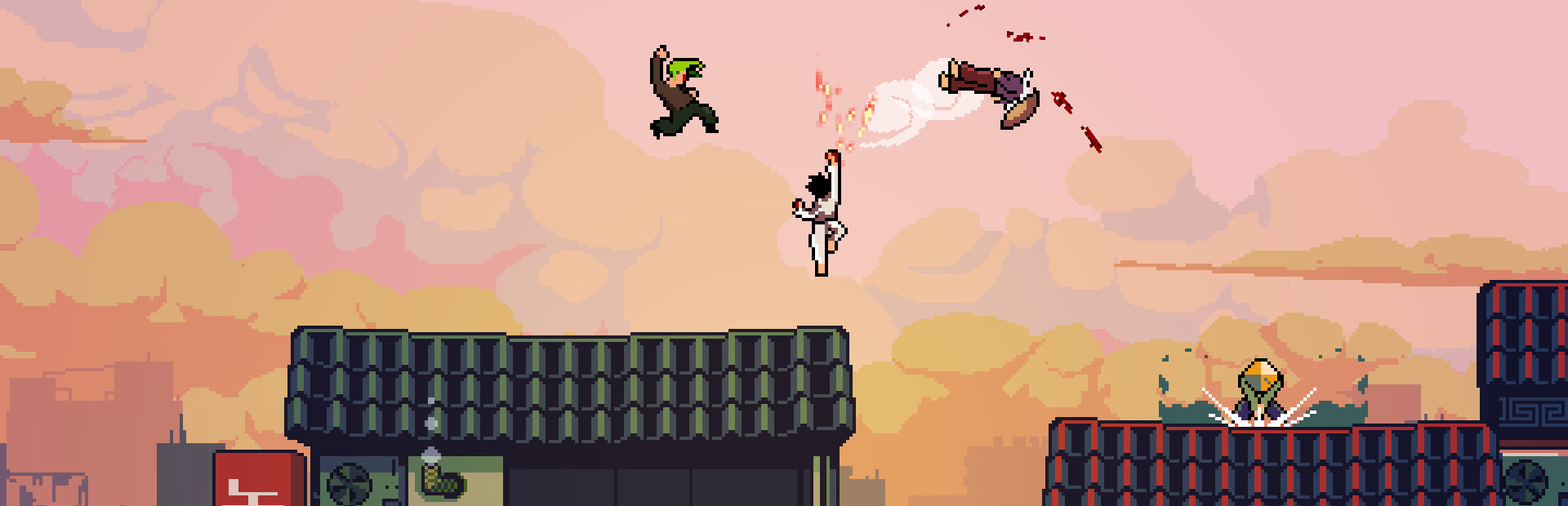
My instinct with sub-five-dollar platform fighters is to assume they're Smash clones with placeholder art and a forgotten netcode branch. Roof Rage mostly proves that instinct wrong, and the part where it does is interesting enough to talk about. Early Melon's solo project does pull hard from the Smash playbook - stock lives, ring-outs, double and wall jumps, a shield with dodge i-frames - but then quietly dismantles two of Smash's core pillars: analog movement is gone, replaced with 8-way digital inputs, and percentage-based damage is swapped for health bars. That combo changes the feel of every fight. Trajectories become readable, punishment becomes sharper, and a few clean hits can end a stock fast. It plays less like a party fighter and more like a traditional 2D fighter that happens to have platforms under it. The 13 characters are the game's best argument. Jin the samurai, Hoon the taekwondo specialist with clear Ryu DNA, a gunslinger named Leon (yes, that Leon), and a growing cast that runs from martial artists to more left-field picks. Each one has a distinct move suite - safe normals, a low-damage long-range projectile, and air dodges that double as offensive tools and recovery options. Wave-dashing is in, parrying is in, and the smash attack serves as a proper finisher rather than a high-percentage Hail Mary. The combo potential is real, and discovering it per character is genuinely enjoyable. You can also grab and throw roof tiles, catch incoming projectiles, and deflect them back - small details that add layers without cluttering the screen. Where things get honest: the single-player arcade mode is thin. The AI at lower difficulties mostly camps and jumps rather than engaging, which makes labbing solo a frustrating way to learn. There is no tutorial, so expect your first few matches to be confusing if you come in cold from Smash. The local multiplayer is the obvious sweet spot - up to 8 players across stock, score, team, and practice modes on 13 culturally inspired rooftop stages. Squeezing all eight fighters onto stages not really designed for that count leads to chaos, but three or four players hits the ideal balance between readability and carnage. The pixel art is clean if modest, and the soundtrack has that early-90s fighting game energy that fits the aesthetic without trying too hard. The online side is where I have the most hesitation. It is 1v1 only - quick random match or private invite - and the active PC population is small enough that finding a random opponent takes patience. If you have a friend to invite, the online works, but ranked grinding or building matchup knowledge against strangers is not really on the menu here. Netcode quality has not been independently benchmarked at any meaningful scale, so I can't call it solid or broken - just thin in population. For a game at this price, that's forgivable. For someone buying it primarily to play online, it's a real caveat worth knowing upfront. Bottom line: this is a local multiplayer brawler first, a casual competitive fighter second, and an online game a distant third. The mechanical ambition is genuine - the traditional fighter DNA grafted onto a platform fighter structure is a legitimate design choice, not a gimmick - and the character variety justifies multiple sessions. Solo players and online-first buyers will hit its ceiling fast. Everyone else at a LAN night or with controllers to spare will find it punches above its weight class.

Shooters
Tags
System Requirements
Minimum
- OS
- Microsoft® Windows® Vista / 7 / 8 / 10
- Memory
- 512 MB RAM
- Storage
- 500 MB available space
- Graphics
- Integrated graphic card with at least 32MB of video memory
- Processor
- 1.2GHz processor
Keep exploring
Community Discussion
Be the first to comment on Roof Rage.
Reviews & Ratings
No ratings available
Game Info
- Developer
- Early Melon
- Publisher
- Early Melon
- Release Date
- Oct 16, 2019