Pine
Open-world sim where rival AI species actually pursue their own agendas, your job is to survive and nudge the balance of power.
GamerScout Verdict
Best for players who want a living-world faction sim and can forgive thin combat, sparse writing, and visible AI seams.
Compare Prices(6 stores)
Every store in this table quotes us in euros, so the EUR figure is the price the seller actually set, not our arithmetic — which is why EUR is also the currency we rank in. We only list an offer here when the store gives us its price in euros, so nothing in this table is a number we invented.
Pick USD, PLN, GBP, CAD or AUD in the header and we convert from EUR at the European Central Bank reference rate — converted amounts are prefixed with ~. Your bank or the store may apply a different rate at checkout. We never hide offers based on where you are: everyone sees this whole table.
We may earn a commission when you buy games through links on this page — at no extra cost to you. It never affects our rankings or verdicts.
Price History
Screenshots & Media
About Pine
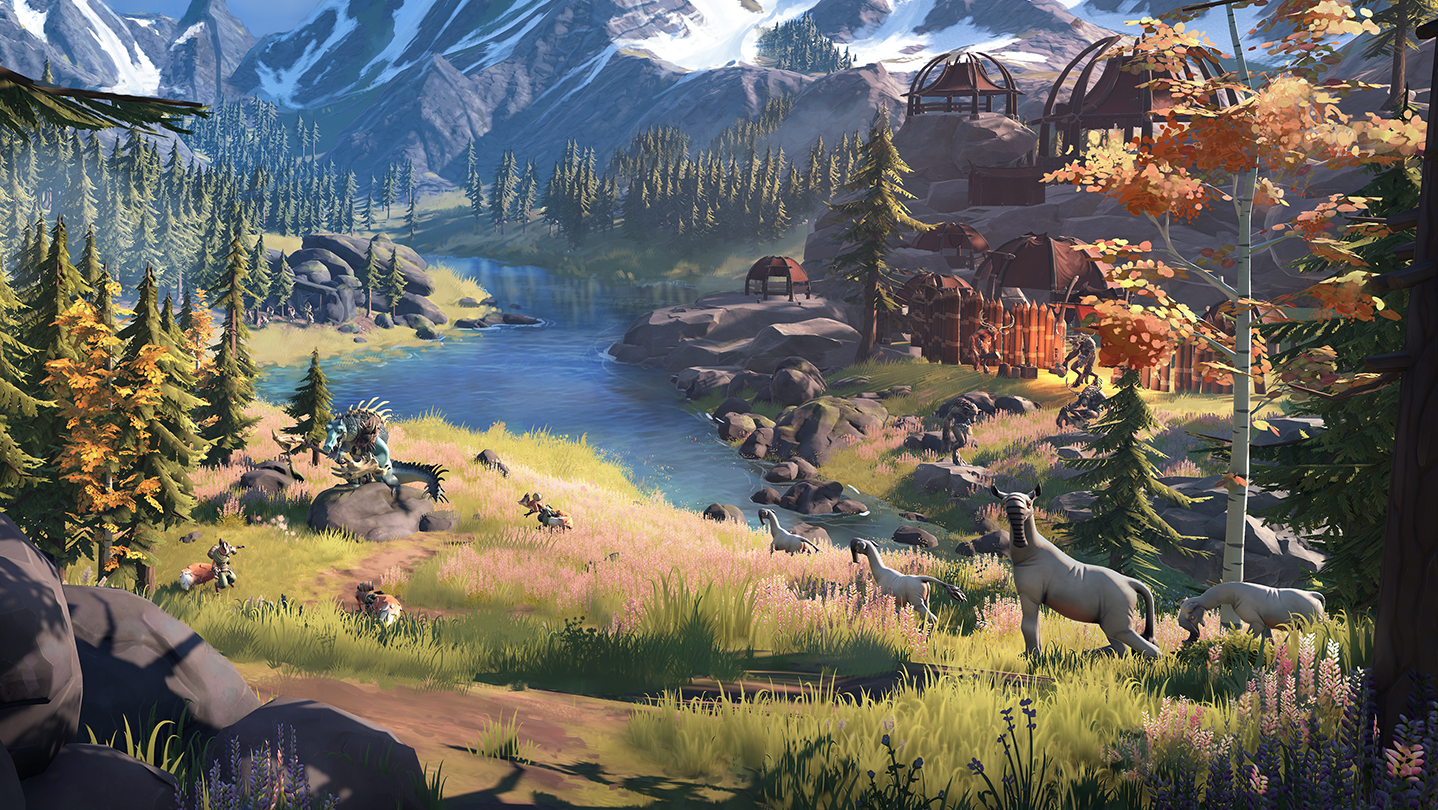
Pine pitches itself as something genuinely interesting: a living open world where multiple intelligent species, not just the player, have goals, economies, and territorial ambitions. You play as Hue, a young human from a tribe searching for a new homeland, and the hook is that the world does not revolve around you. Factions of humanoid creatures, think stocky boar-people and reptilian traders, compete for resources and territory through their own AI-driven routines. In theory, you can ally with one species, help them push another out of a region, and watch the map reshape itself accordingly. That systemic premise is genuinely fresh and, during the moments it clicks, surprisingly tense. The simulation side is the soul of Pine, but the action-RPG shell around it is noticeably thin. Combat is a stamina-managed brawl with light and heavy attacks, a dodge roll, and a modest selection of craftable weapons and tools. It works, but it never evolves into anything requiring serious build thought. There is no character class system, skill trees are minimal, and most of the equipment variety comes from crafting different tiers of the same weapon archetypes. If you come in expecting the gear and progression depth of something like a proper action RPG, you will run into a ceiling well before hour fifteen. The writing is functional rather than memorable. Hue's people-pleasing quest to find a safe settlement gives the story a clear throughline, but the dialogue is sparse and the characters rarely do anything surprising. For a game whose main selling point is emergent faction drama, there is a missed opportunity to make those factions feel genuinely written-in rather than procedurally convenient. You notice the AI seams. Species will occasionally stand around or make economically strange decisions, and the world's behavior can feel more scripted than simulated on repeated observation. The ecological fantasy is real, but it is also fragile. Where Pine earns genuine goodwill is atmosphere. The island of Albamare is visually appealing in a storybook-illustration way, the biomes are distinct, and wandering into a valley to find two factions mid-skirmish over a resource node is exactly the kind of emergent moment the game is designed to produce. Exploration feels purposeful because your presence in an area actually has downstream effects. That is rare, and worth acknowledging even when the broader execution is uneven. At its current state, Pine sits best with players who value world systems over narrative richness or deep combat. It is a proof-of-concept that mostly proves its concept, with rough edges visible throughout. If the idea of an AI-driven faction sim wrapped in accessible action-adventure sounds compelling to you, the experience delivers that core fantasy more often than not. Just do not expect the writing to reward re-reads, and do not expect your build decisions to matter much past the midgame. For RPG veterans hunting for story depth or mechanical complexity, this one is more of a curio than a destination.

RPGs
Tags
System Requirements
Minimum
- Processor
- Quad Core 3.2 Ghz or equivalent
- Memory
- 8 GB RAM
- Graphics
- NVIDIA GeForce GTX 660 or equivalent
- Storage
- 4 GB available space
Recommended
- OS
- Windows 10 (64-bit)
- Processor
- Quad Core 3.40 Ghz or equivalent
- Memory
- 8 GB RAM
- Graphics
- NVIDIA GeForce GTX 970 or equivalent
- Storage
- 4 GB availa…
Keep exploring
Community Discussion
Be the first to comment on Pine.
Reviews & Ratings
Game Info
- Developer
- Twirlbound
- Publisher
- Kongregate
- Release Date
- Oct 10, 2019