Piano Glow
If you have ever wanted to practice piano without the guilt of ignoring sheet music drills, this gamified multiplayer tool turns your QWERTY keyboard into a legitimate instrument and makes leaderboard climbing feel earned.
GamerScout Verdict
Worth it for anyone who wants a gamified on-ramp to piano with real multiplayer stakes, provided you can tolerate Early Access rough edges.
Compare Prices(2 stores)
Every store in this table quotes us in euros, so the EUR figure is the price the seller actually set, not our arithmetic — which is why EUR is also the currency we rank in. We only list an offer here when the store gives us its price in euros, so nothing in this table is a number we invented.
Pick USD, PLN, GBP, CAD or AUD in the header and we convert from EUR at the European Central Bank reference rate — converted amounts are prefixed with ~. Your bank or the store may apply a different rate at checkout. We never hide offers based on where you are: everyone sees this whole table.
We may earn a commission when you buy games through links on this page — at no extra cost to you. It never affects our rankings or verdicts.
Price History
Screenshots & Media
About Piano Glow
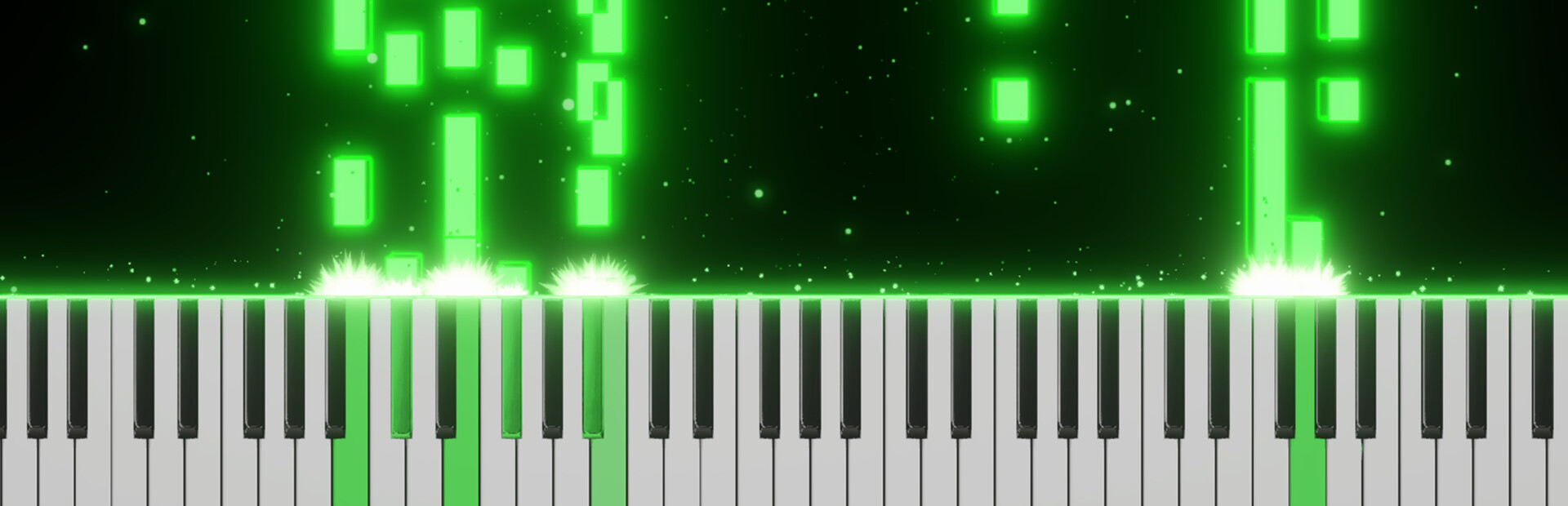
I will be straight with you: I came into Piano Glow expecting a gimmick. A piano game where you hit QWERTY keys instead of actual piano keys sounds like the kind of idea that falls apart in ten minutes. It does not fall apart. After time with it, I kept coming back, which is more than I can say for a handful of rhythm games I have shelved this year. The core loop is cleaner than its genre-tag soup suggests. You pick a mode, ear training, sheet training, rhythm, or falling notes, and the game feeds you notes to hit on a virtual keyboard mapped to your QWERTY layout. The falling-notes mode is the most immediately satisfying, especially if you already have some muscle memory from typing-heavy games. Ear training and sheet training are slower burns but the stat tracker is smart about it: it logs your wrong answers and resurfaces those gaps more often, so you are actually drilling weaknesses rather than just repeating your strengths. That is a small design decision that matters a lot over longer sessions. The multiplayer side is a queue-based lobby where players take turns performing, and others watch and listen in real time. Push-to-talk voice chat was added post-launch. There is a global chatroom and an in-game currency system tied to daily rewards, quests, and tipping other players. Competitive drive comes from leaderboards, not from a ranked ladder in any traditional sense, so if you are looking for an Elo grind this is not it. What you get instead is a surprisingly engaged community. The concurrent player count is modest, but the Discord and Workshop are active, and the developer ships updates on a tight cadence based directly on user feedback. A reported CPU spike to 100 percent on launch is a known issue worth tracking if your rig is not powerful, though it appears to be intermittently flagged in community threads rather than universal. Hardware note since it matters here: if you have a Wooting analog keyboard, Piano Glow supports velocity sensitivity so you can actually play loud and soft on a QWERTY board. That is a legitimately clever integration and it closes some of the gap between keyboard-as-controller and a real MIDI instrument. Speaking of which, connecting a digital piano over USB-B works, and the SoundFont support including VST3 and loadable .sf2 and .sf3 files means the audio can sound as good as whatever samples you throw at it. The built-in reverb and EQ are usable without going deep into customization. The Early Access label is honest. The visual and mode variety is still growing, the developer has flagged that the price will increase as content ships, and some UI rough edges are visible. But the fundamentals hold up right now, and the Workshop already gives you a sheet library to pull from at no additional effort. For a solo developer, the update cadence is credible.

Shooters
Tags
System Requirements
Minimum
- OS
- Windows 7 (SP1+) and Windows 10
- Memory
- 2000 MB RAM
- Storage
- 700 MB available space
- Graphics
- DX10, DX11, DX12 capable
- Processor
- 1.7 GHz Dual Core CPU
- Sound Card
- Any
Keep exploring
Community Discussion
Be the first to comment on Piano Glow.
Reviews & Ratings
No ratings available
Game Info
- Developer
- TheAlanski
- Publisher
- TheAlanski
- Release Date
- Mar 10, 2025