
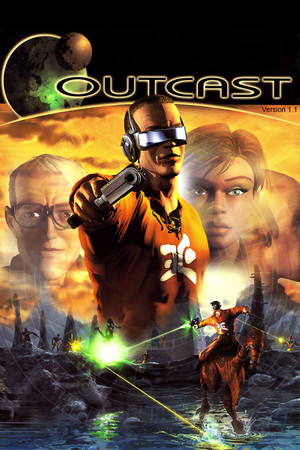
Outcast 1.1
A cult 1999 open-world adventure that still punches above its age for anyone who cares about alien worldbuilding and NPCs with actual schedules, though its clunky combat and glacial opening will weed out the impatient fast.
GamerScout Verdict
Worth it for open-world history buffs and lore-chasers; newcomers should start with Second Contact or A New Beginning instead.
Compare Prices(8 stores)
Every store in this table quotes us in euros, so the EUR figure is the price the seller actually set, not our arithmetic — which is why EUR is also the currency we rank in. We only list an offer here when the store gives us its price in euros, so nothing in this table is a number we invented.
Pick USD, PLN, GBP, CAD or AUD in the header and we convert from EUR at the European Central Bank reference rate — converted amounts are prefixed with ~. Your bank or the store may apply a different rate at checkout. We never hide offers based on where you are: everyone sees this whole table.
We may earn a commission when you buy games through links on this page — at no extra cost to you. It never affects our rankings or verdicts.
Price History
Screenshots & Media
About Outcast 1.1
I went into Outcast 1.1 expecting a museum piece, the kind of thing you load up, nod respectfully at its historical importance, and then quietly close. What I got instead was something that kept me glued to the alien world of Adelpha for way longer than I planned, mostly against my better judgment. This is a recompiled, stability-patched release of the 1999 original, rebuilt from source code with a multithreaded voxel renderer, support for resolutions up to 1920x1080, a redesigned HUD, and native Xbox controller support. It is not a remake. The voxel rendering still renders through the CPU rather than the GPU, the character animations have not been touched, and the controls are firmly of their era. Set your expectations accordingly and this thing rewards patience in ways that many modern open-world games simply do not. The setup is pulpy sci-fi: ex-Navy SEAL Cutter Slade escorts scientists to the parallel-universe planet of Adelpha, gets separated from them almost immediately, and is proclaimed the Ulukai, a prophesied savior, by the native Talan people. Cutter's dry, sarcastic responses to being worshipped are a quiet delight throughout. What makes the world hold up is not the plot beats but the texture underneath them. Each Talan NPC has a function and a daily routine. Merchants sell ammunition that actually fits your weapons, and the lore explains why. Even the save mechanic, the in-world Gaamsaav item that emits a sound audible to nearby enemies when activated, is woven into the fiction rather than tacked onto a pause menu. For an RPG-adjacent person like me, details like these are the whole game. The five regions of Adelpha, including the rice-paddy temples of Shamazaar and the hub zone of Talanzaar, can be accessed via portal in a largely non-linear order, and the quest structure genuinely lets you decide which of the sacred Mon artifacts to chase first. The problems are real and worth naming plainly. The opening act is painfully slow: lengthy cutscenes dump Talan lore on you before you have touched a button, followed by a patronizing tutorial that walks a Navy SEAL through jumping across a small gap. Combat in both third-person and first-person modes feels floaty and imprecise, with enemy soldiers who fire slowly enough that side-stepping their shots is always an option. Some regions have large stretches of empty terrain that feel less like atmosphere and more like filler. The merchant interaction system is known to cause freezes in this version, so saving frequently with the Gaamsaav is non-negotiable advice, not optional caution. The resolution cap at 1920x1080 is a hard ceiling due to the fixed-point z-buffer, which will bother anyone on a high-DPI monitor. Who is this for, honestly? Players who already finished Outcast: Second Contact and want the original experience without the polygon facelift. History-minded adventure fans curious about one of the first 3D games to attempt a populated, non-linear open world at this scale. Anyone drawn to orchestral worldbuilding, Lennie Moore's score was performed by the Moscow Symphony Orchestra and it genuinely elevates the atmosphere in ways the visuals cannot. And people who bounced off the Second Contact remake because its polygon upgrade softened the distinctive voxel look. If you want responsive combat systems, build variety past hour 40, or a UI that does not make you feel like it is 1999, this is not your entry point into the series, and Outcast: Second Contact or A New Beginning will serve you better. But if the question is whether the original game's soul survives in this version, the answer from Steam's community, sitting at 90% positive across several hundred reviews, is a clear yes.

RPGs
Tags
System Requirements
Minimum
- OS
- Windows XP SP2, Vista, Windows 7, Windows 8
- Memory
- 1 GB RAM
- DirectX
- Version 9.0c
- Storage
- 2 GB available space
- Graphics
- Generic DirectX compatible card (compatible with DirectDraw 8)
- Processor
- 1.2 Ghz Processor or higher
- Sound Card
- DirectX Compatible SoundCard
Keep exploring
Community Discussion
Be the first to comment on Outcast 1.1.
Reviews & Ratings
No ratings available
Game Info
- Developer
- Fresh3D
- Publisher
- THQ Nordic
- Release Date
- Dec 18, 2014