
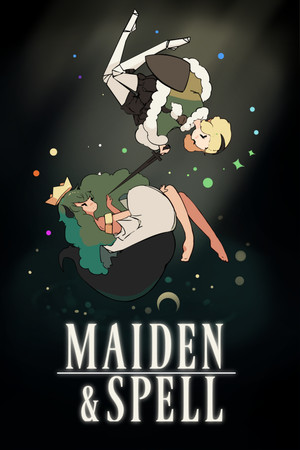
Maiden and Spell
Rollback netcode, a three-pixel hitbox, and eight wildly distinct characters: this tiny solo-dev fighter punches harder than its price tag suggests, but only if you have someone to play it with.
GamerScout Verdict
Strong pick for anyone who can bring a regular opponent; solo players get a decent boss-rush tutorial and not much else.
Compare Prices(3 stores)
Every store in this table quotes us in euros, so the EUR figure is the price the seller actually set, not our arithmetic — which is why EUR is also the currency we rank in. We only list an offer here when the store gives us its price in euros, so nothing in this table is a number we invented.
Pick USD, PLN, GBP, CAD or AUD in the header and we convert from EUR at the European Central Bank reference rate — converted amounts are prefixed with ~. Your bank or the store may apply a different rate at checkout. We never hide offers based on where you are: everyone sees this whole table.
We may earn a commission when you buy games through links on this page — at no extra cost to you. It never affects our rankings or verdicts.
Price History
Screenshots & Media
About Maiden and Spell
I came into this one skeptical. Cute anime girls throwing magic at each other sounds like the kind of game that gets recommended in Discord servers and then quietly dies because nobody actually queues. I was wrong to be dismissive. Maiden and Spell is a solo-dev 1v1 bullet hell fighter that does two things most games in either genre fail at separately: it has genuinely readable projectiles during live combat, and its netcode holds up under real-world conditions. The core loop borrows from danmaku (think Touhou lineage) but reframes it as a competitive fighter. No health bar in the traditional sense. Getting hit costs you a life, burn through your lives and you lose the card (round), first to take enough cards wins the match. There are no complex motion inputs, no grab mechanics, no block button. Each of the eight characters has four attack types: a precise aimed shot, a spread pattern that punishes sloppy movement, an offensive special, and a defensive special on cooldown. That last one matters more than it sounds. In most bullet hell games the bomb is a panic button you hoard. Here it regenerates, so the decision to use it becomes about timing and spacing rather than resource anxiety. The meta consequence is that matches play less like reaction tests and more like positional chess with projectile density. You are laying traps, controlling corridors, forcing your opponent into corners. The game even has a "closing walls" mechanic that kicks in after ten seconds of no hits, so stalling is not an option. Character variety holds up under scrutiny. The Hero of Frost wants to close distance and exploit invincibility frames on her dodge roll for aggressive mixups. The Lich of Flowers plays the opposite game, generating persistent flower hazards and butterfly turrets that make the whole screen progressively more hostile as the round drags on. The Silent Redhood lays stationary traps to enforce range. These are not cosmetic differences. Matchup knowledge actually matters here, which for a game this small is a genuine achievement. The eight-character roster sounds light but the tighter headcount means the balance is noticeably tighter than most indie fighters manage. Netcode is where I need to spend a minute, because this is the thing that separates a fun local-party game from something you can actually grind online. Maiden and Spell uses rollback. Players have reported smooth sessions across significant geographic distance with minimal interruption. That is not guaranteed in any online fighter, let alone one built by a solo developer. The lobby system is styled after Arc System Works-style rooms rather than anonymous matchmaking, which means the player base organizes through Discord. The community is small but active, with tournament events running regularly. If you are expecting to fire up ranked and get a game in thirty seconds, you will not find that here. If you are willing to hop in a Discord and find a room, the online experience is legitimately solid. The story mode exists, runs roughly three hours if you push through it once, and functions mainly as a structured way to learn each character's patterns before you face a human. The boss rush escalates through 70-plus attack patterns at higher difficulties and the Very Hard setting stops being a joke fast. The writing is light and knowingly silly, and the pre-fight dialogue between characters has more personality than you would expect from a game at this price point. Solo players should treat it as a training ground, not the main event. The aesthetic does exactly what it needs to. The simplified, bold art style makes bullet patterns readable even when the screen is saturated with projectiles, which is genuinely hard to pull off. The soundtrack, composed by Steel_plus, fits the pacing without being intrusive. The chibi in-fight sprites lose some of the quality of the full character illustrations, but the fights themselves are clean enough that it does not affect play. If you have one person to play this with regularly, local or online, this is an easy recommendation. If you are strictly solo, the story mode gives you value but the ceiling is low. The game is at its best when two people who have both spent time in story mode sit down and immediately realize they have been learning the wrong lessons.

Shooters
Tags
System Requirements
Minimum
- OS
- Windows 7 and above
- Memory
- 4 GB RAM
- DirectX
- Version 10
- Storage
- 400 MB available space
- Graphics
- 512 mb video memory
- Processor
- 1.2 ghz
Keep exploring
Community Discussion
Be the first to comment on Maiden and Spell.
Reviews & Ratings
No ratings available
Game Info
- Developer
- mino_dev
- Publisher
- mino_dev
- Release Date
- Feb 24, 2020