Hero Emblems II
Match-3 meets JRPG in a way that actually works, but the story won't make you lose sleep over narrative payoff - the puzzle combat might, though.
GamerScout Verdict
Worth it for match-3 tacticians who can stomach a thin story, but JRPG narrative-chasers should lower their expectations considerably.
Compare Prices(5 stores)
Every store in this table quotes us in euros, so the EUR figure is the price the seller actually set, not our arithmetic — which is why EUR is also the currency we rank in. We only list an offer here when the store gives us its price in euros, so nothing in this table is a number we invented.
Pick USD, PLN, GBP, CAD or AUD in the header and we convert from EUR at the European Central Bank reference rate — converted amounts are prefixed with ~. Your bank or the store may apply a different rate at checkout. We never hide offers based on where you are: everyone sees this whole table.
We may earn a commission when you buy games through links on this page — at no extra cost to you. It never affects our rankings or verdicts.
Price History
Screenshots & Media
About Hero Emblems II
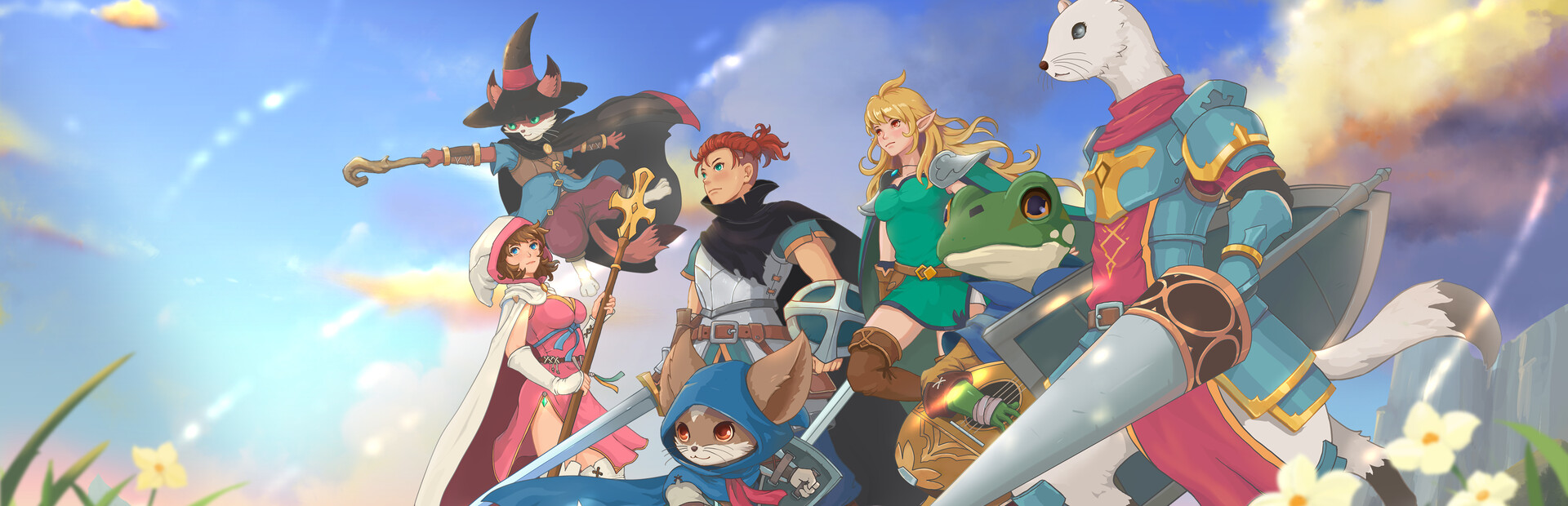
I came to Hero Emblems II half-expecting Puzzle Quest with a chibi coat of paint, and walked away with genuinely mixed feelings that took a few sessions to untangle. The core proposition is this: every combat encounter plays out on a match-3 board, where clearing three or more emblems triggers your party members to attack, heal, or generate Magic Emblems for more powerful skill activations. Combos chain, the board carries over between fights in a dungeon, and if you plan ahead you can walk into a boss fight with a board pre-loaded with devastating Ultra Emblems. That last part, stacking the board through a whole dungeon run to nuke a boss in the opening turn, is the kind of emergent tactical thinking that elevates the system past casual territory. The party you build around that board is worth paying attention to. You start with four core characters - Zack the Human Warrior, Lucien the Marten Knight, Odelia the healer, and Sid the Felinian Black Mage - and expand the roster from there, eventually picking up characters like Abner the Frogkin Bard. Each character has their own life bar, their own emblem type on the board, and a set of passive Trait Cards that activate on swap-in. Managing who is on the field at any moment, balancing Odelia's healing output against Lucien's shield generation while Sid dishes elemental pressure, becomes the actual game once the difficulty ramps. Enemies inflict Poison, Ignition, Petrification, and Curse debuffs, and without the right accessory loadout and elemental resistance planning, mid-game difficulty spikes can and will brick a run. Complaints about the Steam community flagging certain boss encounters as AOE one-shot nightmares are not exaggerated. Where the game gets complicated is in everything sitting outside the board. The writing is the obvious weak point. The story - an amnesiac elf named Dolores, a disbanded mercenary guild called the Night Chasers, a world-threatening conspiracy underneath it all - is functional at best and clumsy at worst, and the English localization, though patched and re-edited since launch, still stumbles enough to pull you out of scenes that should land harder. As an RPG specialist I kept wanting to care about these characters, and the game occasionally lets me, but the narrative never builds the kind of layered worldbuilding that makes a JRPG worth replaying for story alone. This is not Disco Elysium. It is not even trying to be, which is fine, but the game's Steam reception sitting at a mixed 57% reflects a real tension: players who came for the RPG half feel underserved by the writing, while players who came purely for match-3 get a system that rewards genuine planning. The gold grind is real. Gearing up multiple party members, buying equipment at village shops, unlocking and swapping Trait Cards - all of it funnels through a gold economy that pushes you toward dungeon replays when a difficulty wall appears. If you like the combat loop, this is a feature. If you find the loop repetitive, it tips into a slog, and the random encounter rate on the overworld map does not help. The food consumption system, added post-launch, provides temporary stat boosts and adds a light resource-management layer, but it does not meaningfully address the core grind problem. On the plus side: no microtransactions, no ads, no gacha, no subscriptions. You pay once and get a complete, dense game, which in 2024 is not nothing. Hero Emblems II is the right game for a specific kind of player: someone who genuinely enjoys match-3 as a tactical medium rather than a casual pastime, wants a JRPG skeleton to hang that combat on, and can make peace with thin-ish writing. Fans of the original will find it bigger and more complex in almost every dimension. Newcomers who bounced off a similar game before should probably try a dungeon or two and see if the mid-game board management clicks before committing. My recommendation lands cautiously positive, weighted heavily toward the puzzle side of the equation.
RPGs
Tags
System Requirements
Minimum
- OS
- Windows 10 64-bit
- Memory
- 4 GB RAM
- Storage
- 700 MB available space
- Graphics
- OpenGL 3.3 compatible with 2GB RAM (Nvidia GTX 660 or equivalent)
- Processor
- Intel Core i3 or equivalent
Recommended
Requires a 64-bit processor and operating system
Keep exploring
Community Discussion
Be the first to comment on Hero Emblems II.
Reviews & Ratings
No ratings available
Game Info
- Developer
- HeatPot Games
- Publisher
- HeatPot Games
- Release Date
- Aug 5, 2024