
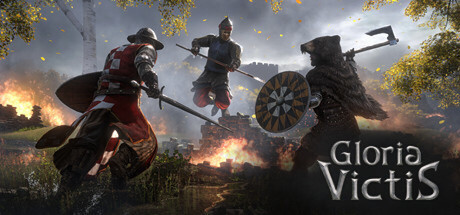
Gloria Victis: Medieval MMORPG
If Mount and Blade ran a server-wide faction war with MMO progression layered on top, this is roughly what you'd get. The population problem is real, and right now it is the main thing standing between you and the fun.
GamerScout Verdict
A mechanically interesting medieval PvP MMO strangled by low population - check SteamDB before buying, and wait for the relaunch to actually land.
Compare Prices(1 stores)
Every store in this table quotes us in euros, so the EUR figure is the price the seller actually set, not our arithmetic — which is why EUR is also the currency we rank in. We only list an offer here when the store gives us its price in euros, so nothing in this table is a number we invented.
Pick USD, PLN, GBP, CAD or AUD in the header and we convert from EUR at the European Central Bank reference rate — converted amounts are prefixed with ~. Your bank or the store may apply a different rate at checkout. We never hide offers based on where you are: everyone sees this whole table.
We may earn a commission when you buy games through links on this page — at no extra cost to you. It never affects our rankings or verdicts.
Price History
Screenshots & Media
About Gloria Victis: Medieval MMORPG
I want to like Gloria Victis more than the current numbers justify, and that tension is basically the whole review. The combat system is the kind of thing that makes you sit up straight: no tab-targeting, no auto-aim, just a four-directional attack-and-block scheme driven entirely by your mouse movement. You read the enemy's swing angle, you counter it, you drag an attack wide to clip multiple opponents in a scrum. It plays closer to Chivalry 2 than to any traditional MMO, and in a large castle siege that system genuinely sings. Organized groups that hold formation and rotate blocks can push through bigger, sloppier warbands through pure discipline. That is a real, rare thing in the MMO space. The three factions - Midlanders (medieval European), Ismirs (Viking-flavored, strong in smithing), and Sangarians (Roman-Byzantine aesthetic) - each have their own lore, heraldry, and starting equipment bias. Classes at creation are soft archetypes: pick one to get your starter gear and a rough talent direction, but you can respec freely until level 90 and freely mix your build around the talent tree. The tree itself reads like a flatter WoW tree - passive nodes, stat boosts, no active abilities hanging off it - which keeps build variety tighter than you might hope. Gear that drops from enemies is lootable, but a loot-point cap limits how badly a kill can clean you out, which at least takes the sting off dying in the open world early on. The crafting system is legitimately deep and, initially, legitimately intimidating. There is a full player-driven economy, an auction house, and a food system where cooked meals provide combat buffs, so dedicated crafters and merchants have a real role that is not just busywork. The gathering layer is active, not a progress bar - you are physically swinging at rocks and trees rather than watching a spinner. PvE content is the clear weak point: quests exist mostly to funnel you toward max level, NPCs fold quickly, and the writing will not hold your attention past the tutorial island. If you came here for story, wrong address. Now the hard part. The Steam review score sits at a mixed 67 percent across roughly four thousand reviews, and the concurrent player count as of mid-2026 is in the single digits. The game went through a shutdown, accumulated nostalgia from a vocal returning community, and is heading toward a relaunch - but right now you would log in and find nobody to fight. An open-world PvP MMO with no population is not a game, it is a map. Even players from the beta phase have flagged that the combat's high skill ceiling reads as "janky and outdated" to anyone who did not already invest time learning its rhythms. The netcode was deliberately slowed to accommodate 150ms ping, which is a reasonable MMO engineering call but produces animations that look sluggish compared to Chivalry 2 or Mordhau. First impressions suffer for it. If gamigo follows through on the relaunch and pulls even a modest concurrent population back in, Gloria Victis has a real identity worth revisiting: skill-gated melee PvP, territory control at faction scale, and an economy that actually depends on crafters. That is a compelling package. Right now though, buying in is a bet on a comeback, not a live game. Wait for the relaunch news to drop, check the concurrent player count on SteamDB, and only pull the trigger if the numbers say the war is actually happening.

Shooters
Tags
System Requirements
Minimum
- OS
- Windows 7 Sp. 64-bit
- Memory
- 8 GB RAM
- DirectX
- Version 11
- Network
- Broadband Internet connection
- Storage
- 15 GB available space
- Graphics
- GeForce GT 740, Radeon HD 7750 - at least 2GB GPU memory
- Processor
- Intel Core i3 or AMD Athlon II X4 with at least 2,7 GHz
Recommended
- OS
- Windows 7 64-bit
- Memory
- 12 GB RAM
- DirectX
- Version 11
- Network
- Broadband Internet connection
- Storage
- 15 GB available space
- Graphics
- GeForce GTX 960, Radeon HD 7970 - at least 4GB GPU memory
- Processor
- Intel Core i5 or AMD Phenom II X4 with at least 3.2 GHz
Keep exploring
Community Discussion
Be the first to comment on Gloria Victis: Medieval MMORPG.
Reviews & Ratings
No ratings available
Game Info
- Developer
- gamigo US
- Publisher
- gamigo US
- Release Date
- Feb 7, 2023