
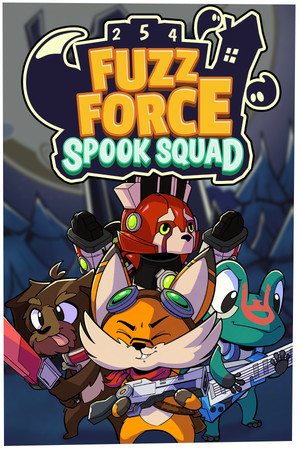
Fuzz Force: Spook Squad
If you ever wanted a ghost-busting board game on your PC that rewards smart dice management over raw luck, Spook Squad mostly delivers, with one foot firmly planted in charming tabletop nostalgia and the other dangling over a mimic chest.
GamerScout Verdict
Best for casual roguelite fans who want snappy, spooky dice-building without committing to a 40-hour grind.
Compare Prices(3 stores)
Every store in this table quotes us in euros, so the EUR figure is the price the seller actually set, not our arithmetic — which is why EUR is also the currency we rank in. We only list an offer here when the store gives us its price in euros, so nothing in this table is a number we invented.
Pick USD, PLN, GBP, CAD or AUD in the header and we convert from EUR at the European Central Bank reference rate — converted amounts are prefixed with ~. Your bank or the store may apply a different rate at checkout. We never hide offers based on where you are: everyone sees this whole table.
We may earn a commission when you buy games through links on this page — at no extra cost to you. It never affects our rankings or verdicts.
Price History
Screenshots & Media
About Fuzz Force: Spook Squad
I went in expecting a novelty - dice swapped for cards in a genre already drowning in Slay the Spire imitators - and came out genuinely surprised by how much thinking the game asks of you underneath its Halloween-cute exterior. Fuzz Force: Spook Squad is a roguelite that replaces the usual card deck with physical dice you slot into customisable, weapon-mounted loadouts. Each run you pick one of five fuzzy agents - Finn the fox is your starter, but Dotty, Lix, Peppa and the rest unlock quickly - and each character brings a different passive stat spread, a unique Animal Power special ability, and weapon synergies that genuinely shift how a run feels. That character-to-playstyle pipeline is the game's best design decision, and it gives the small roster more mileage than the number would suggest. Combat is turn-based and stripped to three actions per turn: attack (red dice), shield (blue dice), and charge (green dice). The charge system feeds your more powerful secondary dice, so you are constantly balancing whether to build energy now or push for damage before the enemy's next attack. On top of that sits a Lucky Numbers mechanic that lets you designate a number on your primary dice as a critical trigger, granting you a second action on that turn. When you roll your lucky number into a fully charged battery with a status-effect die loaded up, the combat loop clicks into something genuinely satisfying. Enemies are not passive punching bags either - ghost miniatures each carry their own passive skills, some healing, some draining your shields, some fusing together into harder tag-team encounters for the floor's mid-point fights. The board game presentation is the real soul of Spook Squad. You move your character token one mystery tile at a time across procedurally shuffled floors that run through the Forest, the Hotel Halls, and the Attic before you hit the rooftop showdown with the Polter Prince. Adjacent tiles telegraph what is coming - fight, shop, chest, event - so there is real planning involved in your path. The trade-off is that the same three zones repeat every single run, the boss order does not rotate, and enemy variety thins out noticeably by hour three. For anyone arriving from Hades or Monster Train expecting a constantly expanding unlock tree, the repetition will bite. Spook Squad is not that kind of roguelite. Runs cap out around an hour, which is honestly a feature: it is a commute game, a lunch-break game, a wind-down-before-bed game. Where the game stumbles is on the luck pendulum. The pre-battle Bonus Roll mechanic, where you gamble health or dice for random boons before a fight, can be wildly punishing on unlucky streaks. Mimic encounters lurking inside chests are supposed to sting, but reviewers and players alike have flagged they appear too frequently relative to the reward for opening chests in the first place. The result is that some runs feel decided by RNG long before you reach the Polter Prince, which undercuts the otherwise solid strategic layer. There is also no real narrative to speak of - random events carry most of the game's personality and humour, and the agent backstories are gated behind Special Mission completions, so a story-hungry RPG player will find slim pickings unless they grind for those unlocks. As someone who reads every tooltip and re-rolls characters to test builds, I found the dice synergy system deep enough to keep me coming back, but I will not pretend the lore rewards are substantial. Spook Squad is a small, carefully made debut that punches above its weight on mechanical elegance and art direction. The plastic miniature aesthetic, the tabletop-accurate board feel, and the speedy run structure all point to a developer who understood the assignment even if the content breadth did not quite stretch to match the ambition. If you treat it as a palate cleanser between heavier RPGs rather than your main course, it holds up well past the first few hours.

RPGs
Tags
System Requirements
Minimum
- OS
- Windows 7
- DirectX
- Version 10
- Storage
- 400 MB available space
- Graphics
- 512 Mb Video Memory
- Processor
- 2.0 Ghz
Keep exploring
Community Discussion
Be the first to comment on Fuzz Force: Spook Squad.
Reviews & Ratings
No ratings available
Game Info
- Developer
- Fuzz Force
- Publisher
- Fuzz Force
- Release Date
- Jun 8, 2021